
Discover the 5,000-year-old royal tomb unearthed at Wangzhuang ruins in Henan Province, China. Explore artifacts, cultural significance, and secrets of a prehistoric kingdom from the Dawenkou Culture.
Yongcheng, Henan Province, China – A remarkable 5,000-year-old tomb, believed to be that of a prehistoric king, has been uncovered at the Wangzhuang ruins in Yongcheng, Henan Province. This ancient Chinese tomb, part of the Neolithic Dawenkou Culture (4000–2600 B.C.), offers new insights into a prehistoric kingdom’s social hierarchy and cultural exchanges, as reported by Xinhua and China Daily in October 2024.
Unearthing Tomb M27 at Wangzhuang Ruins
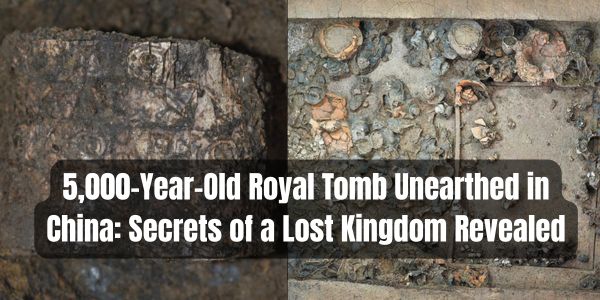
The tomb, labeled M27, spans over 17 square meters, making it one of the largest Neolithic burials in central China. Measuring 4.52 to 4.8 meters long and 3.47 to 3.68 meters wide, it features inner and outer coffins, a sign of high status. Zhu Guanghua, associate professor at Capital Normal University, noted, “The scale of this tomb suggests the Wangzhuang ruins were the capital of a prehistoric kingdom, not just a settlement.”
Must Read: Bitcoin Hits All-Time High as Crypto Sentiment Surges in 2025
Artifacts Reveal Wealth and Cultural Exchange
Over 350 artifacts were excavated, including 200 jade ornaments, bone tools, pottery, and animal remains like pig mandibles, symbolizing wealth. These Dawenkou Culture artifacts showcase advanced craftsmanship and cultural fusion. Liu Haiwang, an archaeologist, stated, “The pottery, stone tools, and jade jewelry reflect a sophisticated division of labor.” Items also indicate trade with eastern China and the Yangtze River basin, highlighting Wangzhuang’s role as a cultural hub.
Signs of Ancient Looting
Curiously, the tomb lacks most of the occupant’s remains, with only toe bones found. Zhu Guanghua suggests ancient looting, possibly due to rivalries, as many artifacts were deliberately broken. This Neolithic burial site’s condition adds mystery to the prehistoric king’s identity and the kingdom’s history.
Dawenkou Culture and Social Hierarchy
The Dawenkou Culture is known for its sophisticated pottery and social stratification. Tomb M27’s size and offerings, including over 200 ceramic vessels for feasting, confirm a clear elite class. Li Xinwei from the Chinese Academy of Social Sciences called it evidence of “archaic states,” emphasizing its historical significance.
Why This Matters
This ancient Chinese tomb discovery illuminates early civilization’s complexity, with Wangzhuang as a potential capital. Its artifacts reveal extensive trade networks, enriching our understanding of Neolithic cultural exchange. Ongoing excavations may uncover more about this lost kingdom.
Must Read: Ancient Homo Erectus Bones Unearthed Off Java Coast Reveal Lost Ice Age Population