

New Delhi, January 19, 2026, 09:54 p.m. (IST)
Trump’s Board of Peace is a new U.S.-led body to govern and rebuild Gaza after war. Here is how it works, who runs it, and why it matters.
Key Highlights
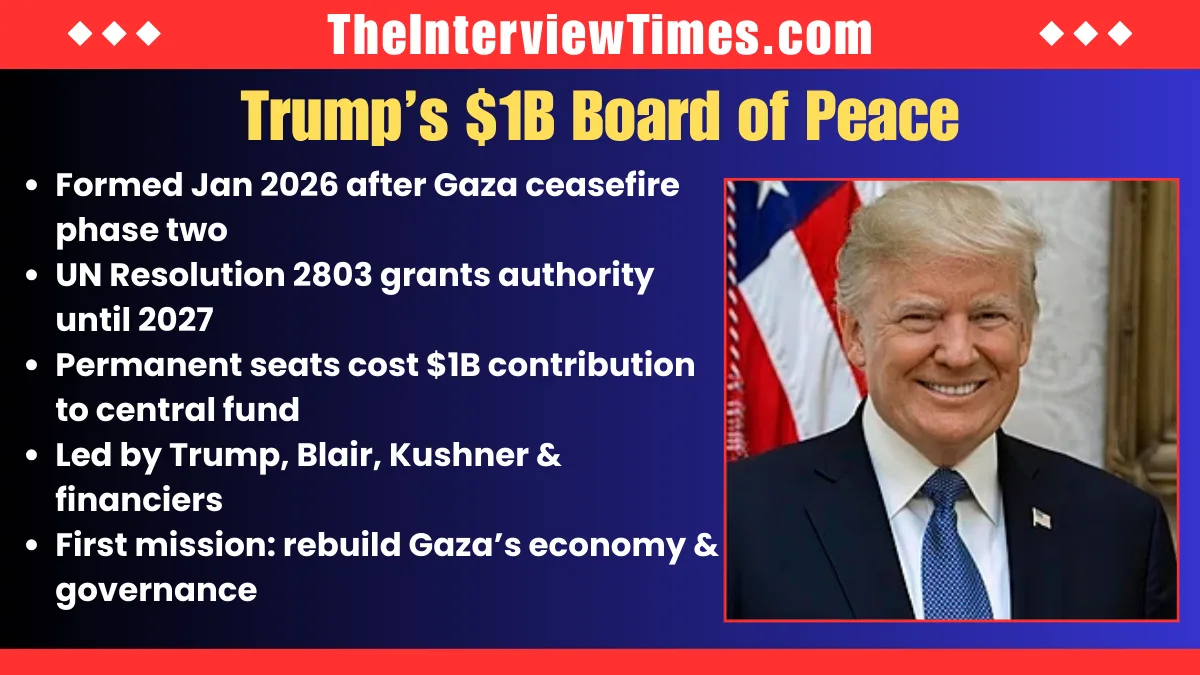
- Donald Trump launched the Board of Peace in January 2026 after the Gaza ceasefire entered Phase Two
- The body has United Nations backing and temporary authority over Gaza until at least 2027
- Permanent membership requires a $1 billion contribution to a U.S.-controlled fund
- The board combines political leaders, financiers, and former diplomats
- Supporters see a fast-track peace model, critics warn of U.S. overreach
What Is Trump’s Board of Peace?
The Board of Peace is a new international governing body announced by Donald Trump in January 2026. It is designed to oversee post-war governance, reconstruction, and economic revival in Gaza, while also serving as a future model for resolving global conflicts.
Trump has described the board as a practical alternative to slow and divided multilateral systems. Unlike traditional peacekeeping missions, the Board of Peace blends political authority, private capital, and executive power under a single structure led by the United States.
The initiative follows the fragile but ongoing ceasefire in Gaza and marks one of the most ambitious foreign policy moves of Trump’s second term.
How the Gaza War Shaped the Idea
The concept grew directly out of the Gaza war that began in October 2023, following attacks by Hamas and allied groups on Israel. The conflict devastated Gaza’s infrastructure and displaced hundreds of thousands of civilians.
In August 2025, former UK prime minister Tony Blair publicly suggested temporary international administration of Gaza to prevent a power vacuum. Trump expanded this idea in September 2025 with a broader framework that linked security, governance, and investment.
A key turning point came in October 2025, when Blair met Palestinian representatives in Jordan. Shortly after, Trump declared that active hostilities were effectively over and that a new governing structure would soon follow. An Egypt-hosted summit later that month laid the groundwork for Gaza’s post-war transition.
Official Launch and UN Mandate
Trump formally announced the Board of Peace on January 15, 2026, through social media and a White House briefing. The timing was strategic, coming one day after the Gaza peace agreement entered its second implementation phase.
Crucially, the initiative received backing from the United Nations Security Council, which passed Resolution 2803 in November 2025. The resolution grants the board authority over Gaza’s civil administration, reconstruction, and economic planning until at least 2027, subject to review.
This UN endorsement gives the board international legal standing, even as it operates largely outside traditional UN agencies.
Top World News: NATO Allies Defy Trump Tariffs with Greenland Troop Deployment, EU Triggers Emergency Trade Response
Who Leads the Board of Peace?
Trump serves as chairman, supported by a core group of around ten senior international figures. The executive council includes:
- Jared Kushner
- Steve Witkoff
- Tony Blair
- Marco Rubio
- Ajay Banga
- Marc Rowan
- Robert Gabriel
Former UN Middle East envoy Nickolay Mladenov acts as director-general, managing daily operations. Regional oversight includes Turkish foreign minister Hakan Fidan, Egyptian intelligence chief Hassan Rashad, and UAE minister Reem Al-Hashimy.
The leadership structure reflects a mix of diplomacy, finance, and political authority, which Trump argues is essential for rapid decision-making.
Which Countries Have Joined?
Trump invited several nations to become founding members. Those that have publicly accepted include:
- Argentina under Javier Milei
- Canada led by Mark Carney
- Albania under Edi Rama
- Turkey led by Recep Tayyip Erdogan
- Vietnam under To Lam
Invitations were also extended to India, Jordan, Russia, and Paraguay, among others.
Permanent membership requires a $1 billion contribution to a central fund controlled by the board. Countries that do not pay receive renewable three-year terms without veto powers.
India has also received an invitation to join the Board of Peace.
Honored to convey @POTUS invitation to Prime Minister @narendramodi to participate in the Board of Peace which will bring lasting peace to Gaza. The Board will support effective governance to achieve stability and prosperity! pic.twitter.com/HikLnXFFMp
— Ambassador Sergio Gor (@USAmbIndia) January 18, 2026
Goals, Funding, and Gaza’s Future
The Board of Peace focuses on restoring security, enforcing lawful governance, and creating long-term economic stability in post-conflict zones. Gaza is its first test case, guided by Trump’s 20-point redevelopment plan.
Funds are earmarked for housing reconstruction, road networks, water systems, and job creation. Private investors are expected to play a major role alongside state funding.
The board’s first formal meeting is expected on the sidelines of the World Economic Forum in Davos, where European Union leaders have signaled interest in participating through existing regional missions.
Top World News: EU Braces for Trade War as Trump Tariffs Trigger 93 Billion Euro Retaliation Threat
Global Reaction and Controversy
International response has been mixed. Many leaders have welcomed the end of large-scale fighting in Gaza, but concerns remain about concentrated U.S. authority.
Hamas has demanded quicker inclusion of Palestinian representatives. Some diplomats warn the model sidelines established UN mechanisms. Critics also argue the $1 billion entry fee creates a pay-to-play system that favors wealthy states.
Supporters counter that decades of negotiations failed Gaza, and that decisive leadership paired with funding may deliver results where diplomacy alone did not.
Top World News: Explained: Why the United States Wants Greenland
Why the Board of Peace Matters
Trump’s Board of Peace represents a sharp shift in how global conflicts may be managed in the future. It tests whether centralized power, financial leverage, and political will can succeed where consensus-driven diplomacy has struggled.
For Gaza, the stakes are immediate and real. The board’s success or failure will shape daily life for millions and could redefine post-war governance worldwide.
Whether it becomes a lasting solution or a controversial experiment, the Board of Peace has already altered the global conversation on conflict resolution.
Top World News: Chabahar Port Project Explained: Why India Is Determined to Stay Despite US Sanctions Pressure
