
International Law During War sets legal limits on armed conflict. Know the Geneva Conventions, war crimes rules, and who enforces global humanitarian law.
Key Highlights
- International Law During War is mainly based on the 1949 Geneva Conventions and the Hague laws.
- Nearly all 193 UN member states are party to the Geneva Conventions.
- War crimes include targeting civilians, torture, and use of banned weapons.
- Enforcement is carried out by national courts, the International Criminal Court, and UN mechanisms.
- There is no global police force, making enforcement politically complex.
Even in times of war, nations are not free to act without limits. International Law During War, also known as International Humanitarian Law or the Law of Armed Conflict, establishes binding legal rules that regulate how wars are fought. Its central aim is to reduce human suffering, protect civilians, and restrict certain weapons and tactics.
As global conflicts continue to shape geopolitics, understanding International Law During War has become increasingly important for governments, militaries, and civilians alike.
What Is International Law During War?
International Law During War refers to a body of international treaties and customary laws that apply once an armed conflict begins. These laws apply to both international armed conflicts between states and non international conflicts such as civil wars.
The foundation of International Law During War rests on two major legal pillars:
1. The Geneva Conventions of 1949
The four Geneva Conventions form the backbone of modern humanitarian law. They protect:
- Wounded and sick soldiers on land
- Shipwrecked military personnel at sea
- Prisoners of war
- Civilians in conflict zones
Today, almost every country in the world, 193 in total, has ratified the Geneva Conventions, making them one of the most universally accepted treaties in history.
2. The Hague Conventions
The Hague laws focus on the means and methods of warfare. They regulate:
- Lawful weapons
- Military occupation rules
- Protection of cultural property
- Prohibited tactics
In addition to treaties, customary international law plays a key role. These are rules that countries follow out of consistent practice and legal obligation, even if they have not signed a specific treaty.
Top News: Violence Against Women: WHO-UN Report Finds 840 Million Survivors and No Progress in 20 Years
Core Principles of International Humanitarian Law
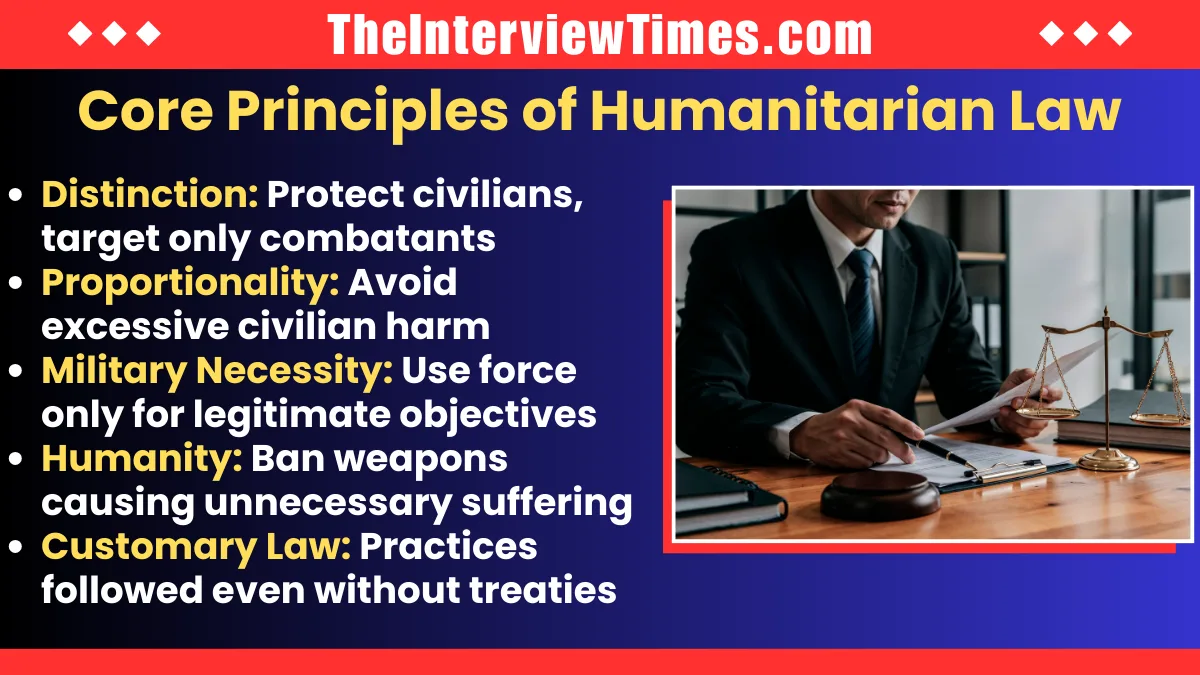
International Law During War is built on four essential principles that guide military conduct.
Distinction: Combatants must always distinguish between military targets and civilians. Direct attacks against civilians are strictly prohibited.
Proportionality: Military operations must avoid excessive civilian harm in relation to the anticipated military advantage.
Military Necessity: Force can only be used to achieve legitimate military objectives. Destruction without military justification is unlawful.
Humanity: Weapons and tactics that cause unnecessary suffering are banned. This principle underpins prohibitions on chemical weapons, biological weapons, and certain explosive devices.
These principles form the ethical and legal backbone of International Law During War.
What Qualifies as a War Crime?
Serious violations of International Law During War are classified as war crimes. These include:
- Intentionally targeting civilians
- Torture or inhumane treatment
- Killing prisoners of war
- Taking hostages
- Using prohibited weapons such as chemical weapons
- Deliberate attacks on hospitals or humanitarian workers
Under international law, individuals, not just states, can be held criminally responsible.
Who Enforces International Law During War?
Unlike national legal systems, there is no single global authority that enforces International Law During War. Instead, enforcement relies on multiple mechanisms.
National Courts
Countries have the primary responsibility to investigate and prosecute war crimes committed by their armed forces or citizens. Many states incorporate international humanitarian law into domestic legislation.
International Criminal Court
The International Criminal Court, established in 2002, prosecutes individuals for:
- War crimes
- Crimes against humanity
- Genocide
- The crime of aggression
However, the ICC can only act if the state concerned is a member or if the UN Security Council refers the case.
Special International Tribunals
Ad hoc tribunals have been created for specific conflicts, such as those in the former Yugoslavia and Rwanda. These courts have prosecuted senior political and military leaders.
United Nations Security Council
The Security Council can impose sanctions, authorize peacekeeping missions, or refer cases to the ICC. However, political divisions among permanent members often limit action.
Why Enforcement Remains Challenging
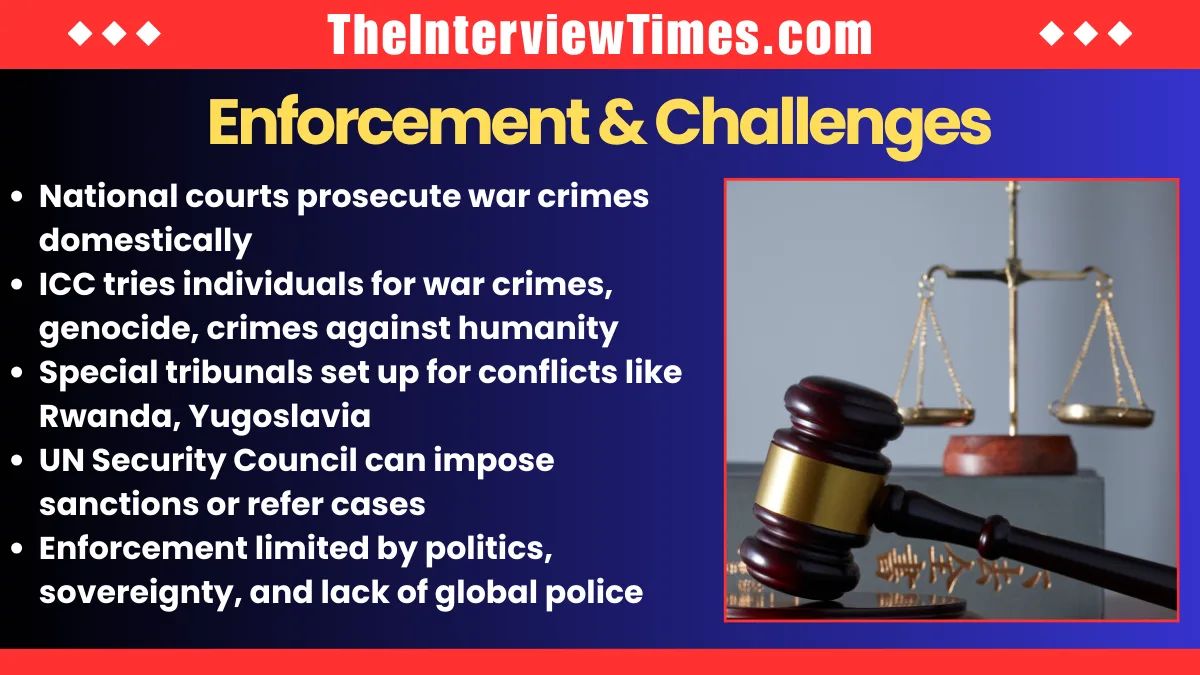
Enforcing International Law During War is often politically sensitive. Major challenges include:
- Non participation of powerful states in the ICC
- Veto powers within the UN Security Council
- Ongoing conflicts that restrict evidence collection
- Sovereignty concerns
As a result, accountability can be uneven and slow. Still, prosecutions in recent decades have demonstrated that even senior leaders are not immune from legal scrutiny.
Why These Laws Matter in Modern Conflicts
In today’s world of hybrid warfare, drone strikes, and cyber operations, International Law During War remains a critical legal safeguard. It provides a global framework that:
- Protects civilians and humanitarian workers
- Limits escalation of violence
- Promotes accountability
- Preserves a minimum standard of humanity
While enforcement mechanisms are imperfect, the existence of International Law During War shapes military planning, diplomatic negotiations, and international responses to armed conflicts.
Top News: Theia: New Breakthrough Study Reveals Inner Solar System Origin of the Planet That Formed the Moon
