
TheInterviewTimes.com | March 08, 2026 | 09:14 PM IST | New Delhi
On International Women’s Day 2026, a critical look at gender equality in India, examining gaps in women’s economic participation, safety, health and political representation.
Every year on International Women’s Day, India celebrates the achievements of its women: astronauts, entrepreneurs, scientists, athletes and political leaders. Government campaigns highlight empowerment, corporations run social media tributes, and institutions reaffirm commitments to equality.
Yet beneath this celebration lies an uncomfortable truth. India’s progress on gender equality remains deeply uneven and structurally fragile.
Despite constitutional guarantees of equality and decades of policy initiatives, women across India continue to face economic marginalization, systemic violence and limited political power. The contradiction is stark.
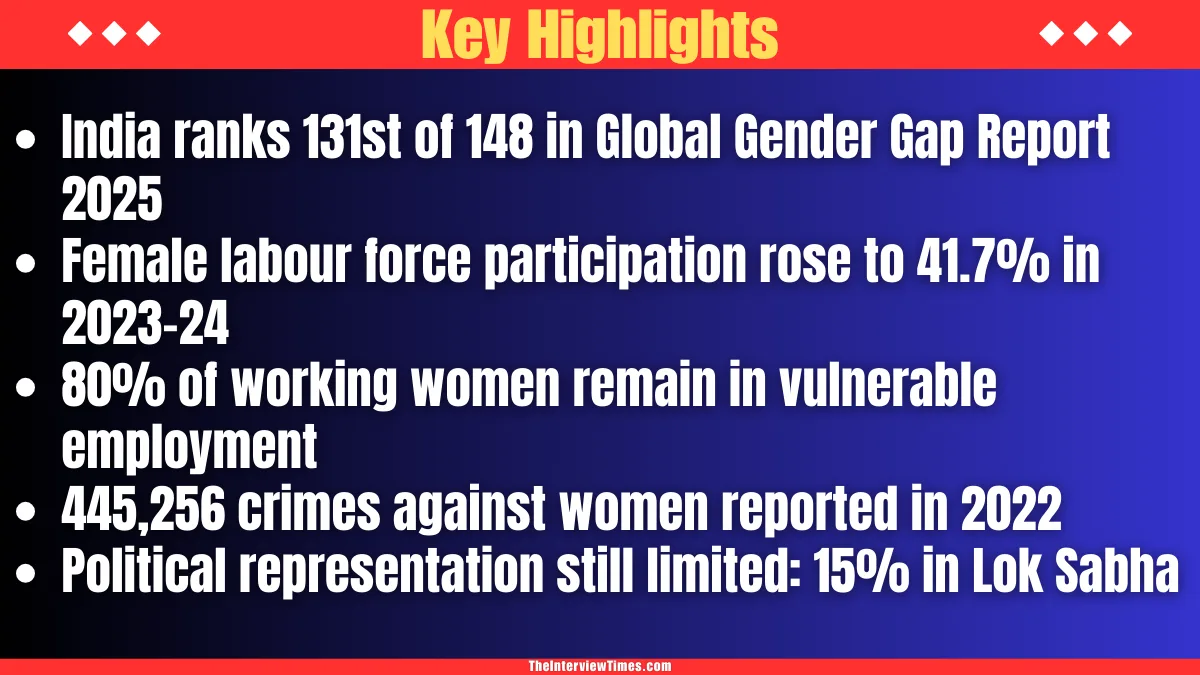
According to the Global Gender Gap Report 2025 by the World Economic Forum, India ranks 131st out of 148 countries, with a gender parity score of 64.1 percent, slipping slightly from the previous year. For a country aspiring to global leadership, the numbers tell a sobering story.
On International Women’s Day 2026, the time has come to move beyond symbolic celebration and confront the deeper realities shaping women’s lives.
Economic Participation: Progress Built on Precarious Foundations
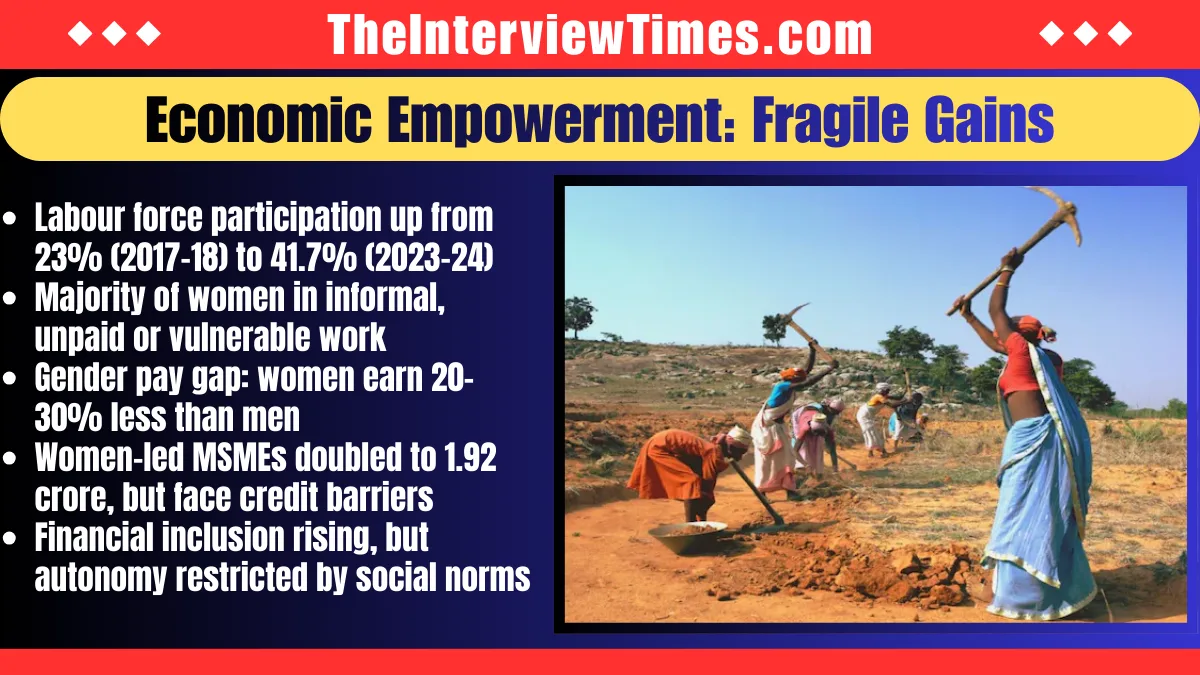
India’s female labour force participation rate has shown improvement in recent years. It rose to 41.7 percent in 2023-24, up from 23 percent in 2017-18, according to the Periodic Labour Force Survey.
At first glance, this appears to be a remarkable turnaround. A closer look reveals a more troubling picture.
A significant portion of this increase is driven by rural women entering agriculture or self-employment, often as unpaid family workers. Women’s worker population ratio remains just 40.3 percent, compared with 78 percent for men.
More importantly, nearly 80 percent of working women are in vulnerable employment, meaning they lack stable contracts, social security protections and predictable wages.
Self-employment among women has surged to 67.4 percent, but in many cases this reflects survival in the informal economy rather than true entrepreneurship.
The gender pay gap further widens the divide. Women in India earn 20 to 30 percent less than men for similar work. This gap reflects deep occupational segregation.
Women dominate lower-paid sectors such as retail, logistics and care work. However, they remain underrepresented in high-growth fields such as artificial intelligence, cybersecurity and advanced engineering.
Even when women start businesses, structural barriers remain. Women-led micro, small and medium enterprises (MSMEs) have nearly doubled to 1.92 crore between 2021 and 2023, generating approximately 8.9 million jobs. Yet many of these enterprises struggle with limited access to credit, markets and digital infrastructure.
Government initiatives such as Jan Dhan Yojana and Atal Pension Yojana have expanded financial inclusion, with women accounting for nearly 48 percent of subscribers in some schemes. However, financial access does not automatically translate into economic autonomy, particularly in regions where social norms continue to restrict women’s financial decision-making.
Economic empowerment therefore remains incomplete.
Violence Against Women: The Persistent National Crisis
No discussion about women’s status in India can ignore the enduring reality of gender-based violence.
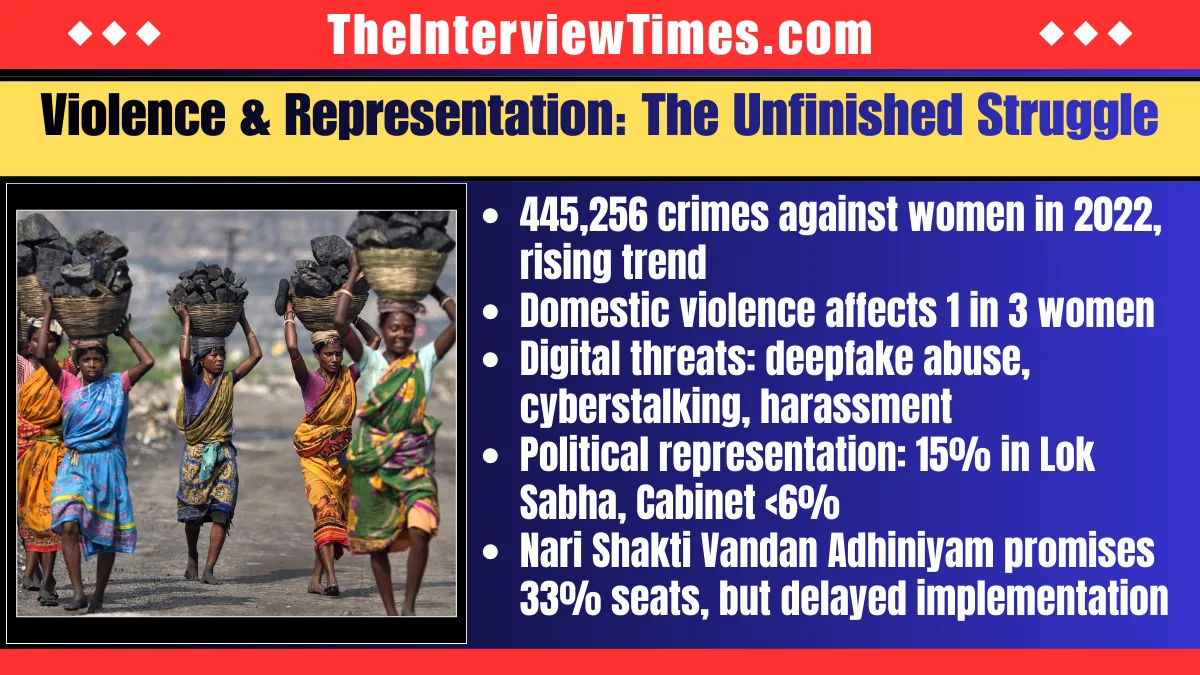
Data from the National Crime Records Bureau (NCRB) recorded 445,256 crimes against women in 2022, a 4 percent increase from the previous year. The crime rate rose to 66.4 cases per 100,000 women, compared with 58.8 in 2018.
The most common crime remains cruelty by husbands or relatives, accounting for over 31 percent of cases.
Statistics, however, capture only a fraction of the problem.
Social stigma, fear of retaliation, police reluctance and family pressure discourage countless women from reporting abuse. Surveys suggest one in three Indian women experiences domestic violence during her lifetime.
New forms of violence are also emerging in the digital era. Deepfake pornography, overwhelmingly targeting women, has surged by over 500 percent globally between 2019 and 2023. Cyberstalking, online harassment and non-consensual image sharing have become increasingly common threats.
Meanwhile, entrenched social practices persist. Dowry deaths still claim more than 6,000 lives annually, while reported rape cases average one every 20 minutes.
Despite strong laws, including the Protection of Women from Domestic Violence Act (2005), implementation remains inconsistent. Judicial delays, inadequate police training and limited victim support systems often leave survivors without meaningful justice.
Violence against women is not merely a law-and-order issue. It reflects deeper societal attitudes about power, gender roles and entitlement.
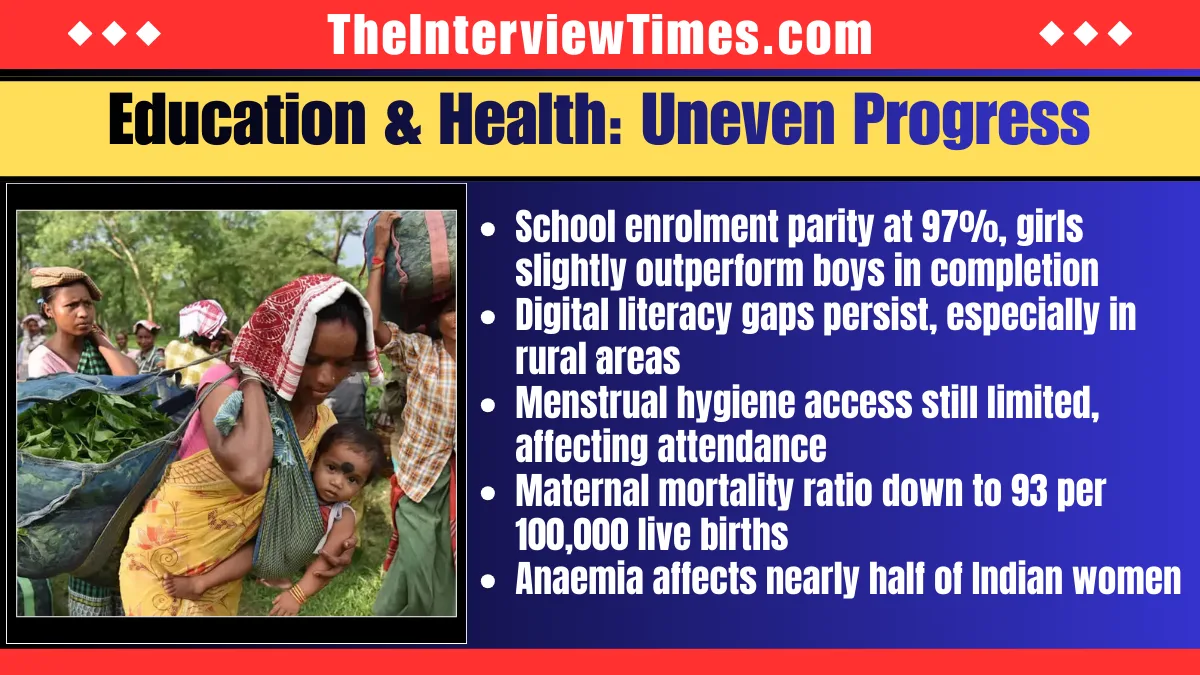
Education and Health: Gains That Mask Persistent Gaps
India has made genuine progress in education.
Gender parity in school enrolment is now close to 97 percent, and girls’ lower-secondary completion rate stands at 88.3 percent, slightly higher than boys at 86.3 percent. These improvements reflect decades of public investment and social campaigns.
Yet education does not always translate into opportunity.
Digital literacy gaps remain significant, particularly in rural areas. Access to basic menstrual hygiene products is still limited for many young women. This affects school attendance and long-term educational outcomes.
In higher education and STEM fields, female participation is growing. However, retention remains a challenge because of workplace bias, limited mentorship and family pressures.
Health indicators also show improvement. India’s maternal mortality ratio has fallen to 93 deaths per 100,000 live births, while under-five mortality for girls has dropped significantly.
However, other health concerns persist. Anaemia affects nearly half of Indian women, and early marriages, often driven by economic pressures, continue to affect adolescent health outcomes.
Progress exists, but it remains uneven and fragile.
Top News: Nvidia CEO Jensen Huang Says AI Agents Will Replace Seat-Based Software Models
Political Representation: Power Still Out of Reach
India has made historic promises on political representation.
The Nari Shakti Vandan Adhiniyam (2023), which reserves one-third of seats in Parliament and state assemblies for women, was widely hailed as a transformative reform.
However, the law will only come into effect after delimitation, meaning implementation could take several years.
Until then, women remain underrepresented in national politics. Women hold roughly 15 percent of seats in the Lok Sabha, while only about 5 to 6 percent of Union Cabinet ministers are women.
Local governance offers a more encouraging picture. Since the 1992 constitutional amendments, reservations in panchayats have enabled millions of women to participate in grassroots governance.
Yet at the national level, political leadership pipelines remain constrained by party gatekeeping, electoral violence and entrenched male dominance.
Representation without real power risks becoming symbolic inclusion.
Beyond Celebration
International Women’s Day is meant to celebrate progress. It should also provoke reflection.
India has undeniably moved forward. Women are increasingly visible in education, entrepreneurship, sports and public life. Legal frameworks supporting gender equality have expanded.
But structural barriers remain deeply embedded in economic systems, political institutions and social norms.
Real transformation will require enforcing labour protections, strengthening justice systems, expanding childcare infrastructure, closing digital divides and ensuring meaningful political representation.
Above all, it will require a societal shift that recognizes women not as beneficiaries of development but as equal architects of India’s future.
Until that happens, India’s story of gender progress will remain a narrative of remarkable achievements overshadowed by unfinished change.
And that is the challenge the country must confront, not just on International Women’s Day, but every day.
