
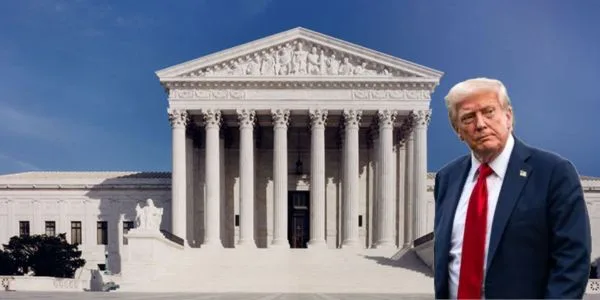
The Supreme Court Trump CPSC ruling permits the removal of three Democratic commissioners from the Consumer Product Safety Commission, raising major concerns over the future of independent federal agencies.
Washington, D.C. – In a major development that could reshape the future of independent federal agencies, the U.S. Supreme Court has granted former President Donald Trump permission to remove three Democratic commissioners from the Consumer Product Safety Commission (CPSC), effectively overturning a lower court’s reinstatement order.
The decision, issued on Wednesday, July 23, 2025, in a 6–3 ruling, allows the firings to stand while the case continues to be litigated in lower courts. Though not a final judgment, the emergency ruling marks a significant win for presidential authority and signals a broader shift in the Court’s view of agency independence.
Bipartisan Commission at the Center of Supreme Court Trump CPSC Ruling
The CPSC, formed in 1972, is a bipartisan federal agency tasked with protecting consumers from dangerous products. Commissioners are appointed by the president but serve staggered seven-year terms and, by law, may only be removed “for cause”—such as neglect of duty or malfeasance—to preserve the agency’s independence from political interference.
On May 9, 2025, during his second term, Donald Trump dismissed three commissioners: Chair Alexander Hoehn-Saric, Mary Boyle, and Richard Trumka Jr.—all Democrats appointed by President Biden. Their terms were not due to expire for several years.
The removals triggered immediate legal action and became the subject of what is now known as the Supreme Court Trump CPSC ruling. The commissioners argued that their dismissals were unlawful and violated both statutory protections and the longstanding Supreme Court precedent set in Humphrey’s Executor. In June, U.S. District Judge Matthew Maddox ruled in their favor and ordered their reinstatement—a decision later upheld by the Fourth Circuit Court of Appeals.
Must Read: Anthropic Study Reveals AI Inverse Scaling: Longer Thinking Time Hurts Performance
Supreme Court Intervenes
However, on July 23, the Supreme Court issued an emergency stay, temporarily halting the lower court’s decision and clearing the way for Trump to proceed with the removals. The majority did not provide a full opinion but referenced its earlier decision in Trump v. Wilcox, a May 2025 ruling that granted the president broad authority to dismiss members of other independent agencies like the National Labor Relations Board and the Merit Systems Protection Board.
In essence, the Court’s majority concluded that the president’s authority to remove executive branch officials—even those at independent agencies—takes precedence, especially when the statute does not provide explicit enforcement mechanisms to prevent it.
Fierce Dissent from Liberal Justices
The Court’s three liberal justices—Elena Kagan, Sonia Sotomayor, and Ketanji Brown Jackson—issued a sharp dissent. They argued that the majority’s decision dismantles the very principle of agency independence enshrined in decades of U.S. law.
“This Court’s emergency order effectively eliminates Congress’s carefully constructed protections for independent commissions,” Justice Kagan wrote. “It allows the president to fire commissioners not for cause, but for political reasons—completely undermining the bipartisan design of these agencies.”
The dissent warned that the ruling would set a dangerous precedent, giving presidents unchecked power to politicize regulatory bodies that were explicitly designed to operate above the political fray.
Must Read: Trump Signs Historic GENIUS Act: First Major Crypto Law Boosts Stablecoins in 2025
Implications of the Supreme Court Trump CPSC Ruling
Although the ruling is temporary and procedural, it has wide-reaching implications. It builds on recent decisions by the Supreme Court that have steadily eroded limits on presidential removal powers—such as Seila Law v. CFPB and Collins v. Yellen—and it suggests a growing judicial willingness to redefine the structure of the administrative state.
Legal scholars say the decision could affect a wide array of federal agencies, including the Federal Trade Commission (FTC), Securities and Exchange Commission (SEC), and others that rely on staggered, bipartisan appointments for stability and public trust.
Some consumer safety groups have expressed deep concern. Without protections for commissioners, critics argue, regulatory decisions could become subject to political pressure, undermining public safety.
Supporters of the decision, including several conservative legal analysts, argue that presidents should be able to control their administrations fully and remove officials who do not align with their policies. They contend that the previous restrictions were outdated and inconsistent with modern executive power.
What’s Next After the Supreme Court Trump CPSC Ruling?
The legal battle is far from over. The case will continue in the Fourth Circuit Court of Appeals, which may eventually revisit the merits of the original district court ruling. Depending on the outcome, the matter could return to the Supreme Court for a full hearing and final resolution.
In the meantime, the three ousted commissioners will not be returning to their posts. The Trump administration is expected to quickly nominate replacements, potentially tilting the CPSC in a new ideological direction.
This decision reflects a broader judicial and political trend in Washington—one that increasingly favors executive power over congressional constraints. If the Court ultimately upholds the removals, it may signal the end of a century-long effort to insulate regulatory agencies from direct political control.
For now, the Supreme Court has sent a clear message: the president’s authority over federal appointees may be broader than previously imagined, even when it comes to agencies designed to remain independent.