TheInterviewTimes.com | September 7,2026 | New Delhi
Discover the best AI tools for small business in 2026, from ChatGPT and Canva to Zapier and QuickBooks, and learn which tools are worth paying for.
Quick Answer
The best AI tools for small business in 2026 are not necessarily the tools with the longest feature lists. For most small businesses, the best approach is to choose AI software around specific business problems: ChatGPT for general work, Canva for design, Zapier for automation, QuickBooks for accounting, CRM software for customer management, and specialized AI tools for marketing, meetings and customer support.
The right AI stack can help a small team produce more work without immediately adding more employees. Recent U.S. research shows that AI adoption among small businesses is already significant, although smaller firms continue to lag larger businesses.
The key is not to buy 15 AI subscriptions.
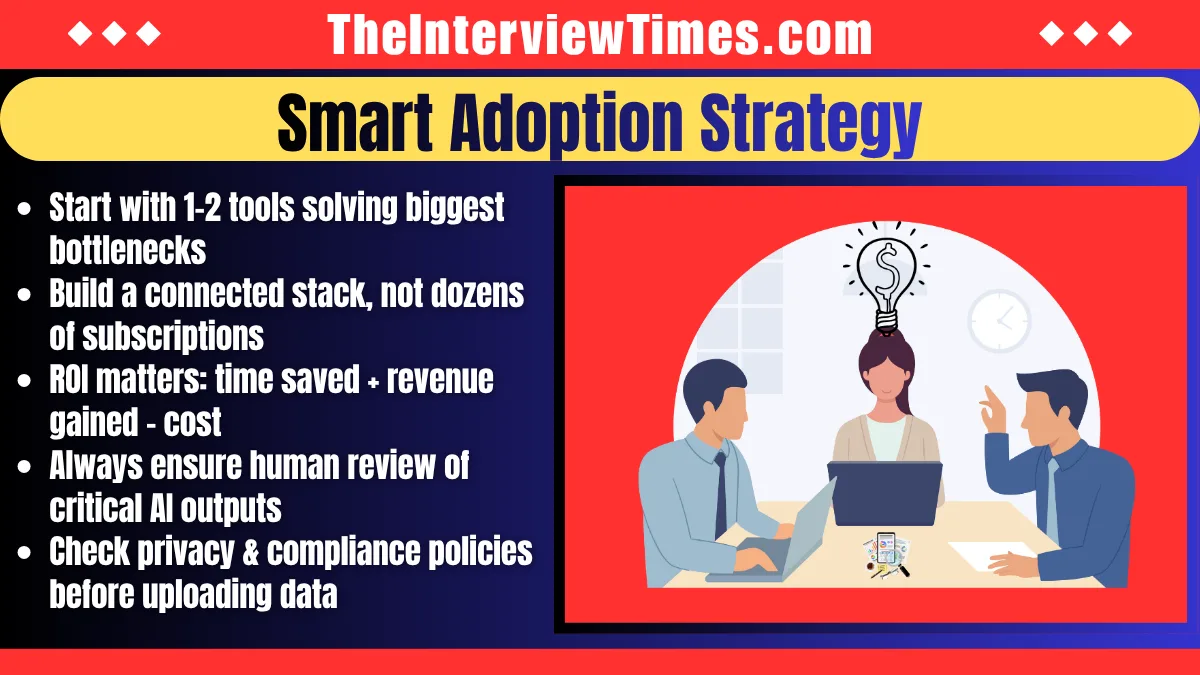
Start with one or two tools that solve your biggest bottleneck, measure the result, and expand from there.
Key Highlights
- ChatGPT is the strongest general-purpose AI starting point for many small businesses.
- Zapier is useful when the biggest problem is repetitive manual work between apps.
- Canva is particularly useful for businesses producing their own marketing graphics and visual content.
- QuickBooks can help businesses streamline bookkeeping and financial workflows.
- CRM platforms become more valuable as a business begins managing a larger volume of leads and customers.
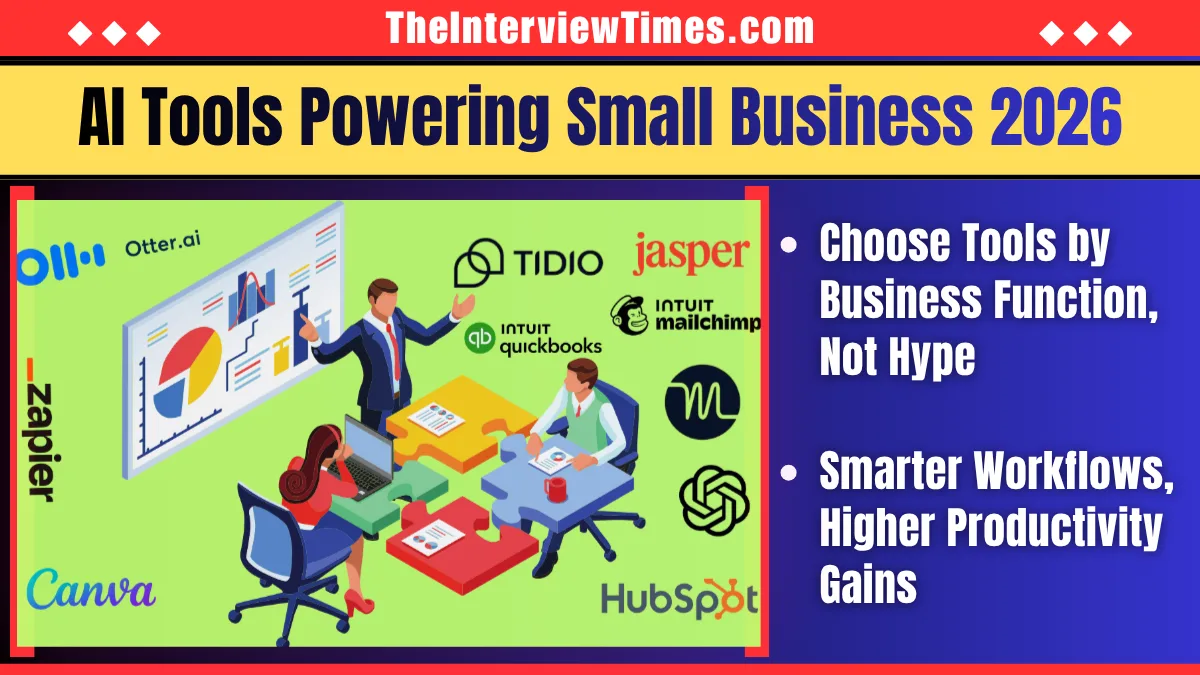
- AI should be selected by business function, not by hype.
- Small businesses should pay close attention to privacy, data handling, subscription costs and human review of AI-generated output.
- The best AI stack is usually a small, connected group of tools, rather than dozens of disconnected subscriptions.
Why AI Tools Matter for Small Businesses in 2026
For a large corporation, adopting AI can mean creating a dedicated AI team, hiring consultants and integrating new enterprise systems.
A small business usually does not have that luxury.
The owner may simultaneously handle:
- sales
- customer service
- marketing
- accounting
- hiring
- scheduling
- social media
- operations
- research
- administration
That makes AI particularly interesting for small businesses.
The San Francisco Fed reported in July 2026 that nearly 40% of small-business respondents in its 2024 Small Business Credit Survey were either already using AI or planning to use it. Reported use cases included productivity, marketing, written communications, visual content, customer service, analytics and forecasting.
The U.S. Chamber of Commerce Foundation also reported in June that half of workers at small businesses were already using AI at work, with most users saying the primary benefit was increased productivity rather than replacing their jobs.
That distinction matters.
For a small business, AI’s immediate value is often not “replace a person.”
It is:
Give one person the capacity of a larger team.
OpenAI’s small-business research similarly found that at least four million people in the United States used ChatGPT during March 2026 to help plan, start, run or grow a business.
The 10 Best AI Tools for Small Business in 2026
There is no universal winner because a local service business, online store, consultant and software startup have very different needs.
Our ranking therefore focuses on business usefulness rather than raw AI capability.
| Rank | AI Tool | Best For | Best Business Use |
| 1 | ChatGPT | General business work | Research, writing, analysis, planning |
| 2 | Zapier | Automation | Connecting apps and workflows |
| 3 | Canva | Marketing & design | Social media, presentations, graphics |
| 4 | QuickBooks | Accounting | Bookkeeping and financial management |
| 5 | HubSpot | CRM & sales | Leads, customers and marketing |
| 6 | Tidio | Customer support | AI-powered customer conversations |
| 7 | Mailchimp | Email marketing | Campaigns and automation |
| 8 | Otter.ai | Meetings | Transcription and meeting notes |
| 9 | Motion | Productivity | Calendar, tasks and scheduling |
| 10 | Jasper | Marketing content | Brand-focused content creation |
This isn’t simply a list of the most famous AI companies. Current 2026 small-business comparisons are similarly moving toward job-specific tool selection rather than treating AI as one generic category. Recent coverage has highlighted tools ranging from Jasper and Tidio to QuickBooks, Motion, Canva, Mailchimp and Zapier.
1. ChatGPT: Best Overall AI Tool for Small Business
Best for: Almost every small business
If a business owner is buying only one AI tool, a general-purpose AI assistant is arguably the most flexible place to start.
ChatGPT can assist with:
- business research
- email drafting
- marketing ideas
- customer-response templates
- business plans
- data analysis
- brainstorming
- document analysis
- content creation
- internal knowledge work
OpenAI has specifically expanded its small-business offering in 2026. Its ChatGPT Business environment includes shared workspaces, administrative controls and access to ChatGPT Work and other business capabilities.
OpenAI also launched a dedicated small-business program in July 2026, including training and practical workflows for areas such as accounting, marketing and ecommerce.
Best use case
A five-person company can use ChatGPT as a shared productivity layer across several departments rather than buying a separate AI application for every small task.
Watch out for
Do not treat AI output as automatically correct.
Financial information, legal documents, customer communications and important business decisions should still receive human review.
Our verdict: Best starting point for most small businesses.
2. Zapier: Best for AI Automation
Best for: Businesses drowning in repetitive tasks
Many small businesses don’t actually have an “AI problem.”
They have a workflow problem.
For example:
New website lead → email notification → CRM entry → follow-up email → salesperson notification.
If employees are manually moving information between different applications, automation can create significant time savings.
Zapier is valuable because it connects different business applications and can automate workflows between them.
Best use case
Use automation when the same digital task happens repeatedly and follows predictable rules.
Watch out for
Automation can also automate mistakes.
A poorly designed workflow may send incorrect information to hundreds of customers faster than a human employee ever could.
Our verdict: One of the highest-potential tools once a business has repetitive workflows.
3. Canva: Best AI Design Tool for Small Businesses
Best for: Marketing teams without a professional designer
A small company may need:
- Instagram graphics
- Facebook posts
- presentations
- flyers
- advertisements
- YouTube thumbnails
- brochures
- product visuals
Hiring a designer for every small asset isn’t practical for many businesses.
Canva’s AI-powered design ecosystem makes it easier for non-designers to create and modify visual content.
Recent 2026 reviews continue to position Canva among the leading options for small-business visual production.
Best use case
A small business owner who needs professional-looking marketing material but doesn’t have a full-time designer.
Our verdict: Excellent value for marketing-heavy small businesses.
4. QuickBooks: Best for AI-Assisted Accounting
Best for: Bookkeeping and financial administration
Accounting is one area where small businesses cannot afford chaos.
QuickBooks combines accounting software with AI-assisted capabilities designed to reduce some of the manual work around financial management.
Potential use cases include:
- bookkeeping
- expense tracking
- financial reporting
- invoices
- cash-flow visibility
- financial organization
Recent small-business AI guides continue to include QuickBooks among the practical tools for accounting workflows.
Best use case
Businesses that want to reduce administrative accounting work while maintaining proper financial records.
Important caution
AI should assist accounting—not replace professional financial judgment.
Tax filings, complex financial decisions and compliance issues may require a qualified professional.
Our verdict: A strong choice where accounting is a major administrative burden.
5. HubSpot: Best for CRM and Customer Management
Best for: Managing leads and customers
As a business grows, spreadsheets become increasingly difficult to manage.
A CRM helps organize:
- leads
- prospects
- customers
- sales pipelines
- follow-ups
- marketing activity
HubSpot is particularly interesting for small businesses because CRM, marketing and sales functionality can exist within a connected ecosystem.
Best use case
A growing business that has enough leads that customer information is starting to become difficult to track manually.
Watch out for
Don’t buy a complex CRM before you actually need one.
If your business has 10 customers and no sales pipeline, a sophisticated CRM may create more work than it removes.
Our verdict: Best once customer and lead management becomes a real operational problem.
6. Tidio: Best for AI Customer Support
Best for: Websites receiving repetitive customer questions
Customer support is one of the clearest areas where conversational AI can save time.
A business may receive the same questions repeatedly:
- What are your hours?
- How much does this cost?
- Do you ship?
- What’s your return policy?
- How can I book?
- Where is my order?
An AI-powered customer-support system can handle many routine interactions before a human need to intervene.
Tidio’s AI customer-support product has been highlighted in current 2026 small-business tool comparisons.
Best use case
Businesses with significant website-based customer inquiries.
Watch out for
Customer support AI should have a clear escalation path to a human.
Our verdict: Worth considering when repetitive customer questions consume staff time.
7. Mailchimp: Best for AI-Assisted Email Marketing
Best for: Email campaigns and customer retention
Email remains one of the most useful channels for businesses that already have a customer or subscriber base.
AI can assist with:
- campaign ideas
- copy
- audience segmentation
- automation
- subject-line testing
- content creation
Mailchimp remains one of the recognizable platforms in the small-business marketing ecosystem, and current AI-tool guides continue to include it among useful options.
Best use case
Businesses with an established email list.
Our verdict: Strong option when email is already part of the sales strategy.
8. Otter.ai: Best for Meeting Notes
Best for: Consultants, agencies and professional services
Meetings generate a lot of valuable information.
Without proper documentation, important ideas, decisions and action items can easily be forgotten or missed.
AI meeting tools can:
- Transcribe conversations
- Summarize meetings
- Identify action items
- Create searchable records
For consultants, agencies and professional service businesses, this can reduce the administrative work that follows every client meeting and make it easier to keep track of important discussions.
Our verdict: Particularly useful for businesses that spend significant time in meetings.
9. Motion: Best for AI-Assisted Scheduling
Best for: Busy founders and small teams
Entrepreneurs often don’t have a shortage of tasks.
They have a shortage of time.
AI scheduling tools attempt to connect tasks, calendars and priorities so work can be organized more dynamically.
Motion has been highlighted in current small-business AI coverage for task and calendar management.
Best use case
Founders managing multiple projects, meetings and deadlines simultaneously.
Our verdict: Most useful for people whose biggest problem is time management rather than content creation.
10. Jasper: Best for Brand-Focused Marketing Content
Best for: Marketing teams producing substantial amounts of branded content
Jasper focuses heavily on marketing and content workflows.
That can make it more attractive than a general-purpose chatbot when a company has an established marketing operation and needs consistent brand-oriented content production.
Current 2026 small-business AI coverage continues to include Jasper among marketing-oriented tools.
Best use case
Businesses producing regular marketing content across multiple channels.
Our verdict: Better suited to businesses with a genuine content-marketing workflow than to an owner who only needs occasional copy.
Which AI Tool Should Your Small Business Choose?
Instead of asking:
“What is the best AI tool?”
Ask:
“What is the most expensive or time-consuming problem in my business?”
Then choose accordingly.
| Your Biggest Problem | Start With |
| Writing, research and general productivity | ChatGPT |
| Repetitive digital tasks | Zapier |
| Graphics and marketing design | Canva |
| Accounting and bookkeeping | QuickBooks |
| Lead and customer management | HubSpot |
| Customer questions | Tidio |
| Email marketing | Mailchimp |
| Meeting documentation | Otter.ai |
| Scheduling and time management | Motion |
| Marketing content at scale | Jasper |
You Probably Don’t Need 10 AI Tools
This may be the most important advice in this article.
The AI software market has exploded, but more subscriptions do not automatically mean more productivity.
Recent 2026 comparisons increasingly emphasize the same principle: choose tools around jobs, not hype. One current guide found a typical small-business AI stack centered on a general LLM plus several workflow-specific tools, while other guides recommend starting with only a few tools.
A sensible starting stack might be:
For a solo entrepreneur
ChatGPT + Canva + Zapier
For a service business
ChatGPT + CRM + accounting software
For an ecommerce business
ChatGPT + Canva + email marketing + automation
For a consulting business
ChatGPT + CRM + Otter.ai + automation
The goal is not to collect AI tools.
The goal is to remove bottlenecks.
How Much Should a Small Business Spend on AI?
There is no universal number.
A business should calculate ROI, not simply count features.
Suppose an AI tool costs $30 per month.
If it saves a business owner just two hours of valuable work every month, the economics may already make sense depending on the value of that time.
But if a business buys five overlapping tools at $30–$50 each and barely uses them, the technology becomes an expense rather than an investment.
A simple framework is:
AI ROI = Value of Time Saved + Additional Revenue + Cost Avoided − Software Cost
The exact calculation will differ by business.
What About AI Data Privacy?
This is an issue small business should take seriously.
Before uploading customer information, financial records, contracts or confidential company material into an AI system, check:
- data-use policies
- privacy controls
- retention policies
- administrator controls
- access permissions
- whether business data is used for model training
- compliance requirements relevant to your industry
For example, OpenAI says ChatGPT Business provides administrative controls, encryption and that business data is not used to train its models by default.
That does not mean every AI service has identical policies.
Always check the specific vendor’s current terms before using sensitive business data.
The Bottom Line
The best AI tools for small business in 2026 are not necessarily the newest or most expensive products.
The strongest strategy is to build a small AI stack around real business problems.
For most businesses, ChatGPT is the strongest starting point, because it can support many different types of work. From there, specialized tools can be added for automation, accounting, CRM, design, customer service, meetings and marketing.
The evidence suggests that small-business AI adoption is moving beyond experimentation. The U.S. Census has documented meaningful business adoption, while Federal Reserve research shows that many smaller firms are already using or considering AI.
But adoption alone doesn’t create value.
The winners will be the small businesses that use AI to solve specific problems, measure the results and build repeatable workflows—not those that simply subscribe to the most AI tools.
Our Editorial Verdict
Best overall: ChatGPT
Best automation: Zapier
Best design: Canva
Best accounting: QuickBooks
Best CRM: HubSpot
Best customer support: Tidio
Best email marketing: Mailchimp
Best meetings: Otter.ai
Best scheduling: Motion
Best marketing content: Jasper
Our recommended starting stack for most small businesses:
ChatGPT + one workflow-specific tool + one tool for your biggest operational bottleneck.
That is usually a better starting point than buying an entire shelf of AI subscriptions.
Important Editorial Note
Tool features and pricing can change quickly. This article should be reviewed and updated regularly, particularly before publishing specific prices, free-plan limits or product-feature claims. The ranking is an editorial assessment based on business usefulness, current product positioning and available 2026 evidence—not a guarantee that every tool will produce the same ROI for every business