
TheInterviewTimes.com | New Delhi, 1 November 2026
What are US Midterm Elections? Understand how the House, Senate and Congress work, what voters decide in 2026 and why the results matter.
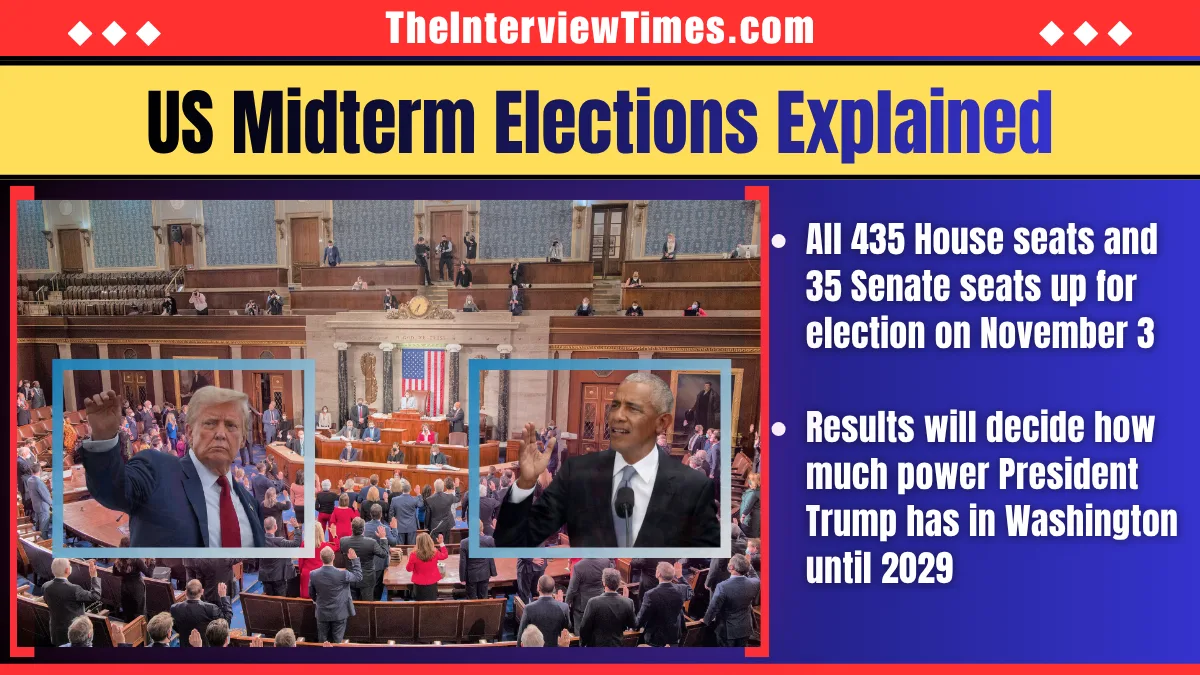
The United States will hold its Midterm Elections on November 3, 2026, giving voters an opportunity to reshape the balance of political power in Washington. Although President Donald Trump is not seeking re-election in this contest, the results could significantly influence his ability to advance his legislative agenda during the remaining two years of his presidential term.
All 435 voting seats in the House of Representatives and 35 seats in the Senate will be contested. Voters will also elect governors in 36 states, alongside thousands of state and local officials.
Midterm elections are an important feature of the American political system. They allow voters to change the composition of Congress halfway through a presidential term, influencing how effectively the administration can implement its policies.
But what exactly are midterm elections? How does the American electoral system work, and what happens if the President’s political party loses control of Congress?
What Are US Midterm Elections?
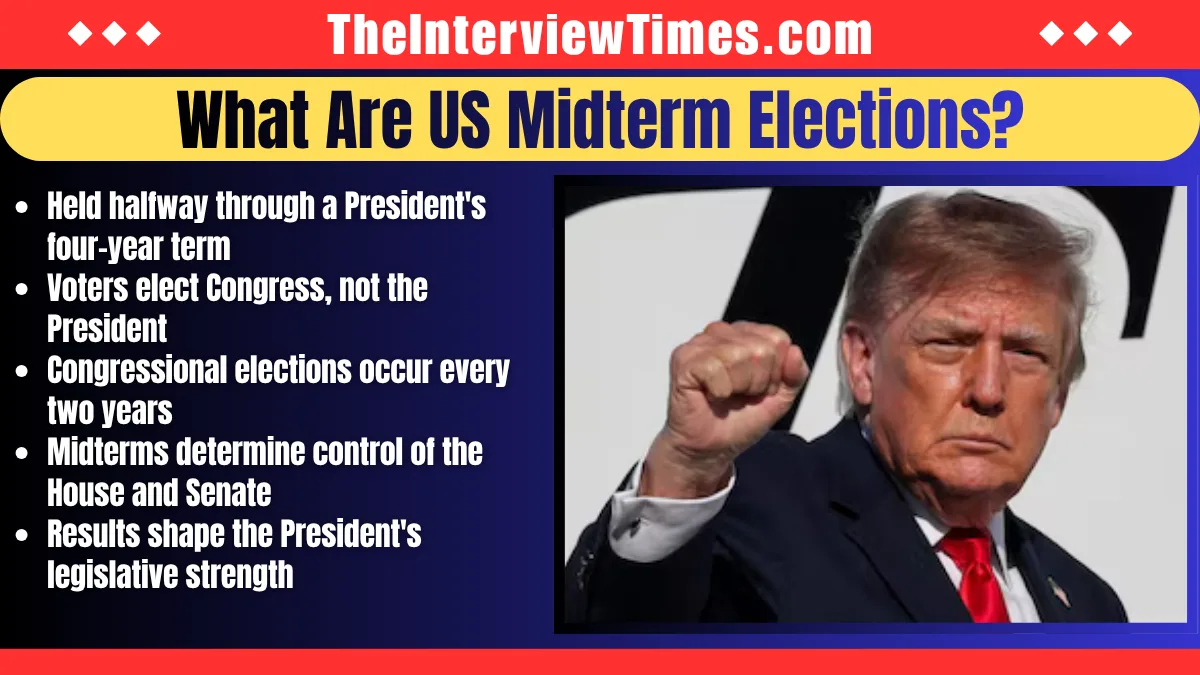
Midterm elections are congressional elections held approximately halfway through a four-year presidential term in the United States.
American presidential elections take place every four years, while elections for Congress are held every two years. The congressional elections that take place between two presidential elections are known as midterm elections.
For example, Donald Trump began his second presidential term on January 20, 2025. His current term is scheduled to end on January 20, 2029, with the next presidential election scheduled for November 7, 2028.
The 2026 elections therefore take place halfway through his presidential term.
Unlike presidential elections, midterms do not determine who becomes President or Vice President. Instead, voters elect members of Congress and several state and local officials.
The results determine which political party controls the two chambers of Congress and how much legislative support the President has for the remainder of the term.
Understanding the US Congress: House and Senate
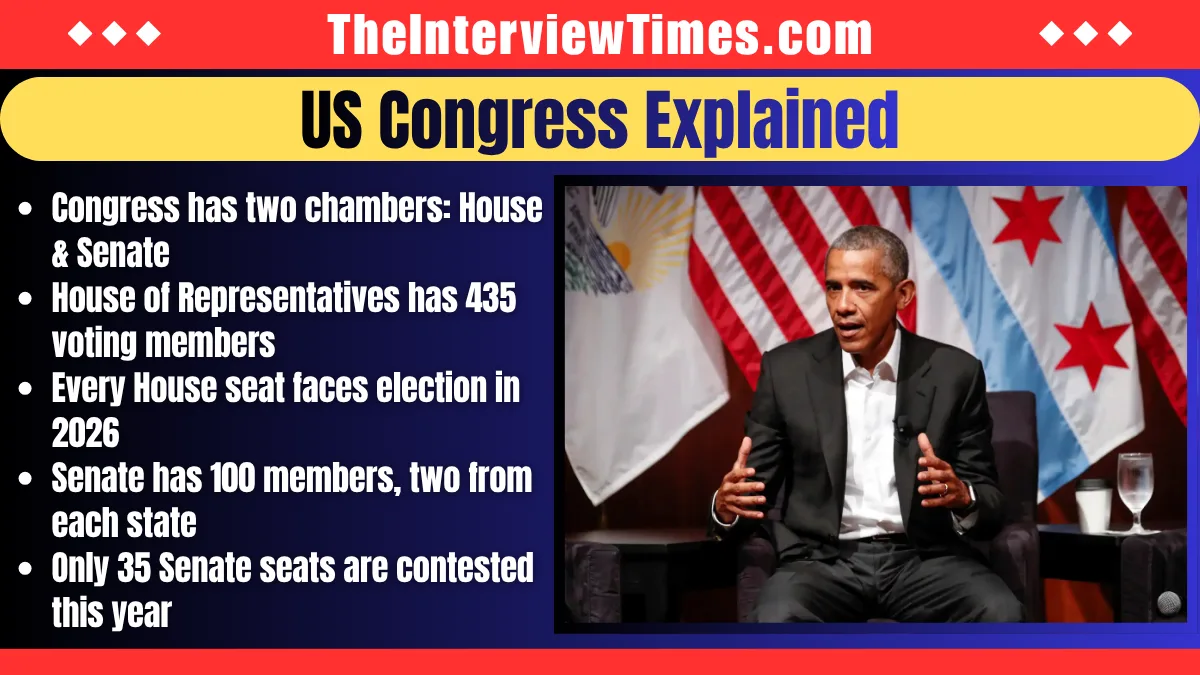
The United States Congress is the federal government’s legislative branch. It consists of two chambers: the House of Representatives and the Senate.
Both chambers participate in passing federal legislation, approving government spending and overseeing the executive branch. Most legislation must be approved by both chambers before it can be sent to the President.
1. House of Representatives
The House of Representatives is the lower chamber of Congress and has 435 voting members.
Seats are distributed among the 50 states according to population. States with larger populations have more representatives, while smaller states have fewer.
Each representative serves a two-year term and represents a specific congressional district. Consequently, all 435 voting seats are contested in every regular congressional election, including midterms.
The House also has six non-voting members: five delegates representing the District of Columbia and certain US territories, and a resident commissioner representing Puerto Rico. These members are not included in the 435 voting seats.
2. The US Senate
The Senate is the upper chamber of Congress and gives equal representation to every state.
There are 100 senators, with each of the 50 states electing two senators, regardless of population size.
Senators serve six-year terms. Their elections are staggered, meaning approximately one-third of the Senate faces voters every two years.
This arrangement ensures that the entire Senate does not change at once, providing continuity in the legislative process.
The Senate also has important constitutional responsibilities, including confirming many presidential appointments, approving treaties with the support of two-thirds of senators present, and conducting presidential impeachment trials.
What Is at Stake in the 2026 US Midterm Elections?
The 2026 Midterm Elections will take place on Tuesday, November 3.
The major contests include:
- 435 House seats: Every voting seat in the House of Representatives will be contested.
- 35 Senate seats: This includes 33 regularly scheduled elections and two special elections in Florida and Ohio.
- 36 governorships: Voters in 36 states will elect their governors.
- State legislatures: Numerous state legislative seats will also be contested.
- Local elections: Voters will decide various local offices and ballot measures across the country.
The two special Senate elections will fill the remaining portions of the terms previously held by Marco Rubio of Florida and JD Vance of Ohio, following their departures from the Senate.
The newly elected Congress, known as the 120th Congress, will begin its term on January 3, 2027.
Why Does Control of Congress Matter?
The US Constitution divides federal government powers among three branches: executive, legislative and judicial.
The President leads the executive branch, Congress makes federal laws, and the judiciary interprets the law.
This separation of powers is designed to prevent any single branch from exercising unlimited authority.
Although the President can propose legislation and establish policy priorities, Congress has the constitutional authority to pass federal laws.
For example, a President may propose changes to taxation, immigration or healthcare. However, major legislative changes generally require congressional approval.
Congress also plays a central role in federal spending. Government funding and appropriations require legislative approval, giving Congress substantial influence over national priorities.
Consequently, winning control of the House or Senate gives a political party considerable influence over the legislative process.
What Happens If the President’s Party Loses Congress?
When the President’s party loses control of one or both chambers, the country can enter a period known as divided government.
For example, a Republican President may face a Democratic-controlled House of Representatives. In such circumstances, the administration could find it more difficult to pass its proposed legislation.
An opposition-controlled House can reject or amend legislative proposals and use its committee powers to investigate government policies and officials.
The Senate has separate responsibilities. It considers many presidential appointments, including federal judges and senior executive officials, and plays a role in approving international treaties.
Congress also has the constitutional power to initiate impeachment proceedings. The House of Representatives has the sole power to impeach federal officials, while the Senate conducts the trial. Conviction requires a two-thirds vote of senators present and results in removal from office.
However, losing control of Congress does not automatically remove a President or prevent the executive branch from functioning. The President retains constitutional powers, including the power to veto legislation. Congress can override a presidential veto with a two-thirds vote in both chambers.
How Do Americans Vote in Midterm Elections?
Unlike countries with a single national election administration authority, the United States operates a largely decentralised election system.
State and local authorities administer elections, while voting procedures and registration requirements vary across states.
Eligible American citizens can generally vote through different methods, depending on the rules of their state:
- In-person voting on Election Day.
- Early in-person voting, where available.
- Absentee or mail-in voting, subject to state requirements.
Voters must meet eligibility requirements and follow applicable registration rules. Voting is not compulsory in the United States.
Political parties also conduct primary elections before the general election. These allow voters to select the candidates who will represent their parties in November. The rules governing primary elections differ across states.
How Are US Midterm Elections Different From Presidential Elections?
The biggest difference is the offices being contested.
In presidential elections, Americans participate in choosing the President and Vice President through the Electoral College system. The President serves a four-year term.
In midterm elections, voters elect members of Congress and various state and local officials. There is no presidential contest.
However, congressional elections take place during both presidential and midterm election years. All House seats and approximately one-third of Senate seats are contested in both.
Another important distinction is that Americans do not directly elect their President through a nationwide popular vote. The Electoral College determines the outcome of the presidential election through state-based electoral votes.
Congressional elections, by contrast, are decided through voting in individual congressional districts and states.
Why Do US Midterm Elections Matter Beyond Washington?
The consequences of US midterm elections extend beyond domestic politics.
Congress has significant influence over defence spending, international assistance, trade legislation and oversight of foreign policy. Its decisions can affect international security, economic relations, immigration policy and technology partnerships.
A change in congressional control can influence debates about trade agreements, tariffs, defence cooperation, relations with major powers and government funding for international programmes.
For international governments, businesses, investors and diplomatic observers, the political composition of Congress is therefore an important factor in understanding the direction of US policy.
However, a change in congressional control does not automatically change American foreign policy. The President continues to lead the executive branch, and major international decisions involve several government institutions.
Conclusion: A Midterm Test of Presidential Power
The 2026 US Midterm Elections are more than a routine congressional voting exercise. They are a central part of America’s system of democratic representation and constitutional checks and balances.
The elections will not determine who occupies the White House, but they will establish the political composition of Congress during the final two years of Donald Trump’s current presidential term.
Their outcome can influence legislative priorities, government spending, congressional investigations, presidential appointments and the administration’s ability to implement its policies.
For international observers, the elections also provide an important indication of how domestic political developments in the world’s largest economy can influence its approach to global economic and diplomatic affairs.
Ultimately, US midterm elections demonstrate that winning the presidency does not give a political party complete control over the American government. Voters have another opportunity to influence the balance of power just two years later