

Discover India’s homestay reforms unveiled by NITI Aayog to unlock a ₹4,722 crore tourism market. Learn about single-window clearance, incentives, and sustainable growth strategies for 2025 and beyond.
In a significant push for India’s burgeoning tourism sector, NITI Aayog, the government’s premier policy think tank, has released a comprehensive report titled “Rethinking Homestays: Navigating Policy Pathways.” Launched on August 22, 2025, in collaboration with the Internet and Mobile Association of India (IAMAI), the report proposes sweeping reforms to streamline regulations, boost incentives, and promote sustainable growth in the homestay and bed-and-breakfast (B&B) industry. This initiative comes amid a post-pandemic surge in domestic and experiential tourism, positioning homestays as key drivers of local entrepreneurship, employment, and cultural immersion.
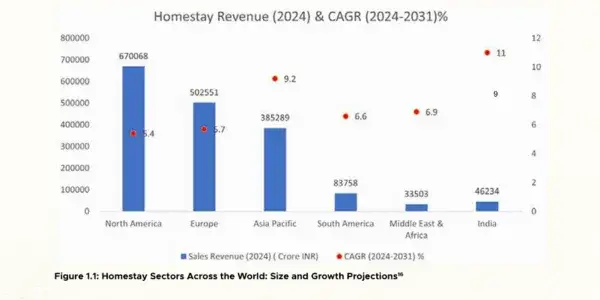
The report highlights the homestay market’s current valuation at ₹4,722 crore in 2024, with projections of an 11% compound annual growth rate (CAGR) through 2031, potentially transforming lesser-known destinations into thriving tourism hubs. As India aims for a Viksit Bharat (Developed India) by 2047, these reforms could unlock economic opportunities in rural and urban areas alike, fostering inclusive growth.
Key Highlights from the NITI Aayog Homestay Reforms Report
The report, drawing insights from aggregators, hosts, policymakers, and on-ground surveys across states like Goa, Kerala, Uttarakhand, and Uttar Pradesh, underscores homestays’ role in blending cultural authenticity with modern hospitality. It was launched by Shri Suman Bery, Vice Chairman of NITI Aayog, in the presence of senior officials from the Ministry of Tourism, Ministry of Culture, and state representatives.
- Market Potential: Valued at ₹4,722 crore in 2024, the sector is expected to grow at 11% CAGR until 2031, driven by rising demand for authentic, community-driven travel experiences.
- Growth Drivers: Post-COVID tourism boom, with a focus on domestic travelers seeking offbeat destinations, has fueled this expansion. Homestays offer immersive experiences like spice harvesting in Kerala or rural stays along the Ganges in Uttar Pradesh.
- Economic Impact: By promoting local entrepreneurship, homestays can generate employment and preserve cultural heritage, aligning with sustainable tourism goals.
Shri Suman Bery emphasized the need for “light-touch, transparent regulatory frameworks” to ensure tourist safety, homeowner protection, and heritage conservation while enabling sustainable economic growth.
Must Read: Adani Rewards: India’s First All-Traveler Airport Loyalty Program Goes Live
Proposed Homestay Reforms: Streamlining for Ease and Efficiency
NITI Aayog’s recommendations focus on simplifying processes to reduce bureaucratic hurdles and enhance accessibility. Key proposals include:
- Single-Window Clearance System: A streamlined registration process requiring only essential documents like proof of ownership, applicant ID, and GST registration (if applicable). Applications should be disposed of within 30 days to minimize delays.
- Digitalization Push: Development of a unified digital portal for registrations, renewals, and compliance, incorporating self-declaration mechanisms and randomized inspections to ease operations.
- Destination-Focused Incentives: Shift from individual homestay perks to tiered financial support for underdeveloped regions (Tier 1 and Tier 2 destinations). This includes subsidies, interest relief, and non-financial aids like project support organizations (PSOs) and residential utility rates.
- Marketing and Awareness Campaigns: State-led initiatives in collaboration with online travel agencies (OTAs), influencers, and official channels to promote lesser-known areas. Launch Information, Education, and Communication (IEC) campaigns and local facilitation centers.
- Homestay Clusters and Experiential Tourism: Create clusters leveraging local resources for high-value tourism, such as thematic circuits and anchor hubs, ensuring community involvement and environmental sustainability.
- Capacity Building: Targeted training programs on digital literacy, hospitality, and compliance to boost occupancy rates and operator skills.
These reforms draw inspiration from the Economic Survey 2025, which advocates a “get out of the way” approach to simplify regulations for small businesses.
Must Read: India-China Direct Flights to Resume in 2025: Key Routes and Updates

State Models: Lessons from Goa, Kerala, Uttarakhand, and Uttar Pradesh
The report showcases best practices from select states, serving as blueprints for nationwide adoption:
- Goa: Efficient digital portal with five-year registration validity, minimal documentation (three documents), and incentives like fee reimbursements and furniture subsidies for hinterland homestays.
- Kerala: Structured verification with quorum-based assessments, domestic electricity rates, and promotion of experiential activities like spice harvesting.
- Uttarakhand: Offers 25-33% subsidies and interest relief but struggles with disbursement delays and marketing gaps.
- Uttar Pradesh: Focuses on cluster promotion via schemes like Gange Gramin Krishi Prayatan Yojana, training over 330 homestays in 229 villages, though lacking fiscal incentives.
These examples highlight the need for harmonized policies to address regional disparities.
Challenges in the Homestay Sector
Despite growth potential, the sector faces hurdles:
- Regulatory Complexity: Multiple policies and middlemen exploitation lead to high costs and confusion, with 50% of operators relying on intermediaries.
- Incentive and Training Gaps: 70% unaware of incentives or training; programs often generic and lack digital focus.
- Marketing and Infrastructure Issues: Limited state support for promotion, seasonal occupancy dips, and infrastructural woes like water shortages and poor roads.
- Community and Compliance Barriers: Low awareness, Form C compliance issues for foreign guests, and inter-departmental miscommunication.
NITI Aayog warns that without reforms, unregistered homestays and exploitation could hinder progress.
Must Read: Discover India’s Erotic Temples: A Journey Into Sacred Sensuality and Spiritual Heritage
India’s Homestay Reforms: Public and Industry Reactions
The report has garnered positive reactions on social media and from stakeholders. NITI Aayog’s official post on X highlighted the launch, emphasizing public-private collaboration. Media outlets like All India Radio and Business Standard praised the single-window system for boosting tourism. Industry experts view it as a step toward inclusive growth, with calls for swift implementation.
Conclusion: A Path to Sustainable Tourism Growth
NITI Aayog’s homestay reforms could revolutionize India’s tourism landscape, turning cultural assets into economic engines. By addressing challenges through innovative policies, the sector stands poised to contribute significantly to GDP, job creation, and rural development. As states adopt these recommendations, travelers can expect more authentic experiences, while hosts benefit from a supportive ecosystem.