
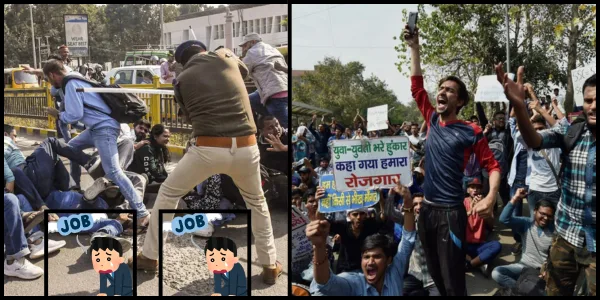
Unemployment in India 2025 shows record lows but youth joblessness and gender gaps persist. Explore decade trends and measurement methods.
Unemployment in India in 2025 has reached record lows, with the official rate at 5.1% in August, driven by rural job growth in agriculture and construction. However, challenges remain—youth unemployment is still high at 14.6%, urban joblessness lingers at 6.7%, and women’s participation in the labor force continues to lag. Over the last decade, PLFS data shows a steady decline from 6.1% in 2017–18 to 3.2% in 2023–24, while CMIE figures highlight volatility, particularly during the COVID-19 shock. Despite improving headline numbers, concerns over informal sector distress, underemployment, and low-quality jobs persist, underscoring the need for policies that create sustainable, skill-intensive employment opportunities.
At a Glance: Unemployment in India in 2025
- Current Rate (Aug 2025): 5.1% (CWS, ages 15+) – lowest in a decade, though urban joblessness remains higher.
- Youth Unemployment: 14.6% (ages 15–29), highlighting challenges for new entrants to the labor market.
- Rural vs Urban: Rural 4.8% vs Urban 6.7% (Apr–Jun 2025 quarter); rural hiring in agriculture and construction drove recovery.
- Labor Force Participation: Improved to 54.9% in July 2025, but female LFPR remains significantly lower.
- Decade Trends (2015–2025):
- PLFS shows a steady decline from 6.1% (2017–18) to 3.2% (2023–24).
- CMIE data highlights volatility—spiking to 8% in 2020 (COVID) and again in 2023.
- Key Concerns: Quality of jobs, informal sector distress, skill mismatches, and gender disparities.
- Data Sources: PLFS (MoSPI/NSO) is official; CMIE offers alternative, often higher estimates.
Unemployment remains a critical economic and social issue in India, affecting millions and influencing policy decisions. As of September 2025, official data indicates a gradual decline in the unemployment rate throughout the year, reflecting improvements in rural hiring and labor market participation.
This explainer examines the current state of Unemployment in India in 2025, changes observed over the past decade (2015–2025), and the methodologies used to measure it. All information is drawn from verified sources, including government reports from the Ministry of Statistics and Programme Implementation (MoSPI) and independent analyses, with a focus on official Periodic Labour Force Survey (PLFS) data where available.
MUST READ: Top Skills Employers Want in 2025: Explainer on the Future Job Market
Methodology of Measuring Unemployment in India in 2025
India’s primary tool for tracking unemployment is the Periodic Labour Force Survey (PLFS), conducted by the National Statistical Office (NSO) under Ministry of Statistics and Programme Implementation (MoSPI). Launched in 2017, the PLFS replaced earlier quinquennial Employment-Unemployment Surveys (EUS) to provide more frequent and detailed labor market insights.
The survey employs a multi-stage stratified sampling design to ensure representative estimates at national and state levels. Rural and urban areas are divided into homogeneous strata, with villages or urban blocks selected as first-stage units (FSUs). Households are then sampled based on criteria like education levels, and detailed questionnaires capture demographic and employment data.
The PLFS measures employment and unemployment using two main reference periods:
- Usual Status (US): This assesses an individual’s primary activity over the past 365 days. It includes:
- Principal Status (PS): The activity pursued for the majority of the year.
- Subsidiary Status (SS): Any additional economic activity for at least 30 days.
- Combined as Usual Principal and Subsidiary Status (UPSS), this provides a broad view of long-term labor trends, often resulting in lower unemployment estimates as it accounts for intermittent work.
- Current Weekly Status (CWS): Based on the seven days preceding the survey, an individual is considered employed if they worked at least one hour during that week. This captures short-term fluctuations and seasonal effects, typically yielding higher unemployment rates than US.
Unemployment in India in 2025: Key Indicators
- Unemployment Rate (UR): Number of unemployed (those available for work but without employment) divided by the labor force (employed + unemployed), multiplied by 100.
- Labor Force Participation Rate (LFPR): Proportion of the population (aged 15+) in the labor force.
- Worker Population Ratio (WPR): Proportion of the population that is employed.
Since January 2025, the PLFS has been enhanced with a rotational panel design, revisiting half the sample monthly while refreshing the other half. This allows for high-frequency monthly estimates in both rural and urban areas, addressing the need for timely data amid economic volatility. Prior to PLFS, data came from periodic NSSO surveys, but comparisons across periods must account for methodological differences.
Alternative sources like the Centre for Monitoring Indian Economy (CMIE) use similar CWS-based approaches but often report higher rates due to different sampling and definitions, highlighting debates over official figures’ accuracy.
MUST READ: Essential Job Interview Tips for Students: Boost Your Chances of Getting Selected
Unemployment in India in 2025
- Unemployment Rate in 2025: As of August 2025, India’s unemployment rate (ages 15+) was 5.1% (CWS measure), down from 5.2% in July and 5.6% in June, matching a record low from April.
- Quarterly Data: April–June 2025 showed a 5.4% unemployment rate, with rural areas at 4.8% and urban areas at 6.7%.
- Rural vs. Urban Trends: Rural hiring in agriculture and construction drove the decline, while urban rates remain higher due to skill mismatches and slow service sector growth.
- Youth Unemployment: 14.6% for ages 15–29 in April–June, highlighting challenges for new workforce entrants.
- Labor Force Participation: LFPR rose to 54.9% in July from 54.2% in June, indicating increased workforce participation.
- State Variations: Significant differences across states, e.g., Nagaland has high rates, while Gujarat shows lower figures.
- Data Accuracy Concerns: Over 70% of economists in a Reuters poll questioned the 5.6% June rate, citing underreporting of informal sector distress.
- CMIE vs. PLFS: CMIE’s May 2025 rate matched PLFS at 5.6%, but annual estimates often differ.
Unemployment in India in 2025: Changes Over the Last 10 Years (2015–2025)
Over the past decade, India’s unemployment landscape has evolved amid economic reforms, the COVID-19 pandemic, and demographic shifts. Official PLFS data (available from 2017–18 onward, using UPSS) shows a downward trend:
| Year | Unemployment Rate (UPSS, Annual) | Source |
| 2017–18 | 6.1% | PLFS |
| 2018–19 | 5.8% | PLFS |
| 2019–20 | 4.8% | PLFS |
| 2020–21 | 4.2% | PLFS |
| 2021–22 | 4.1% | PLFS |
| 2022–23 | 3.2% | PLFS |
| 2023–24 | 3.2% | PLFS |
This decline reflects increased agricultural employment and government schemes like MGNREGA, though critics argue it masks low-quality jobs and falling LFPR (around 50% nationally). The pandemic spiked rates in 2020, but recovery was swift.
For pre-PLFS years (2015–17), CMIE provides estimates using a CWS-like method, showing stable rates around 5.4% before rising to 6.1% in 2017–18. CMIE’s full decade series (annual averages) indicates volatility:
| Year | Unemployment Rate (CMIE) |
| 2015 | 5.44% |
| 2016 | 5.42% |
| 2017 | 5.36% |
| 2018 | 5.33% |
| 2019 | 5.27% |
| 2020 | 8.00% |
| 2021 | 5.98% |
| 2022 | 7.33% |
| 2023 | 8.00% |
| 2024 | 4.90% |
CMIE rates are higher than PLFS UPSS due to methodological differences, capturing more short-term unemployment. ILO modeled estimates align closer to PLFS, averaging 3.4–3.6% pre-2020.
Overall, the last decade shows a post-2020 recovery, with rates dropping from pandemic highs, but persistent issues like youth unemployment (peaking at 17–20% in some years) and gender disparities (female rates often double male rates) remain.
Unemployment in India in 2025: Conclusion
Unemployment in India in 2025 has trended downward in official metrics over the last decade, reaching historic lows in 2025 amid rural job growth. However, methodological nuances between UPSS and CWS, along with debates over data accuracy, highlight the complexity of capturing India’s vast, informal economy. Policymakers must focus on quality job creation to address underlying challenges, ensuring sustainable progress beyond headline figures.