
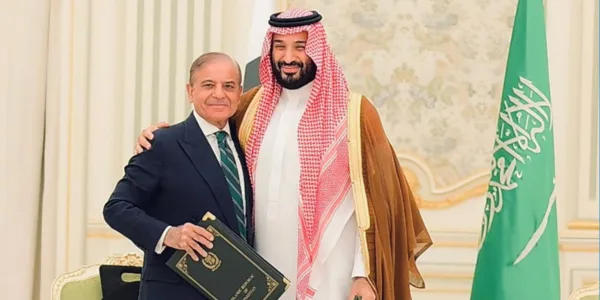
The Pakistan-Saudi Arabia Defence Pact 2025 marks a historic shift in Middle East geopolitics. Explore how this alliance reshapes nuclear deterrence, challenges U.S. influence, and creates new strategic dilemmas for India.
In a landmark development that could reshape power equations across South Asia and the Middle East, Pakistan and Saudi Arabia signed the Pakistan-Saudi Arabia Defence Pact 2025 on September 17, during Prime Minister Shehbaz Sharif’s high-profile visit to Riyadh. The Strategic Mutual Defence Agreement commits both nations to treat aggression against one as an attack on the other, escalating their long-standing security cooperation into a binding treaty.
This Pakistan-Saudi Arabia Defence Pact 2025 comes at a tense moment—days after Israel’s airstrike on Hamas leaders in Qatar—and could have far-reaching implications for nuclear deterrence, regional energy security, and U.S. influence in the Gulf. India’s cautious response underscores the delicate balancing act New Delhi faces in this evolving geopolitical landscape.
MUST READ: NATO Explained: What It Is, How It Works-and the NATO Budget, Bases & Membership Criteria
The Signing Ceremony: A Symbol of Strategic Brotherhood
The agreement was signed at Riyadh’s Al-Yamamah Palace, where Prime Minister Sharif was hosted by Crown Prince Mohammed bin Salman (MBS). A joint statement emphasized the pact’s goal to “develop aspects of defines cooperation and strengthen joint deterrence against any aggression.”
Key Provisions of the Pakistan-Saudi Arabia Defence Pact 2025
- Mutual Defence Clause: Any attack on one nation will be considered an attack on both.
- Joint Military Initiatives: Expansion of training programs, intelligence sharing, and possible co-production of advanced weaponry.
- Economic Integration: Saudi investments in Pakistan’s struggling economy tied to security cooperation.
Sharif described the deal as a “new era of strategic brotherhood,” while MBS called it a “pillar of regional stability.”
MUST READ: BRICS and SCO 2025: How Emerging Alliances Are Reshaping Global Power
Historical Context: From Informal Cooperation to Formal Pact
The Pakistan-Saudi Arabia Defence Pact 2025 formalizes decades of collaboration. Pakistan has long provided military training to Saudi forces and deployed troops in Gulf crises. Speculation about a nuclear “umbrella” has surrounded the partnership since the 1980s.
Recent catalysts driving the pact include:
- U.S.-Saudi Rift: Stalled defence treaty talks with Washington.
- Regional Flashpoints: Israel’s September 9 Doha strike intensified Gulf anxieties.
- Pakistan’s Economic Needs: Financial dependence on Gulf patronage.
Geopolitical Ramifications: A New Power Bloc?
Nuclear Deterrence and Regional Arms Race
Though the pact avoids explicit mention of nuclear weapons, the Pakistan-Saudi Arabia Defence Pact 2025 is seen by analysts as giving Riyadh indirect access to Pakistan’s deterrence capabilities. This could trigger an arms race involving Iran, Turkey, and Egypt.
U.S. Hegemony Challenged
The agreement undermines Washington’s monopoly as Riyadh’s security guarantor. With Saudi Arabia tilting toward China and Pakistan, the U.S. risks losing leverage in OPEC+ and Gulf diplomacy.
Iran and Proxy Wars
Tehran is likely to escalate proxy activity in Yemen, Syria, and even Balochistan. The pact could also encourage a broader alignment of states such as Turkey and Qatar around Riyadh and Islamabad.
India’s Strategic Dilemma: Balancing Security and Economy
For India, the Pakistan-Saudi Arabia Defence Pact 2025 presents a strategic challenge.
- Security Risks: Pakistan may feel emboldened in Kashmir and maritime disputes, with India wary of an extended “nuclear shadow” over the Arabian Sea.
- Economic Stakes: With 8 million Indian workers in the Gulf sending home over $100 billion annually, and Saudi Arabia as India’s top oil supplier, instability could affect vital economic links.
- Diplomatic Calculations: India has responded cautiously, with the MEA stating it will “study the implications.” New Delhi is also deepening engagements with the U.S., Israel, and UAE to balance this emerging axis.
Israel and the Abraham Accords Under Strain
The Pakistan-Saudi Arabia Defence Pact 2025 complicates Saudi-Israeli normalization efforts. Pakistan’s pro-Palestinian stance aligns with Riyadh’s critics of Israel, potentially derailing U.S. mediation under the Abraham Accords framework.
Future Outlook: Stabilizer or Flashpoint?
The Pakistan-Saudi Arabia Defence Pact 2025 has the potential to either stabilize or destabilize the Middle East. Supporters see it as a bulwark against external aggression and a safeguard for global energy flows. Critics warn of nuclear competition, proxy wars, and a declining U.S. role in the Gulf.
For Pakistan, the pact offers military credibility and economic relief. For Saudi Arabia, it diversifies defence partnerships beyond the U.S. For India, it signals the need to reinforce Gulf ties while securing its broader strategic interests.
The coming months will determine whether this historic pact cements a new regional order—or sparks fresh conflicts across an already volatile landscape.