
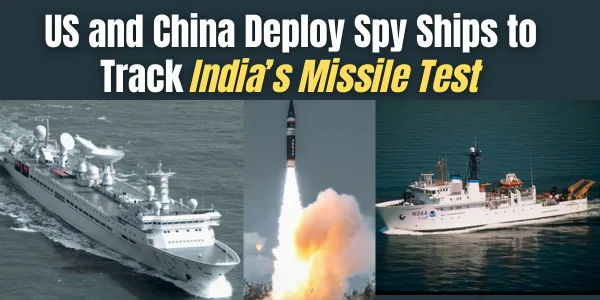
India Missile Test draws US and China surveillance ships to the Indian Ocean, signalling rising Indo-Pacific tensions and strategic competition.
New Delhi | October 14, 2025 | The Interview Times— In a rare and significant development underscoring escalating strategic competition in the Indian Ocean, both the United States and China have deployed advanced surveillance ships near the India Missile Test zone, coinciding with India’s upcoming long-range missile launch scheduled between October 15 and 17, 2025. The move highlights how the India’s Missile Test is drawing global scrutiny amid shifting geopolitical alignments in the Indo-Pacific.
US and Chinese Surveillance Ships Shadow India Missile Test Zone
The U.S. Navy’s Ocean Titan, a repurposed Stalwart-class reconnaissance vessel, has been spotted near the Maldives capital, Male, off India’s western coast. Originally commissioned in 1989, the 68-meter Ocean Titan now serves as a modern intelligence-gathering ship, reportedly positioned to observe telemetry and radar signals associated with the India’s Missile Test.
Meanwhile, China’s Yuan Wang-5 missile tracking ship, operated by the People’s Liberation Army Strategic Support Force (PLASSF), has entered the Indian Ocean Region (IOR) after departing Port Klang, Malaysia. The Yuan Wang-5, known for its large parabolic radar dishes and advanced telemetry technology, is equipped to monitor long-range missile launches such as the India Missile Test, with detection capabilities exceeding 3,000 kilometers.
India Missile Test Expands in Range and Complexity
On October 6, India issued a Notice to Airmen (NOTAM) over the Bay of Bengal, designating a missile test zone of 1,480 km. Within three days, this restricted area was expanded twice — first to 2,520 km, and then to 3,550 km — signaling a significant enhancement in test parameters.
Defense experts suggest that the India’s Missile Test may involve an advanced Agni-series intercontinental ballistic missile (ICBM) equipped with Multiple Independently Targetable Re-entry Vehicle (MIRV) technology. While the 3,550 km range is below the Agni-V’s full 5,000 km capacity, the India Missile Test could be validating new guidance systems or MIRV payload configurations following the “Mission Divyastra” success in March 2024.
Geopolitical Stakes of the Indias’s Missile Test
The concurrent presence of U.S. and Chinese surveillance ships near the India Missile Test zone underscores the Indian Ocean’s emergence as a strategic battleground among major powers.
The U.S. deployment comes amid renewed diplomatic engagement with Pakistan under the Trump administration, which has subtly altered the regional security balance. For Beijing, the redeployment of Yuan Wang-5 signifies China’s intent to closely monitor India’s missile program and maintain a strong intelligence presence in the region.
The Missile Test therefore becomes not just a technological event but a symbol of strategic signaling, where intelligence dominance and electronic surveillance now rival naval firepower as determinants of power projection.
Strategic and Security Implications for the Indo-Pacific
As India prepares for the India Missile Test, the simultaneous arrival of U.S. and Chinese spy ships in the Indian Ocean amplifies international attention on India’s defense modernization. Analysts note that the test represents more than a routine validation — it’s a reflection of India’s growing deterrence capability and global stature.
The India Missile Test also highlights how the Indian Ocean has evolved from a trade corridor into a strategic intelligence frontier, where missile tracking, satellite surveillance, and data interception shape the future of Indo-Pacific geopolitics.
Must Read: What Is the Difference Between a Ballistic Missile and a Cruise Missile?
Conclusion
The India Missile Test has already succeeded in drawing the attention of two global superpowers. As the launch window opens this week, the watchful presence of U.S. and Chinese surveillance ships signals that India’s defense advancements now reverberate far beyond South Asia.
This unfolding scenario underscores how the India Missile Test is not just a moment of national defense assertion but a defining episode in the broader contest for dominance across the Indo-Pacific region.