
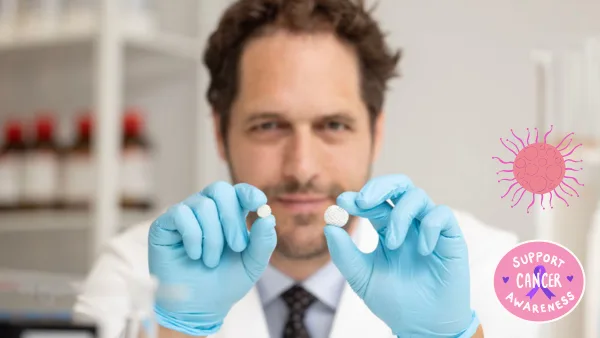
Enzian Pharmaceutics has developed innovative cancer drug delivery tablets that release medication steadily, improving safety and treatment effectiveness.
A Breakthrough in Oral Cancer Treatment
A startup called Enzian Pharmaceutics, co-founded by MIT researchers Aron Blaesi, PhD ’14, and Nannaji Saka, ScD ’74, has developed revolutionary cancer drug delivery tablets that release medication gradually instead of all at once. This innovation could transform how cancer patients take oral medications by making them more effective and reducing side effects.
Most oral cancer drugs dissolve quickly in the stomach, causing a sudden spike in drug concentration in the blood. This not only leads to harmful side effects but also reduces effectiveness as levels drop sharply before the next dose. Enzian’s tablets solve this by maintaining a steady release of the drug over time.
Must Read: UMass Amherst Unveils Super Cancer Vaccine That Stops Tumor Spread
How Enzian’s Cancer Drug Delivery Tablets Work
The company’s cancer drug delivery tablets use tiny 3D-printed fibers that turn into a gel-like structure when exposed to gastric fluid. These fibers form a grid that traps the drug inside and release it slowly as the gel erodes naturally within the stomach.
Animal studies have shown that these tablets can stay in the stomach for 12 to 24 hours, providing consistent dosage and minimizing drug spikes that typically occur after ingestion.
“By taking out that peak and increasing the time the drug is released, we could improve the effectiveness of treatments and mitigate side effects,” says Blaesi.
From MIT Lab to Clinical Trials
The idea began when Blaesi, while pursuing his PhD in mechanical engineering at MIT, worked on alternative drug manufacturing techniques. Instead of compacting powder into pills, he explored injection molding and 3D printing to better control the microstructure of tablets.
He discovered that denser, injection-molded pills dissolved more slowly — leading to the insight that controlling microstructure could regulate drug release. With Dr. Saka’s mentorship, the pair began experimenting with fibrous 3D-printed tablets.
During the COVID-19 pandemic, Blaesi returned to Switzerland and conducted animal trials to test his new formulations. The results proved that with the right design, the tablets could stay in the stomach much longer than conventional pills.
Why Cancer Drugs Are a Perfect Fit
Many cancer drugs are only soluble in acidic conditions, meaning they are best absorbed while still in the stomach. However, normal stomach retention lasts only 30–40 minutes on an empty stomach and a few hours after meals.
This short window forces existing drugs to deliver high doses quickly, resulting in spikes that can be up to 50 times higher than optimal levels. Enzian’s cancer drug delivery tablets solve this by keeping the drug in the stomach longer, enabling steady absorption.
Must Read: Russia Cancer Vaccine Enteromix Shows 100% Efficacy in Early Trials: Breakthrough or Bold Claim?
Smart Cancer Drug Delivery Tablets: Human Trials and Future Potential
Enzian Pharmaceutics is now conducting initial trials in healthy volunteers to confirm that the tablets remain in place safely. Within a year, they plan to test their prostate cancer drug formulation, aiming to reduce daily doses from several hundred milligrams to just a fraction of that amount — without sacrificing therapeutic effect.
The startup also plans to explore its technology for blood, skin, and breast cancers, potentially offering a universal platform for controlled oral cancer therapy.
“This could really be used to improve treatment for a variety of cancers,” Blaesi says. “We believe this is a more efficient and effective way to deliver drugs.”
Smart Cancer Drug Delivery Tablets: A Decade-Long Vision Becomes Reality
What began as an academic experiment at MIT has evolved into a promising medical innovation. Enzian’s cancer drug delivery tablets not only improve patient safety and convenience but also hold the potential to make clinical trials more reliable by reducing drug-related adverse events.
With a combination of engineering precision and pharmaceutical insight, Enzian aims to redefine how cancer therapies are administered — marking a significant leap toward personalized, controlled drug delivery systems.
“The opportunity is enormous,” Blaesi concludes. “So many oral cancer drugs have this delivery problem. We expect this to be a game changer.”