
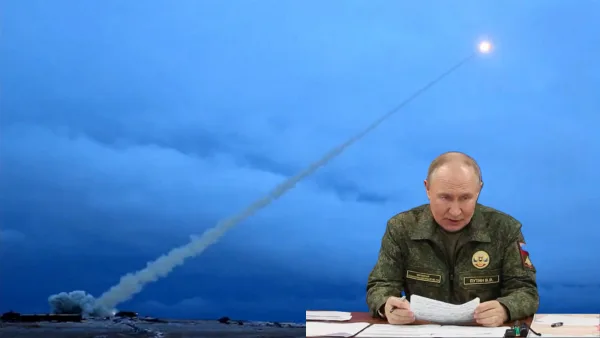
Russia successfully tests the nuclear-powered Burevestnik Cruise Missile, a strategic weapon with unlimited range and advanced evasion capabilities, Putin announces.
TheInterviewTimes.com | Moscow | October 27, 2025 — Russian President Vladimir Putin announced that Russia has successfully conducted a flight development test of the Burevestnik Cruise Missile, a nuclear-powered strategic weapon that the Kremlin claims can fly indefinitely and evade all existing missile defence systems.
Kremlin Confirms Burevestnik Cruise Missile Test
During a televised briefing at the Kremlin, Chief of the General Staff Gen. Valery Gerasimov informed President Putin that the Burevestnik Cruise Missile completed a long-duration test flight on October 21, 2025.
According to the official Kremlin transcript and video released on Sunday, the nuclear-powered missile flew approximately 14,000 kilometres over 15 hours, though officials stated this was “not the maximum distance.”
“On October 21, a successful test launch of the Burevestnik intercontinental-range cruise missile with a nuclear propulsion system was carried out,” said Gen. Gerasimov. “The missile flew about 14,000 kilometres and remained airborne for about 15 hours.”
⚡️ President #Putin:
— MFA Russia 🇷🇺 (@mfa_russia) October 26, 2025
I would ask the Chief of the General Staff to report on #Burevestnik nuclear-powered unlimited-range missile – a unique weapon that no other country has
Substantial work has to be done in order to place this weapon on combat dutyhttps://t.co/cOO4KREYlm pic.twitter.com/jcADAtVBDh
Putin Calls Burevestnik a ‘Unique Creation’
President Vladimir Putin congratulated Russia’s scientific and defence teams, directing the Ministry of Defence to prepare the infrastructure required for the missile’s operational deployment.
“The work on the Burevestnik Cruise Missile has been completed in full,” Putin stated. “It is a unique creation with unlimited range, an unpredictable flight path, and the ability to bypass all existing and future missile defense systems.”
The Kremlin also released an official video showing Putin and Gerasimov examining diagrams of the missile’s flight path. The Russian leader emphasized that the missile strengthens the country’s nuclear deterrent capability.
Burevestnik: Russia’s Nuclear-Powered Strategic Weapon
Known by its NATO codename SSC-X-9 Skyfall, the Burevestnik Cruise Missile was first revealed by Putin in his March 1, 2018 address to the Federal Assembly. It was introduced as part of a new class of Russian strategic weapons aimed at countering U.S. missile defence systems, particularly after Washington’s 2002 withdrawal from the Anti-Ballistic Missile (ABM) Treaty.
The Burevestnik Cruise Missile reportedly uses a compact nuclear reactor to power a ramjet engine, allowing for virtually unlimited range and endurance. It can fly at extremely low altitudes (50–100 metres), follow non-ballistic trajectories, and loiter over potential targets before striking with precision.
Must Read: What Are Hypersonic Glide Vehicles, and How Do They Differ from Traditional Ballistic Missiles?
Past Setbacks and Controversy
The missile’s development, however, has faced significant technical and safety challenges. A 2019 explosion at the Nyonoksa test range in northern Russia killed seven personnel and caused a temporary spike in local radiation levels. Moscow later confirmed that the incident was linked to a nuclear-powered missile test, widely believed to involve the Burevestnik.
Despite those setbacks, the Kremlin now claims the program’s flight development phase has been successfully completed. Independent verification of the October 21 launch or flight data has not yet been provided.
Must Read: Japan’s Historic Type-88 Missile Test Marks First on Hokkaido Soil
Strategic Context and Global Reaction
The test announcement comes amid ongoing large-scale nuclear exercises by Russia’s strategic forces and heightened tensions with Ukraine. It also follows a missile strike in Kyiv on October 25, which killed at least two civilians.
As of Sunday evening, no official response had been issued by the United States, NATO, or the European Union regarding Russia’s successful Burevestnik Cruise Missile test.
A New Era of Nuclear-Powered Weapons
Military analysts suggest that if the Burevestnik Cruise Missile becomes fully operational, it could significantly alter global strategic stability by introducing a missile with theoretically unlimited reach and persistent flight capabilities.
However, concerns remain about the environmental and safety implications of deploying a nuclear-powered weapon system in peacetime conditions.