
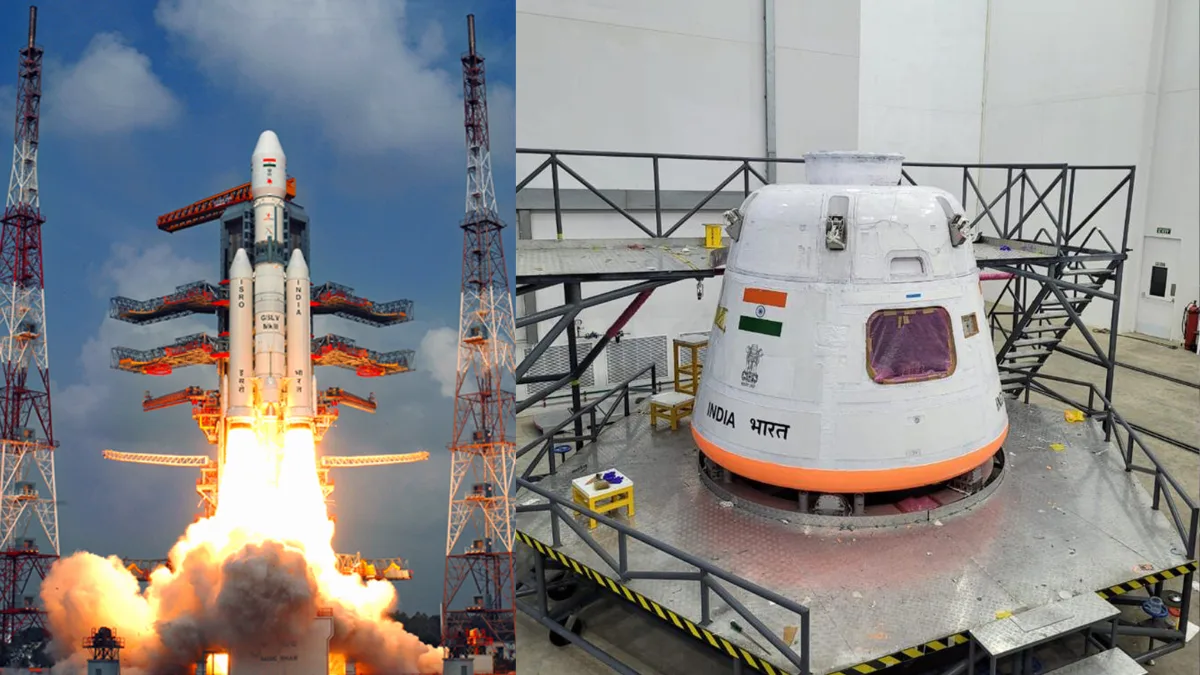
India is preparing for a landmark moment as ISRO gears up to launch the first uncrewed Gaganyaan mission in December 2025. The G1 mission will test critical technologies for India’s future human spaceflight program, carrying half-humanoid Vyommitra. The mission sets the stage for India’s first crewed spaceflight in 2027 and strengthens the nation’s expanding space ambitions.
ISRO Confirms December Launch for Uncrewed Gaganyaan Mission, Marks Key Human Spaceflight
TheInterviewTimes.com | November 20, 2025: India is preparing for a major breakthrough in human spaceflight as the Indian Space Research Organisation (ISRO) confirms the launch window for its first uncrewed Gaganyaan mission in December 2025. The mission, officially named Gaganyaan-1 or G1, marks the most crucial step toward sending Indian astronauts into space aboard an indigenously developed spacecraft.
ISRO Chairman V Narayanan stated that more than 80,000 system and subsystem tests have been completed, confirming mission readiness. The final launch date will be decided in coordination with the Prime Minister’s Office, with the earliest window opening in the first week of December.
Must Read: Nvidia Earnings Surge as AI Demand Soars, But Market Split Over Bubble Risks
Vyommitra to Lead Critical In-Flight Testing
A key highlight of the G1 mission is Vyommitra, the half-humanoid robot designed to mimic human physiology and behavior in microgravity. Vyommitra will monitor life support systems, avionics, navigation, thermal controls, and communication parameters, ensuring all systems function safely for future astronauts.
The successful G1 launch will validate technologies including the crew module, service module, emergency escape system, and re-entry procedures—forming the backbone of India’s human spaceflight strategy.
Must Read: Russia’s Su-57E Offer Unveiled with Full Technology Transfer for India
Crewed Mission Scheduled for 2027
G1’s success will directly pave the way for India’s first crewed Gaganyaan mission, tentatively scheduled for the first quarter of 2027. Three Indian astronauts are expected to spend up to seven days in low Earth orbit, making India the fourth nation with independent human spaceflight capability after the US, Russia, and China.
Must Read: Historic Birth at Kuno: Indian-Born Cheetah Mukhi Delivers 5 Cubs
ISRO Expands Long-Term Space Vision
Beyond the Gaganyaan mission, ISRO has outlined an ambitious roadmap for the next decade. Key missions include:
- Chandrayaan-4 (2027) – India’s first lunar sample-return mission.
- Bharatiya Antriksh Station – First module planned for 2028, full operations by 2035.
- Venus Orbiter (2028) – A landmark scientific mission to study Venusian atmosphere and geology.
- Mars Lander (2030) – Next step after Mangalyaan, pending government approval.
These missions underline India’s push toward advanced planetary science, space infrastructure, and long-term deep-space exploration.
Growing India’s Share of the Global Space Economy
ISRO aims to expand India’s space economy from its current 2% share (valued at $8.4 billion) to 8% by 2035, potentially reaching $49 billion. To achieve this, ISRO plans to triple satellite production and increase annual launch capacity from 12–18 launches to nearly 50 within five years.
This accelerated growth aligns with national goals to position India as a global hub for satellite manufacturing, commercial launches, and space-based services.
Must Read: Elon Musk Returns to White House as Ties with Trump Warm After Months of Public Feud
Key Takeaways
- India will launch the first uncrewed Gaganyaan mission (G1) in December 2025.
- Vyommitra, a half-humanoid robot, will test critical systems during the mission.
- The first crewed Gaganyaan mission is planned for early 2027.
- ISRO is simultaneously preparing major missions, including Chandrayaan-4, a Venus orbiter, and the Bharatiya Antriksh Station.
- India targets an 8% share of the global space market by 2035 through expanded launch and production capabilities.