
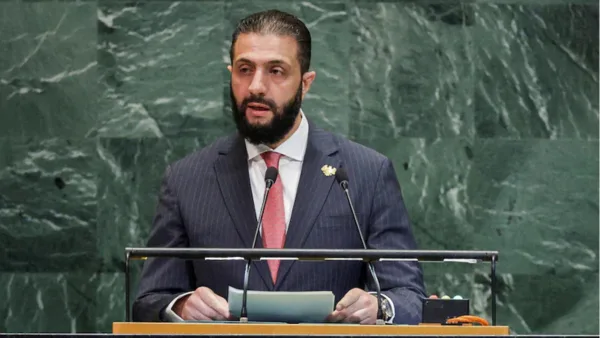
Ahmed al-Sharaa: From Jihadist Commander to Syrian President Recognized by the United States
Ahmed al-Sharaa, once a militant commander, is now Syria’s president cleared from the U.S. terrorism blacklist, marking a turning point in global diplomacy.
TheInterviewTimes.com | New Delhi | November 8, 2025 — Ahmed al-Sharaa, once known as Abu Mohammad al-Julani, represents one of the most remarkable political transformations in modern Middle Eastern history.
Born in 1982 in Riyadh to a middle-class Syrian Sunni family from the Israeli-occupied Golan Heights, Ahmed al-Sharaa grew up amid narratives of displacement and defiance. His family’s eventual return to Damascus in 1989 exposed him to an environment steeped in religious faith and political awareness — forces that would later define both his militant and political journeys.
The origins of Ahmed al-Sharaa’s worldview can be traced to his family’s displacement and his exposure to the Palestinian struggle. The Second Intifada and the U.S. invasion of Iraq became formative experiences for the young al-Sharaa. Drawn toward radical ideologies, he joined jihadist movements and fought against U.S. forces in Iraq after 2003. Captured in 2006 by American troops, he spent five years in detention before being released in 2011, just as the Syrian civil war erupted.
Ahmed al-Sharaa and the Rise of Al-Nusra Front
Upon release, Ahmed al-Sharaa quickly rose to prominence as a leading militant strategist. In 2012, he founded the al-Nusra Front, al-Qaeda’s Syrian branch, and later spearheaded Hay’at Tahrir al-Sham (HTS)—the dominant rebel coalition controlling northwestern Syria’s Idlib Governorate. His rule through the Syrian Salvation Government blended governance and military control, earning him both support and criticism. While some saw him as a stabilizing figure amid chaos, others accused him of authoritarian methods and harsh governance.
Despite this, Ahmed al-Sharaa demonstrated a calculated pragmatism, navigating rival factions and shifting alliances while maintaining control over Idlib. His ability to balance militant command with administrative authority set the foundation for his eventual transformation from a rebel leader to a political head of state.
Must Read: North Korea Warns of ‘More Offensive Action’ as U.S. Nuclear Carrier Docks in South Korea
The Turning Point: Ahmed al-Sharaa’s Rise to Power
In December 2024, Ahmed al-Sharaa orchestrated a rapid offensive that ended Syria’s prolonged civil war and dismantled over six decades of Assad family rule. Bashar al-Assad fled to Russia, marking the end of one of the Middle East’s longest-standing dynasties.
In January 2025, al-Sharaa was sworn in as Syria’s president — a moment that redefined both the nation’s internal politics and its relationship with the global community.
His presidency has since focused on stabilizing post-war Syria, combating extremist remnants, and initiating limited reconstruction projects. Under his administration, reports suggest moderate progress in curbing corruption and restoring civil governance — though challenges remain immense.
U.S. Removes Ahmed al-Sharaa from Terrorism Blacklist
In November 2025, the United States officially removed Ahmed al-Sharaa from its terrorism sanctions list, a decision aligned with a new United Nations Security Council resolution recognizing Syria’s advances in counterterrorism and disarmament. The move paved the way for his historic visit to Washington — the first ever by a Syrian president to the White House.
Analysts view this diplomatic milestone as a strategic recalibration by the U.S. and its allies, acknowledging Syria’s evolving role in regional stability. For Ahmed al-Sharaa, the delisting marks a symbolic redemption — a transition from being one of the world’s most wanted men to a globally recognized statesman.
Ahmed al-Sharaa’s Challenges Ahead
Despite his newfound legitimacy, Ahmed al-Sharaa faces towering challenges. Rebuilding a war-torn nation, reuniting fractured communities, and legitimizing his leadership domestically remain complex tasks. Internationally, he must convince skeptics that his evolution is genuine and that Syria can transform from a pariah state into a responsible member of the global order.
Observers argue that al-Sharaa’s survival and success depend on sustaining stability, respecting human rights, and maintaining cooperation with global powers. His leadership will be tested by the competing expectations of war-weary Syrians and an international community watching closely.
Must Read: Ahmed al-Sharaa Removed from US Terrorism Blacklist Ahead of Historic Washington Visit
Conclusion: Ahmed al-Sharaa and the Future of Syria
The story of Ahmed al-Sharaa is a mirror to Syria’s turbulent modern history — from revolution and radicalization to governance and diplomacy. His journey from militant commander to president underscores both personal reinvention and the geopolitical shifts surrounding the Middle East. Whether his rule ushers in genuine peace or a rebranded form of authoritarianism will define not just his legacy but Syria’s place in the 21st-century world.