
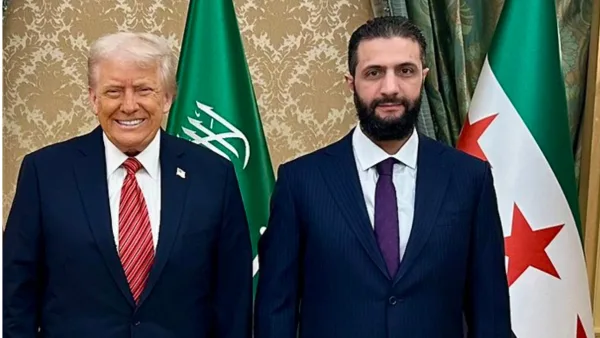
The US removes Syrian President Ahmed al-Sharaa from its terrorism blacklist, signaling a major diplomatic shift before his landmark Washington visit.
Key Points
- Ahmed al-Sharaa removed from the US terrorism sanctions list ahead of Washington visit.
- UN Security Council also lifts sanctions, recognizing Syria’s political transformation.
- Marks the first-ever meeting between a Syrian leader and US president in Washington.
- US credits al-Sharaa’s government for cooperation on security, anti-terror, and narcotics.
- Move signals a major geopolitical realignment and Syria’s reintegration into global diplomacy.
US Removes Syrian President Ahmed al-Sharaa from Terrorism Blacklist
TheInterviewTimes.com | Washington | November 8, 2025 —, In a historic diplomatic shift, the United States has officially removed Syrian President Ahmed al-Sharaa from its terrorism blacklist, paving the way for his landmark visit to Washington next week. The decision marks the first time a Syrian head of state will meet a US president on American soil — a dramatic turnaround in US-Syria relations.
The US Treasury Department confirmed the delisting of Ahmed al-Sharaa, previously designated under Executive Order 13224 as a Specially Designated Global Terrorist. Syrian Interior Minister Anas Khattab was also removed from the list. The move follows a UN Security Council vote on Thursday, which lifted corresponding UN sanctions on both officials with a 14-0 vote (China abstaining).
The coordinated US-UN action removes years of travel and financial restrictions and recognizes the political and institutional progress made by Syria since the ouster of former President Bashar al-Assad in December 2024.
Must Read: North Korea Warns of ‘More Offensive Action’ as U.S. Nuclear Carrier Docks in South Korea
Ahmed al-Sharaa and the New Syrian Transition
State Department spokesman Tommy Pigott said the US decision “acknowledges the progress achieved under Ahmed al-Sharaa’s leadership following the departure of Bashar al-Assad and decades of repression.”
According to Pigott, Ahmed al-Sharaa’s government has worked closely with Washington on key issues such as locating missing American citizens, counterterrorism, counter-narcotics cooperation, and dismantling chemical weapon stockpiles. “The new Syrian administration is demonstrating serious intent to restore stability and integrate into the international system,” he said.
US Ambassador to the United Nations Mike Waltz described the Security Council resolution as a “strong political signal recognizing Syria’s transformation and commitment to peace.”
From Jihadist Commander to National Leader
The story of Ahmed al-Sharaa reflects one of the most extraordinary political transformations in modern Middle Eastern history. Once a wanted jihadist leader with a $10 million US bounty, al-Sharaa commanded Hayat Tahrir al-Sham (HTS), a powerful Islamist faction with past ties to al-Qaeda.
He fought US forces in Iraq, was captured, and spent five years in American custody before returning to Syria in 2011. There, he founded the al-Nusra Front, the Syrian branch of al-Qaeda, and led rebel forces against the Assad regime.
In December 2024, Ahmed al-Sharaa led a broad coalition of opposition groups in a final offensive that toppled Assad’s government after more than 13 years of civil war. Assad fled to Russia, ending over six decades of the Assad family’s rule. Al-Sharaa assumed the presidency of a transitional national unity government, pledging to build democratic institutions and restore international relations.
Analysts now describe him as a “pragmatic radical” — a former insurgent turned statesman. He has renounced global jihad, emphasized religious tolerance, and invited minorities into his administration. His government’s engagement with the US and Western allies aims to rebuild Syria’s economy and seek membership in the US-led coalition against ISIS.
Must Read: U.S. Army to Buy 1 Million Drones: Massive Drone Surge Redefines Modern Warfare
Diplomatic and Economic Implications
The removal of Ahmed al-Sharaa from the terrorism list is expected to accelerate Syria’s reintegration into the international community. It opens the door to trade, reconstruction funding, and normalization with neighboring countries, including Jordan, Lebanon, and potentially Israel.
In Washington, Congressional leaders have shown cautious optimism, discussing potential repeal of remaining Caesar-era sanctions to help modernize Syria’s war-torn economy. The upcoming White House meeting on November 10 will focus on rebuilding Syria’s institutions, improving regional security, and laying the foundation for peace.
President Donald Trump, who first met Ahmed al-Sharaa in Riyadh in May 2025, is expected to welcome him as part of a broader effort to reshape Middle East diplomacy and reward nations moving away from extremism.
Experts see the move as a calculated step — signaling that the US is willing to engage with former adversaries when they demonstrate credible reform and cooperation. The delisting of al-Sharaa, once considered one of America’s most dangerous enemies, now represents a symbolic end to two decades of hostility between Washington and Damascus.
A New Chapter for US-Syria Relations
As Ahmed al-Sharaa prepares for his Washington visit, diplomats across the region view the event as a turning point in Middle Eastern geopolitics. After years of isolation, Syria may now begin its long road to reconstruction — with American and international backing.
For millions of Syrians displaced by conflict, this diplomatic thaw could signal hope for recovery, stability, and global re-engagement. The world will be watching closely as Ahmed al-Sharaa steps into the White House — once as an enemy, now as a partner in peace.