

AI leaders at Davos 2026 warn that artificial intelligence could displace millions of white-collar jobs, urging urgent reskilling and policy reforms.
TheInterviewTimes.com, New Delhi | January 21, 2026 09:05 p.m. IST
Key Highlights
- AI leaders at Davos 2026 warned of rapid white collar job displacement.
- Software engineering and entry level roles face early automation risks.
- IMF estimates up to 60 percent of jobs in advanced economies will be affected.
- Business leaders urge urgent reskilling and new policy frameworks.
- Worker anxiety over AI driven layoffs is rising sharply worldwide.
AI Leaders at Davos Sound Alarm on White Collar Job Displacement
Top executives from the global technology and finance sectors gathered at the World Economic Forum in Davos this week with a stark message. Artificial intelligence is no longer a future disruption. It is already reshaping white collar work at a speed many societies are unprepared to handle.
The 2026 Davos meeting opened amid growing concern that automation will hit professional and office based jobs much faster than previously expected.
Leaders compared the moment to the impact globalization had on manufacturing jobs, warning that the consequences could be even broader.

Larry Fink Warns of Concentrated AI Power
BlackRock CEO Larry Fink set the tone during opening sessions on January 19. He stressed that early gains from artificial intelligence are flowing to those who control data, infrastructure, and AI models.
Fink questioned what happens if AI disrupts white collar employment in the same way global trade transformed blue collar labor. He argued that the challenge is not theoretical or decades away. According to him, the disruption is already unfolding and demands immediate action.
Fink called for a rethink of capitalism that allows more people to share in productivity gains rather than watching them accumulate at the top.
The Day After AGI with @DarioAmodei (@AnthropicAI), @demishassabis (@GoogleDeepMind) and @zannymb (@TheEconomist) #WEF26 https://t.co/YEGHzuAXXg
— World Economic Forum (@wef) January 20, 2026
Software Engineering Faces Immediate Risk
Concerns sharpened during a high-profile panel titled “World After AGI,” featuring Anthropic CEO Dario Amodei and Google DeepMind CEO Demis Hassabis.
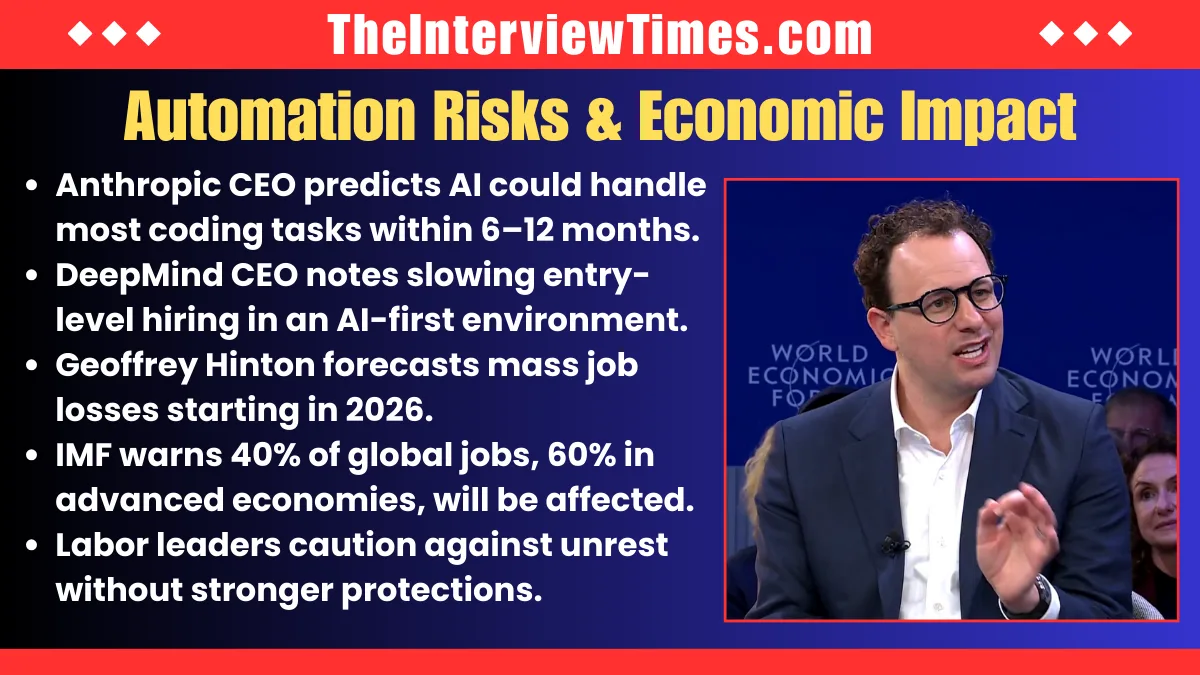
Amodei revealed that engineers at Anthropic increasingly rely on AI to generate code rather than writing it from scratch. Human engineers now focus on editing, testing, and managing outputs. He predicted that within six to twelve months, AI systems could perform most software engineering tasks end to end.
Amodei warned that society may have only one to five years to adapt before the labor market feels full force disruption.
Hassabis echoed the concern, pointing to early signs at the junior level. He said entry level hiring and internships are already slowing as companies reassess workforce needs in an AI first environment.

Broader Economic Risks Highlighted
Warnings extended beyond technology firms. Nobel Prize winner Geoffrey Hinton recently forecasted a wave of job losses starting in 2026, citing AI’s growing ability to manage complex projects lasting months rather than simple tasks.
Labor leaders also voiced alarm. AFL CIO President Liz Shuler cautioned that mass displacement without social protections could provoke widespread unrest. She pointed to large scale automation initiatives at major corporations as a preview of broader workforce changes.
IMF Managing Director Kristalina Georgieva described AI’s labor impact as a tsunami. IMF research indicates that 40 percent of global jobs will be affected by AI, rising to nearly 60 percent in advanced economies. While some roles will be enhanced, many face partial or full replacement.

Surveys Reveal Rising Worker Anxiety
Data presented at Davos reinforced these concerns. A World Economic Forum report estimates AI could displace 92 million jobs globally by 2030. At the same time, 170 million new roles could emerge if reskilling keeps pace.
Employee fears are rising sharply. Surveys show concern about AI related layoffs jumped from 28 percent in 2024 to 40 percent by early 2026. U.S. labor data from 2025 already links AI adoption to more than 55,000 job cuts, including reductions at major technology and retail firms.
PwC’s 2026 Global CEO Survey shows declining confidence among executives, with AI increasingly dividing companies into productivity leaders and laggards.
Calls for Urgent Policy Action
Despite the warnings, leaders stressed that AI does not have to lead to economic collapse. Fink urged policies that expand ownership and opportunity alongside automation.
Hassabis argued that AI tools can act as productivity multipliers if workers are trained to use them effectively. AI researcher Andrew Ng added that most jobs are not fully automatable, but partial automation could widen inequality if skills gaps are ignored.
As Davos continues through January 23, consensus is forming around the need for rapid reskilling, updated labor protections, and fair deployment of AI. Without decisive action, leaders warned that technological progress could fracture economies instead of strengthening them.
Top News: Deepinder Goyal Steps Down as Eternal Group CEO Amid 73 Percent Profit Jump in Q3 FY26
