
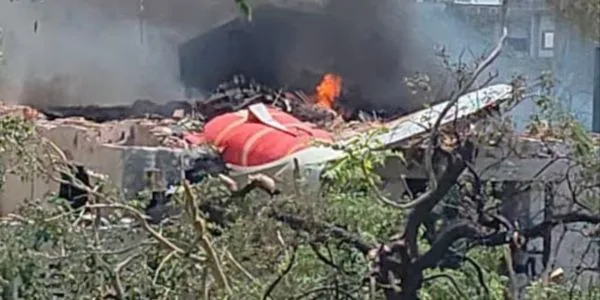
Air India Plane Crash Report: AAIB’s findings on Flight AI171’s fuel cutoff and crash in Ahmedabad. 260 lives lost. Read the full report.
Ahmedabad, India – On June 12, 2025, Air India Flight AI171, a Boeing 787-8 Dreamliner, crashed 32 seconds after takeoff from Ahmedabad’s Sardar Vallabhbhai Patel International Airport, en route to London Gatwick. The Aircraft Accident Investigation Bureau (AAIB) released its Air India Plane Crash Report on July 10, 2025, detailing the tragedy that claimed 260 lives, including 241 of the 242 passengers and crew and 19 people on the ground. A mysterious fuel supply cutoff to both engines three seconds after liftoff was the critical factor.
Key Findings from the Air India Plane Crash Report
The AAIB’s Air India Plane Crash Report outlines the timeline of Flight AI171’s final moments:
- 08:08:39 UTC (1:38 PM IST): The aircraft lifted off from Ahmedabad.
- 08:08:42 UTC: Three seconds later, both engine fuel control switches moved from “RUN” to “CUTOFF” within one second, halting fuel to the GE GEnx-1B engines, causing thrust loss.
- Cockpit Confusion: The cockpit voice recorder (CVR) captured one pilot asking, “Why did you cut off?” with the other responding, “I didn’t,” indicating no intentional switch movement.
- Failed Recovery: 10–14 seconds later, the pilots tried restoring fuel by returning switches to “RUN,” but the engines could not restart in time.
- 08:09:05 UTC: 26 seconds after takeoff, the crew issued a “MAYDAY” call.
- 08:09:11 UTC: 32 seconds after takeoff, the flight data recorder stopped, marking the crash into a medical hostel complex near the airport.

Casualties and Impact
The Air India Plane Crash Report confirms 260 fatalities, one of India’s deadliest aviation disasters. Only one of the 242 people on board survived, with limited details on their condition. On the ground, 19 residents of the medical hostel complex perished. The crash site’s proximity to the airport underscores the rapid sequence of events.
Must Read: UK Firm to Mass-Produce Revolutionary EV Battery That Charges in 18 Seconds
What Caused the Fuel Cutoff?
The AAIB’s Air India Plane Crash Report does not pinpoint the cause of the fuel switch movement but lists possibilities under investigation:
- Pilot Error: The pilots’ dialogue suggests no intentional action. The AAIB is exploring accidental switch movement during takeoff.
- Mechanical/System Failure: A 2018 FAA bulletin noted issues with fuel control switch locking mechanisms on some Boeing aircraft, though its relevance to the 787-8 is unclear. No evidence of fuel contamination, bird strikes, or engine/airframe issues was found.
- Software/Electronic Glitch: Speculation on X suggests a Thrust Control Malfunction Accommodation (TCMA) system issue, but the report does not confirm this.
- External Factors: No evidence supports sabotage theories.
The Ram Air Turbine (RAT) deployed after engine shutdown but could not prevent the crash. The AAIB’s final report will provide further details.
Must Read: Switzerland Ratifies $100 Billion EFTA-India Trade Pact in 2025: A New Era of Economic Partnership
Aviation Safety Implications
The Air India Plane Crash Report raises concerns about the Boeing 787-8 Dreamliner’s safety, though no immediate directives have been issued. Air India grounded its 787 fleet for inspections, and Boeing is assisting the investigation. The report has sparked discussions on pilot training, cockpit design, and automated system reliability.
What Happens Next?
The AAIB will analyze the flight data recorder, CVR, and wreckage to determine the fuel switch issue’s cause. International regulators, including the FAA and EASA, are monitoring developments, which may impact Boeing 787 operations. The Interview Times will provide updates as the investigation progresses.
Conclusion
The Air India Plane Crash Report underscores aviation’s complexities. A fuel supply cutoff three seconds after takeoff led to a catastrophic crash 29 seconds later, claiming 260 lives. As the AAIB continues its investigation, families and the aviation community await answers. Stay updated with The Interview Times.