
New Delhi, January 2, 2026, 5PM IST
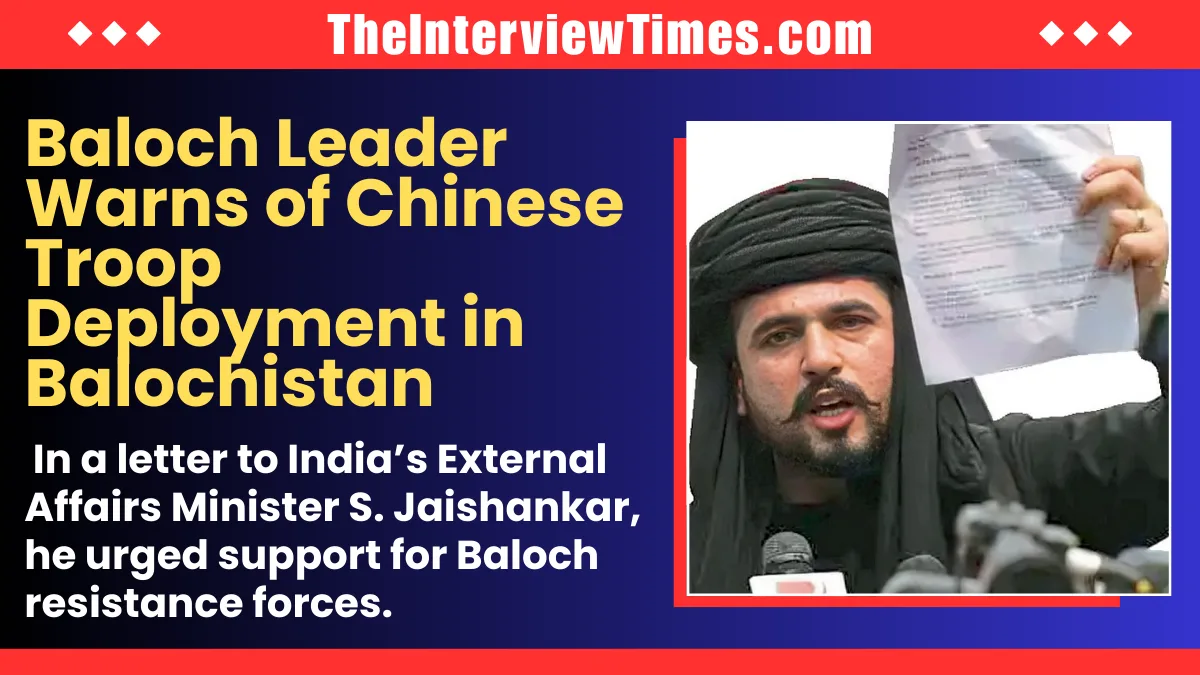
Baloch leader Mir Yar Baloch warns China may soon deploy troops in Pakistan’s Balochistan under CPEC’s final phase, urging India to counter the growing China-Pakistan strategic alliance.
A prominent Baloch nationalist leader has cautioned that China could soon deploy its military personnel in Pakistan’s Balochistan province as part of its deepening involvement in the China-Pakistan Economic Corridor (CPEC), a flagship project under Beijing’s Belt and Road Initiative.
In an open letter addressed to India’s External Affairs Minister S. Jaishankar, Mir Yar Baloch, a representative of the self-styled“Republic of Balochistan,” warned that growing China-Pakistan cooperation in Balochistan has evolved beyond economic interests and could lead to direct military presence. The letter, shared on social media platform X on January 1, 2026, urged New Delhi to support Baloch resistance forces to counter Beijing’s expanding footprint in the region.
Open letter to Honorable Foreign Minister of #Bharat Shri @DrSJaishankar ji
— Mir Yar Baloch (@miryar_baloch) January 1, 2026
From,
Baloch Representative,
Republic of Balochistan
State.
The Honorable Dr. S. Jaishankar,
Minister of External Affairs,
Government of Bharat,
South Block, Raisina Hill,
New Delhi – 110011
January… https://t.co/WdjaACsG2V pic.twitter.com/IOEusbUsOB
Concerns Over CPEC’s Final Phase
According to Mir Yar Baloch, the China-Pakistan Economic Corridor has reached its final construction and operational stages, intensifying security and strategic concerns. He alleged that if local resistance movements are not bolstered soon, Chinese troops may be stationed in Balochistan “within a few months.”
“China’s presence, if formalized militarily, would not only violate Baloch sovereignty but also create grave security challenges for India and the broader South Asian region,” the letter emphasized.
Beijing and Islamabad have consistently denied such allegations, maintaining that CPEC is a purely economic initiative designed to promote trade, infrastructure development, and regional connectivity. India, however, has long objected to the project, arguing that parts of the corridor pass through Pakistan-occupied Jammu and Kashmir, infringing on India’s territorial sovereignty.

Praise for India’s Counter-Terror Operations
In his message, Mir Yar Baloch also applauded India’s recent counter-terror operations, including Operation Sindoor, which targeted terror infrastructure inside Pakistan in May 2025. The strikes followed the deadly April 22 attack in Pahalgam that killed 26 civilians, marking one of India’s most extensive retaliatory operations in recent years.
The Baloch leader described Operation Sindoor as “a decisive step toward regional stability” and called on India to continue efforts against what he termed “state-sponsored militancy and foreign interference.”
Historical and Cultural Connections Highlighted
Emphasizing the long-standing cultural and spiritual ties between India and Balochistan, Mir Yar Baloch pointed to the Hinglaj Mata Temple, located in Balochistan’s Hingol National Park. The temple, part of the 51 Shakti Peethas in Hindu tradition, is considered sacred by Hindus and respected by local Baloch communities, who refer to it as “Nani Mandir.”
The letter described the temple as a “symbol of unity and shared heritage” between the Baloch people and India.
Must Read: Why I Stand for Balochistan’s Independence: A Historical Fight Against Pakistan’s Occupation
No Official Response Yet
As of Friday, there has been no official response from the governments of India, China, or Pakistan regarding the claims made in the letter. Analysts, however, note that such assertions underscore the complex interplay of nationalism, geopolitics, and economic interests shaping South Asia’s evolving security landscape.
