
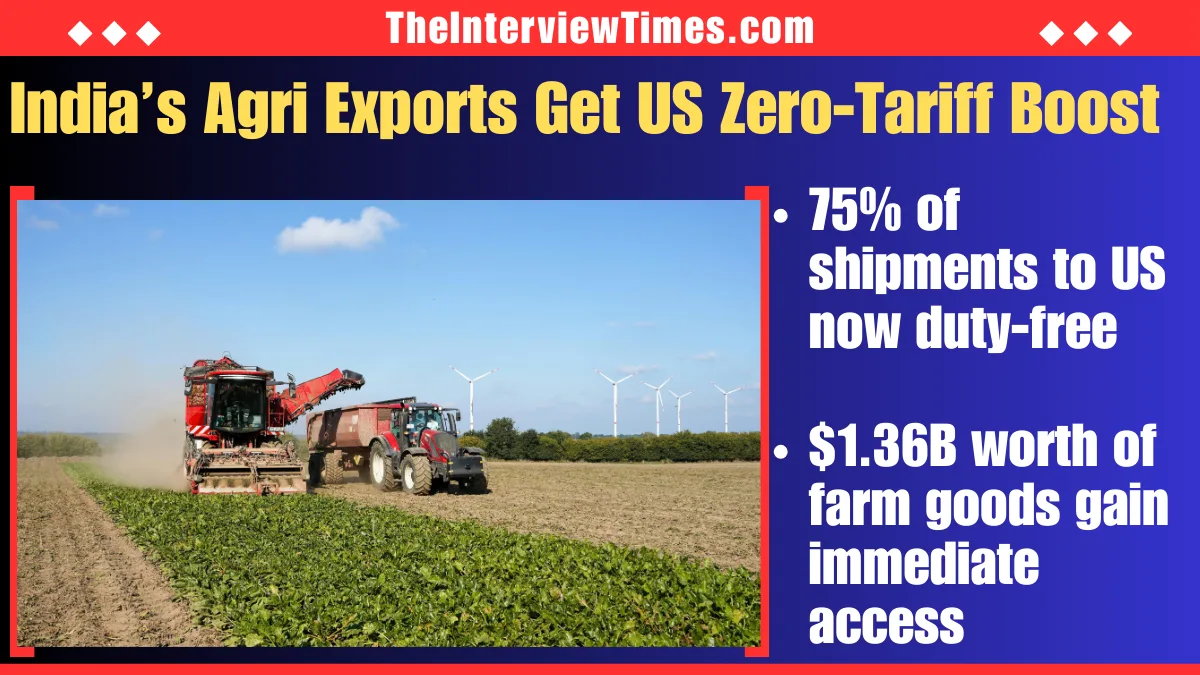
India secures zero-tariff access for 75% of agri exports to the US under a new trade framework, strengthening its $1.3 billion farm trade surplus.
Key Highlights
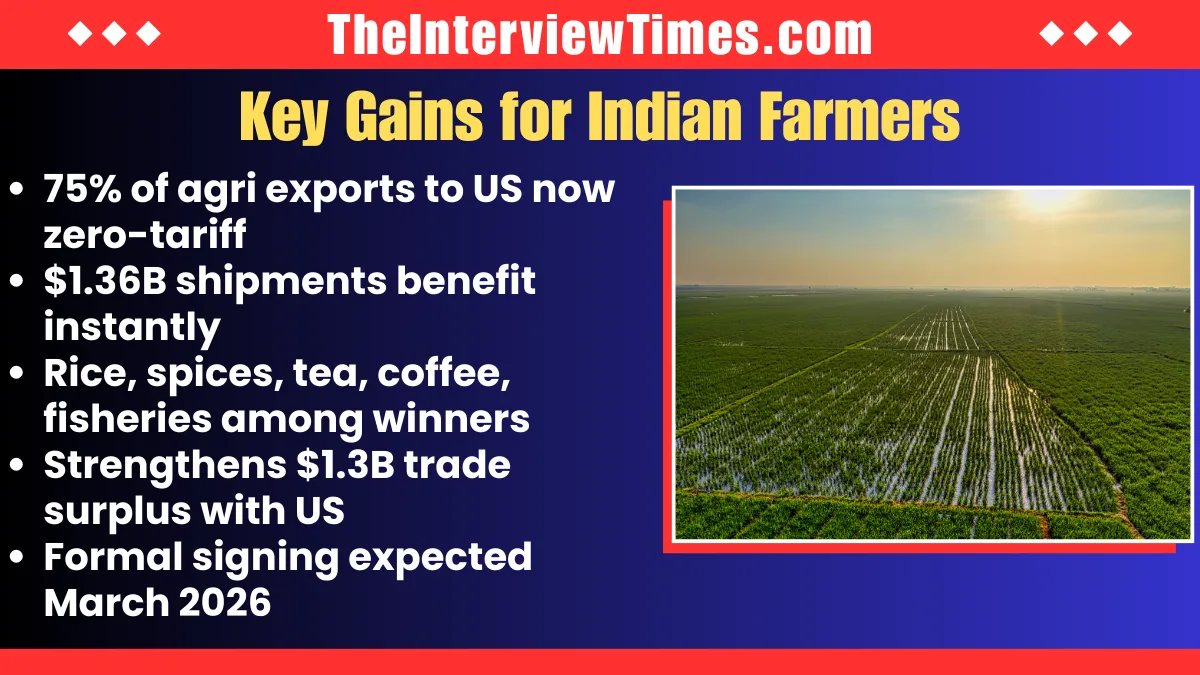
- 75% of India’s agricultural exports to the US now enjoy zero-tariff access
- $1.36 billion worth of agri shipments to benefit immediately
- India continues to hold a $1.3 billion trade surplus in agricultural goods with the United States.
- Rice, spices, fisheries, tea, coffee, and oilseeds among key gainers
- Formal agreement likely to be signed in March 2026
India’s agricultural exports to the United States are set for a major boost after a new interim trade framework granted zero-tariff access to 75 percent of shipments. The development is expected to significantly enhance India’s competitiveness in the US market and strengthen rural incomes.
A detailed research report released on February 12 by State Bank of India Research stated that nearly $1.36 billion worth of agricultural exports will now face no additional US duties. The move reinforces India’s existing $1.3 billion trade surplus in agricultural goods with the United States.
The agreement marks a critical milestone in Indo-US trade relations and could pave the way for broader bilateral economic cooperation.
Origins of the Interim Trade Framework
The interim framework was announced on February 6 following discussions between US President Donald Trump and Indian Prime Minister Narendra Modi.
Under the arrangement:
- US reciprocal tariffs on Indian goods were reduced from as high as 50 percent to 18 percent
- A previous 25 percent penalty tariff on Indian imports was lifted through an executive order
- India agreed to lower duties on certain US industrial and agricultural products
- Sensitive sectors such as wheat, rice, dairy, and poultry remain protected
India also committed to halting purchases of Russian oil, a major US policy demand tied to broader geopolitical considerations.
The formal signing of the agreement is expected in March 2026, opening doors for more comprehensive bilateral trade negotiations.
Key Gains from the SBI Report
According to the SBI analysis:
- $1.035 billion worth of agri exports are explicitly assured zero reciprocal tariff treatment
- Total zero-duty benefit extends to $1.36 billion
- India exports $3.4 billion in agricultural goods to the US annually
- Imports from the US stand at $2.1 billion
The zero-tariff access improves product competitiveness, expands market penetration, and supports scaling up of export volumes.
The report also suggests potential ripple effects across the broader goods trade, estimating that India’s overall exports to the US could eventually rise by up to $100 billion annually across sectors if momentum continues.
Sector-Wise Impact: Who Benefits Most?
Rice
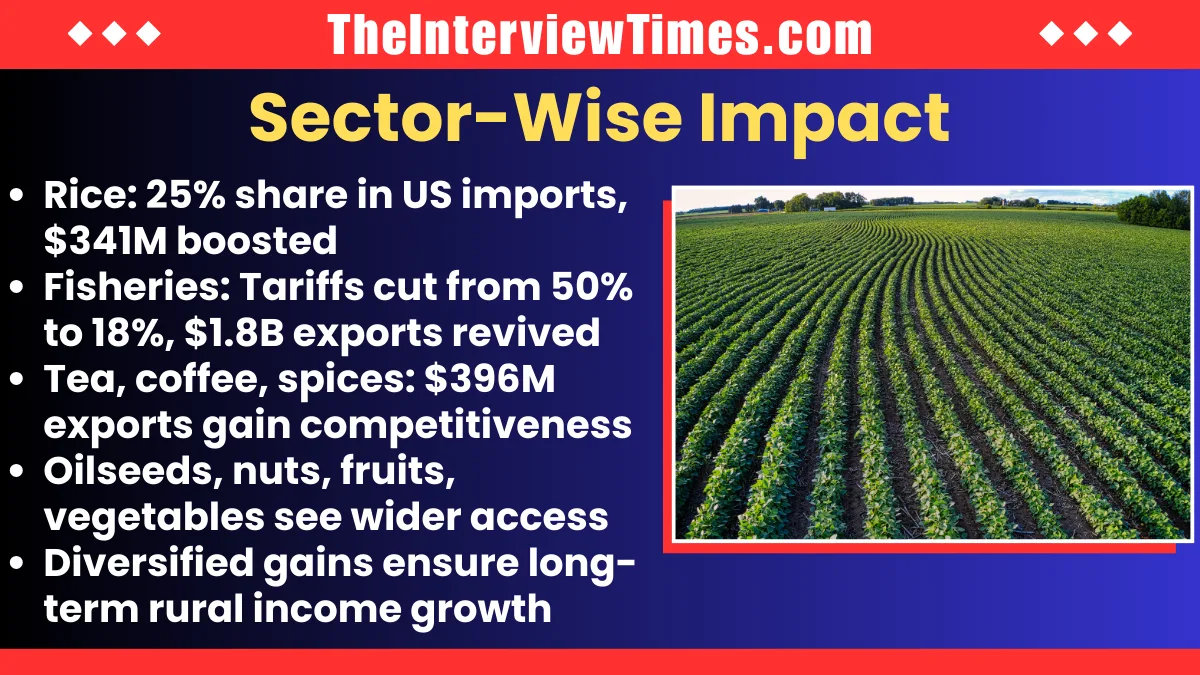
India supplies nearly 25 percent of US rice imports, amounting to $341 million out of $1.378 billion in total US rice imports. With zero additional duty, Indian rice exporters are expected to consolidate their market share.
Tea, Coffee, and Spices
India holds approximately 3 percent share in the US market for tea, coffee, and spices, valued at $396 million out of $14 billion total US imports in this segment. Plantation sectors in Assam, Kerala, and Karnataka could see renewed demand.
Fisheries
One of the biggest beneficiaries is the fisheries sector. Earlier facing tariffs up to 50 percent, Indian seafood exports will now be subject to an 18 percent tariff. India exports around $1.817 billion worth of fisheries products, accounting for roughly 10 percent of total US seafood imports valued at $18.848 billion.
This reduction could significantly revive seafood exports from coastal states like Andhra Pradesh, Gujarat, and Tamil Nadu.
Other Benefiting Products
Additional beneficiaries include:
- Cashews and other nuts
- Fresh fruits and vegetables
- Sesame seeds
- Processed foods such as juices and jams
- Oilseeds and related products
The broader zero-tariff coverage ensures diversification rather than dependence on a single commodity.
Broader Economic Implications
Agriculture remains the backbone of India’s rural economy, supporting millions of farmers and allied workers. Zero-tariff access to the US market provides a stable and high-value destination for Indian farm produce.
The framework balances market access with domestic safeguards. Sensitive commodities such as wheat, dairy, and poultry remain protected from competitive pressures.
Experts believe that if the interim framework evolves into a full bilateral trade agreement, India’s overall trade surplus with the US could cross $90 billion annually in the coming years.
The deal also signals deepening strategic alignment between New Delhi and Washington amid shifting global trade dynamics.
What Happens Next?
With the formal agreement expected in March, trade officials from both sides are likely to begin negotiations on:
- Expanding zero-tariff categories
- Addressing non-tariff barriers
- Strengthening supply chain cooperation
- Facilitating logistics and compliance standards
If implemented effectively, the framework could mark one of the most significant boosts to Indian agricultural exports in recent years.
Top News: Rolls-Royce India Expansion: Fighter Jet Engine Offer, 10,000 Jobs Boost
