
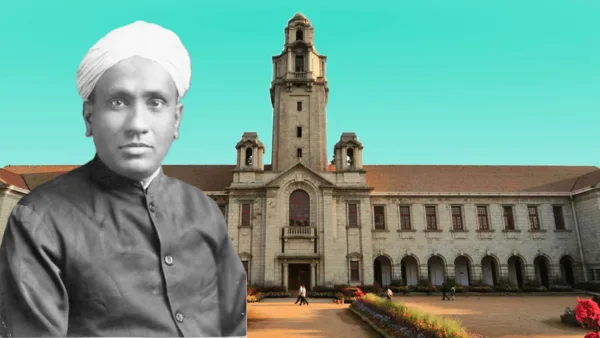
On C.V. Raman’s birth anniversary, revisit the journey of India’s first Nobel laureate in science—the man who made light reveal its hidden secrets.
On 7 November 1888, India witnessed the birth of a scientific genius who would make light itself speak—C.V. Raman. His discovery of the Raman Effect in 1928 revolutionized our understanding of how light interacts with matter and earned him the Nobel Prize in Physics in 1930. As we mark his 137th birth anniversary in 2025, Raman’s life remains a powerful reminder that imagination, curiosity, and courage can illuminate entire nations.
Key Points
- C.V. Raman discovered the Raman Effect in 1928, showing how light changes wavelength when scattered by molecules.
- He became India’s first Nobel laureate in science in 1930 for this groundbreaking discovery.
- Founded the Raman Research Institute in Bangalore to promote independent scientific research.
- His discovery laid the foundation for modern spectroscopy, used in medicine, chemistry, and technology.
- Raman’s life continues to inspire curiosity, creativity, and India’s scientific spirit.
The Early Life of C.V. Raman
Born on 7 November 1888 in Tiruchirapalli, Tamil Nadu, C.V. Raman grew up in a family devoted to learning. His father, a physics lecturer, nurtured his love for science. By sixteen, Raman had already graduated with a gold medal in physics from Presidency College, Madras.
He began his career as an Assistant Accountant-General in the Indian Finance Department in 1907 but spent every spare moment in the laboratory of the Indian Association for the Cultivation of Science (IACS) in Calcutta. It was here that his lifelong fascination with the behavior of light began to take shape.
Must Read: Project Suncatcher: Google’s Bold Step Toward In-Space AI Computing
The Spark: How the Raman Effect Was Born
In 1921, while sailing back from England, C.V. Raman looked out over the deep blue of the Mediterranean Sea and asked why the sea appeared blue. Rejecting conventional explanations, he hypothesized that molecular scattering, not reflection, was responsible for the color.
Back in Calcutta, as the Palit Professor of Physics at the University of Calcutta, he and his student K.S. Krishnan began to study how light scattered through transparent liquids. On 28 February 1928, they observed a faint shift in the wavelength of scattered light—a discovery that proved light could lose or gain energy upon interacting with molecules. This phenomenon became known as the Raman Effect, a cornerstone of modern physics.
Their findings, published in Nature and the Indian Journal of Physics, electrified the global scientific community. C.V. Raman had shown that light could “speak” about the molecular structure of matter.
Nobel Glory and the Rise of Indian Science
In 1930, C.V. Raman received the Nobel Prize in Physics “for his work on the scattering of light and for the discovery of the effect named after him.” He was the first Asian and the first non-white scientist to win the Nobel in any scientific discipline.
After his triumph, Raman used his prize money to lay the foundation of independent Indian research. In 1933, he became the first Indian director of the Indian Institute of Science (IISc) in Bangalore. He transformed the institute into a vibrant center of innovation, nurturing young talent and promoting a culture of open inquiry through the famous Raman Colloquium.
Though his tenure was marked by conflicts over autonomy and resources, his students went on to lead India’s nuclear, space, and defense programs.
Must Read: Bahubali Rocket: How ISRO’s Giant Leap Will Transform Your Life and India’s Future
The Raman Research Institute and Later Years
In 1948, C.V. Raman founded the Raman Research Institute (RRI) in Bangalore using his Nobel funds and savings. Free from government control, he continued exploring optics, sound, crystal physics, and even the colors of flowers and gems. He published over 500 papers and inspired generations of Indian scientists.
Raman’s humility was as striking as his intellect. Knighted in 1929 and awarded the Bharat Ratna in 1954, he once remarked, “I am not Sir C.V. Raman. I am just Raman.” He rejected the idea of patenting discoveries, saying, “Truth is not a commodity to be bought and sold.”

Raman Research Institute (RRI) in Bangalore
Legacy of Light
C.V. Raman passed away on 21 November 1970, still working in his lab just days before his death. His last words were, “Take care of the instruments.” In 1986, India declared 28 February as National Science Day to commemorate his discovery.
Today, the Raman Effect underpins technologies ranging from chemical analysis to medical imaging. Every smartphone camera, drug molecule, or gemstone tested by spectroscopy bears the legacy of his curiosity.
In an era when scientific temper needs revival, C.V. Raman’s life reminds us that imagination matters more than instruments, and that no nation can progress without nurturing its scientists.
As he said in his Nobel banquet speech:
“The pursuit of science is not the privilege of a few. It is the duty of all who have eyes to see and minds to think.”
On this 7 November 2025, let us rededicate ourselves to that duty.
Jai Hind. Jai Vigyan.