
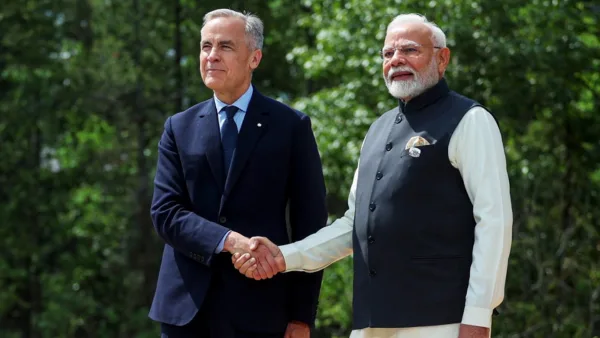
Canada-India Relations are back on track as PM Mark Carney pushes for trade diversification, new economic deals, and diplomatic renewal amid U.S. tensions.
Canada-India Relations: A Strategic Reset for Global Trade Stability
Canadian Prime Minister Mark Carney has underscored significant progress in Canada-India Relations, highlighting a renewed era of cooperation in trade, energy, and technology. Speaking at the APEC Summit in Gyeongju, South Korea, Carney said Canada is accelerating efforts to diversify its trade portfolio beyond the United States — positioning India as a key partner in this global strategy.
This diplomatic revival follows nearly two years of strained ties between the two nations, triggered by the controversial killing of Sikh separatist Hardeep Singh Nijjar in Canada. The incident led to a diplomatic freeze, halting trade negotiations and ministerial engagement. However, both sides have now committed to a fresh start, marking a major turnaround in Canada-India Relations.
Revival of High-Level Engagement and Economic Dialogue
Last month, Canadian Foreign Affairs Minister Anita Anand visited New Delhi and signed a joint roadmap with India’s External Affairs Minister S. Jaishankar. The agreement outlined deeper cooperation in critical sectors such as agriculture, artificial intelligence, energy, and critical minerals.
One of the key takeaways was the decision to restart ministerial-level trade talks and revive the Canada-India CEO Forum, which had been inactive since 2023. Indian officials have projected that bilateral trade could exceed $50 billion annually if the two nations finalize a comprehensive free trade agreement (FTA).
This move signals a clear commitment to rebuilding Canada-India Relations, with both governments acknowledging the importance of a diversified trade framework that reduces overreliance on Western markets.
Must Read: A Global Tourist’s Guide to Lucknow: Exploring India’s UNESCO Creative City of Gastronomy
Carney’s Vision: Reducing Dependence on the U.S.
Carney’s diplomatic pivot is rooted in Canada’s broader strategy to lessen its trade dependence on the United States, particularly after the collapse of bilateral negotiations and renewed U.S. tariffs under the Trump administration.
The Prime Minister emphasized that Canada-India Relations represent a strategic pillar in the country’s Indo-Pacific policy, noting that the region accounts for over 60 percent of global economic output. Carney highlighted the vast opportunities for Canadian businesses to expand in high-growth Asian markets, particularly in technology exports, clean energy partnerships, and sustainable agriculture.
Strengthening Ties Beyond India: A Broader Asia Strategy
While India remains the centerpiece of Canada’s trade diversification plan, Carney also engaged in high-level talks with Chinese President Xi Jinping, marking the first formal meeting between the two leaders since 2017. Both sides described the discussions as a “turning point” in bilateral relations.
This reflects Canada’s broader Indo-Pacific strategy — leveraging relationships with major Asian economies like India, China, and Japan to enhance its global trade resilience. However, India’s democratic governance, expanding market, and strong diaspora in Canada make it an especially strategic partner in the evolving geopolitical landscape.
Future Prospects: Toward a Comprehensive Partnership
As part of this diplomatic thaw, Prime Minister Narendra Modi has extended an invitation to Mark Carney for formal talks in early 2026, signaling the next phase of engagement between the two nations. The agenda is expected to include progress toward a Free Trade Agreement, greater investment in green technology, and enhanced cooperation in education and defense.
Experts view this momentum as a foundation for long-term economic collaboration that benefits both countries. For Canada, India offers a young consumer base, access to critical minerals, and an expanding technology sector. For India, Canada provides advanced research capabilities, clean energy expertise, and opportunities for skilled migration.
Must Read: Trump Imposes New 10% Tariff on Canada Over Ontario’s Reagan Ad Controversy
Conclusion: A New Era for Canada-India Relations
The renewed focus on Canada-India Relations marks a pivotal shift in Canadian foreign policy. Under Carney’s leadership, Canada is moving toward a more balanced, Asia-focused trade network, aiming to double non-U.S. exports within the next decade.
This evolving partnership reflects shared democratic values and complementary economic strengths. As both nations rebuild trust and expand cooperation, Canada-India Relations could emerge as one of the defining trade alliances of the Indo-Pacific era — setting a model for how mid-sized powers can navigate an increasingly multipolar world.