
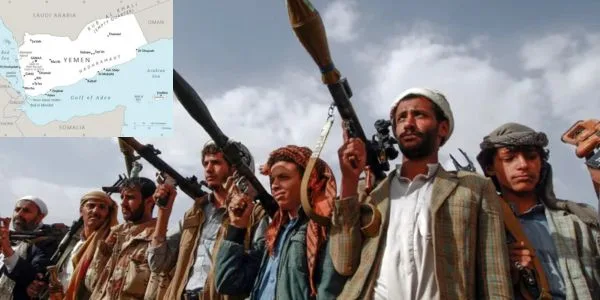
A comprehensive analysis of Yemen’s political turmoil, economic collapse, civil war, and its deep-rooted ties with India — by Senior journalist Mahendra Singh. Understand why Yemen matters to every Indian today.
In a world overshadowed by conflicts from Ukraine to Gaza, Yemen rarely makes the global front pages. Yet, beneath the silence lies a nation teetering on the edge — politically fragmented, economically shattered, and geopolitically significant. As India’s diplomatic constraints play out publicly in the ongoing Nimisha Priya execution case, it compels us to revisit the forgotten story of Yemen: one that Indians need to understand not just as global citizens, but as a country with historic, strategic, and humanitarian stakes in the region.
The Forgotten Crossroads of Arabia
Yemen is more than a war-torn land. Situated at the southern tip of the Arabian Peninsula, it straddles the Bab el-Mandeb Strait, a maritime chokepoint through which nearly 10% of global oil trade flows. Its capital, Sana’a, once a center of Arab culture and learning, now lies in ruins under rebel control. To its south, Aden, the temporary capital, is a battleground of power between the Saudi-backed government and Southern separatists.
Its geography alone makes Yemen a strategic asset — one that regional and global powers cannot afford to ignore.
Must Read: Why India’s Hands Are Tied in Saving Kerala Nurse Nimisha Priya from Execution in Yemen

A State Without Sovereignty
Yemen, since its unification in 1990, has struggled to function as a cohesive state. The 2011 Arab Spring unseated long-time President Ali Abdullah Saleh, triggering a power vacuum that never healed.
By 2014, Houthi rebels — a Zaidi Shia group from the north — seized Sana’a, pushing out the internationally recognized government of President Abdrabbuh Mansur Hadi, who later fled to Saudi Arabia. What followed was a full-blown civil war, still raging as of 2025.
The country today is effectively divided:
- Houthis control the capital and the north — backed militarily and ideologically by Iran.
- The Saudi-led coalition, supporting the Hadi government, holds the south and east — primarily via air power and UAE-backed militias.
- A third faction, the Southern Transitional Council (STC), demands independence for South Yemen, further muddying the political waters.
Yemen, in essence, is a fractured nation, governed by militias, sheikhs, tribal councils, and foreign actors.

War Without End, Peace Without Power
For over a decade, Yemen has been a theater for a proxy war between Saudi Arabia and Iran, fuelled by sectarian, strategic, and territorial ambitions. The result?
- Over 3.5 lakh deaths, with tens of thousands being civilians.
- More than 4 million internally displaced people.
- Widespread famine with nearly 17 million Yemenis facing food insecurity.
- Collapsed infrastructure — hospitals, schools, and water systems either bombed or inoperable.
International efforts, including UN-brokered peace talks, have failed to deliver a durable ceasefire. Both the Houthis and the Saudi-led coalition continue to hold entrenched positions, viewing compromise as weakness.
An Economy in Free Fall
Once modestly oil-rich, Yemen’s economy is now a textbook case of collapse.
- Oil and gas exports, the backbone of the economy, have all but ceased.
- The Yemeni rial has plunged by over 80%, triggering hyperinflation.
- Unemployment exceeds 50%, with most families surviving on remittances or aid.
- In Houthi-controlled areas, a parallel banking system operates, adding to confusion and corruption.
As of 2025, Yemen is almost completely dependent on humanitarian assistance from the United Nations, World Food Programme, and NGOs — aid that is often blocked, stolen, or weaponized by local militias.
India and Yemen: A Legacy Tested by Crisis
India and Yemen share a long civilizational history. Indian traders and sailors have crossed the Arabian Sea for centuries, and the Yemeni coast has hosted Gujarati, Konkani, and Malabari communities. Cultural, linguistic, and religious bonds — especially among Indian Muslims — run deep.
But the modern diplomatic engagement began to unravel post-2015, when war broke out.
Operation Raahat (2015): A Rare Moment of Diplomacy
India evacuated over 4,700 Indians and 2,000 foreign nationals from Yemen during the early days of the war — a feat praised globally. But since then, the Indian embassy has shifted operations to Djibouti, limiting direct outreach.

The Nimisha Priya Case: A Diplomatic Dead-End
In 2025, the case of Kerala nurse Nimisha Priya, sentenced to death for the alleged murder of a Yemeni man, has again drawn India into Yemen’s complexities. With Sana’a under Houthi control, and no diplomatic presence or recognition of the rebel regime, India’s ability to intervene is severely restricted.
Efforts to negotiate “blood money” — a legal provision under Sharia law that allows for pardons in murder cases — have so far failed. The victim’s family has rejected offers, citing the “honour” of their son’s memory. The Indian government has admitted in court that it has “limited capacity” to influence the matter.
Yemen’s Global Footprint
Despite being one of the poorest Arab countries, Yemen remains pivotal in world politics.
- Its control of the Bab el-Mandeb Strait directly impacts global oil markets.
- Houthi attacks on international shipping lanes have led to U.S. and European naval patrols in the Red Sea.
- Its humanitarian crisis has become a test case for international law, aid delivery, and war accountability.
- As Western governments scale back arms sales to Saudi Arabia, China and Russia have moved in diplomatically, seeking leverage in the Gulf.
What Yemen Means for India Going Forward
Yemen may seem peripheral, but for India, it matters:
- Strategic Interests: Yemen sits on India’s extended maritime neighborhood. Stability there influences Indian shipping lanes, energy trade, and naval security.
- Diaspora Safety: Thousands of Indian workers, especially nurses, had migrated to Yemen before the war. Their rights, safety, and legal protection must remain a concern.
- Global South Diplomacy: As India positions itself as a voice of the Global South, cases like Yemen test its capacity to mediate in non-Western, Muslim-majority conflict zones.
- Soft Power through Aid: India’s humanitarian outreach to Yemen — food, vaccines, and scholarships — could be leveraged to rebuild long-term goodwill.
Conclusion: A Cautionary Tale in Realpolitik
Yemen is not just a geopolitical puzzle — it is a warning. Of what happens when global powers turn local politics into proxy war. Of what remains when governance fails, and aid becomes the only currency of survival.
For India, Yemen is both a mirror and a message. A mirror reflecting the limits of diplomacy in a fragmented world order — and a message that engagement, however distant, cannot be selective in a globalized world.
As Nimisha Priya’s fate hangs in the balance, so does India’s ability to navigate the toughest terrains of international relations — with humanity, consistency, and strategic foresight.