

New Delhi, January 7, 2026, 2:05 p.m. IST
The European Union refuses to recognize Delcy Rodríguez as Venezuela’s interim president following the U.S. raid that seized Nicolas Maduro. European capitals are divided over democracy, international law, and Washington’s role in Caracas.
The European Union has refused to recognize Delcy Rodriguez as Venezuela’s interim president, deepening the transatlantic rift over the dramatic U.S. capture of Nicolas Maduro and raising fresh questions about the country’s political future. European capitals are now struggling to balance calls for democracy and international law with the reality of a U.S.-run transition in Caracas following “Operation Absolute Resolve.”
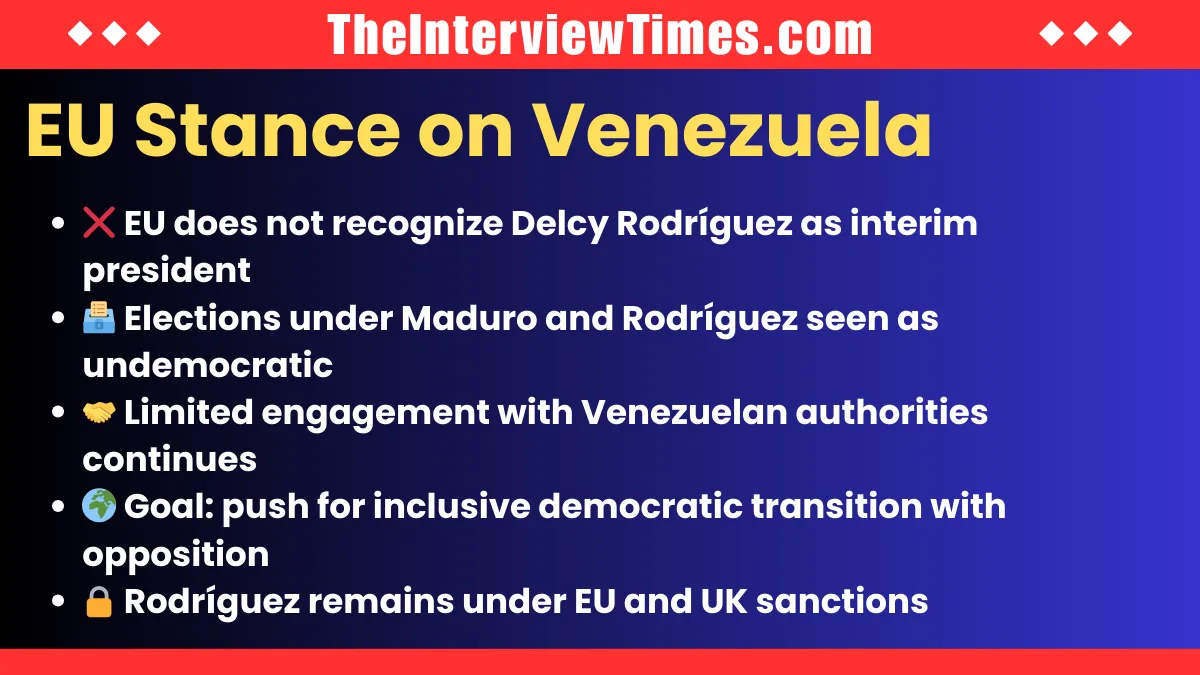
EU stance on Rodriguez
European Commission spokesperson Anitta Hipper said in Brussels that the EU does not consider Delcy Rodriguez a legitimate head of state, just as it never recognized Nicolas Maduro, arguing both drew their mandate from elections that failed to respect the will of Venezuelans for democratic change.
Despite rejecting her legitimacy, the bloc will maintain targeted and “limited” engagement with Venezuelan authorities to safeguard EU interests and push for an inclusive democratic transition involving opposition leaders.
Divisions inside Europe
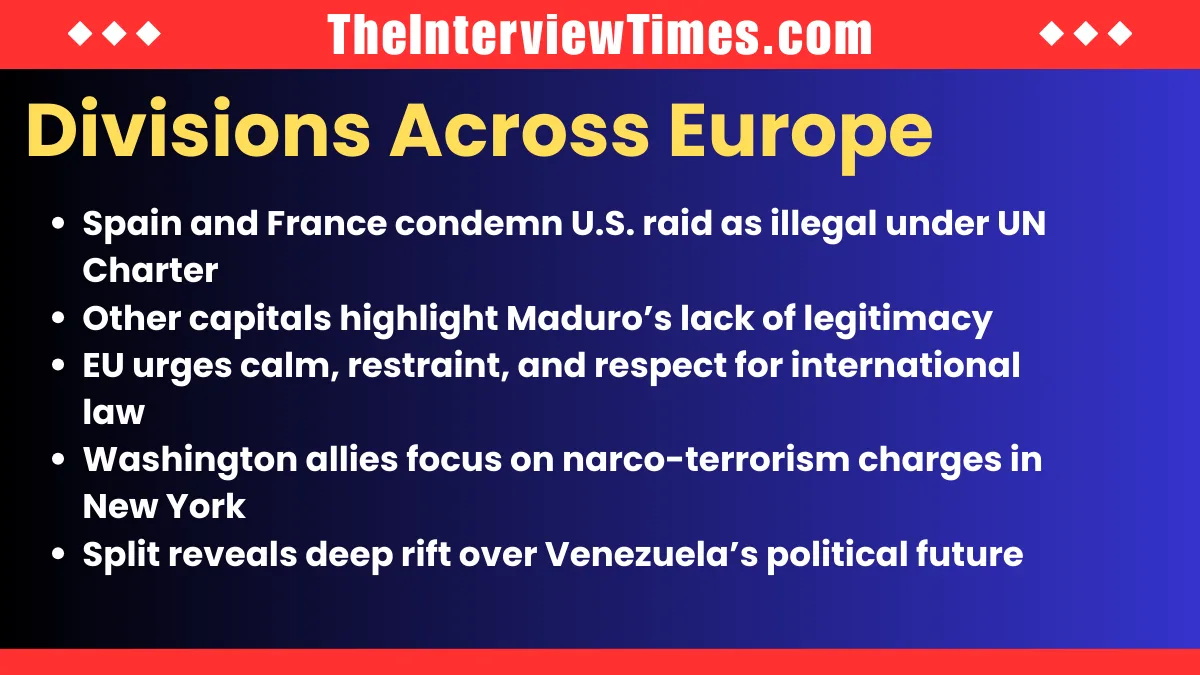
EU foreign policy chief Kaja Kallas coordinated a joint statement from most member states urging calm, restraint and respect for international law after the U.S. raid, but national capitals have taken sharply different lines in public.
Countries such as Spain and France have stressed the illegality of the U.S. operation under the U.N. Charter, while others closer to Washington have highlighted Maduro’s lack of democratic legitimacy and focused on the narco‑terrorism charges he now faces in New York.
From Caracas to a US courtroom
Maduro and his wife Cilia Flores were seized in a pre‑dawn assault on Caracas in a mission dubbed “Operation Absolute Resolve,” involving more than 150 U.S. aircraft and a Delta Force raid on the presidential compound.
After being flown via the USS Iwo Jima and Guantanamo, the couple were transferred to New York, where Maduro is being held on long‑standing U.S. narco‑terrorism and cocaine trafficking charges at a federal facility in the city.
Rodriguez’s fragile position
Venezuela’s Supreme Court ordered Rodriguez, a long‑time Maduro ally and former vice president, to assume the interim presidency after his removal, even though she remains under EU and UK sanctions for undermining democracy.
In recent appearances, Rodriguez has condemned the U.S. raid as a violation of sovereignty while insisting that “no foreign agent” runs Venezuela, signaling willingness to talk but resisting any arrangement that would turn her into Washington’s proxy.
Must Read: India-Germany Defence Partnership Strengthens with Landmark Submarine Deal
Trump’s pressure and the road ahead
President Donald Trump has declared that the United States will “run” Venezuela until a new order is in place, tying any transition to U.S. security interests and the rehabilitation of the country’s oil sector.
Trump and senior officials have sent mixed messages on Rodriguez, alternately signaling readiness to work with her and threatening consequences “bigger than Maduro” if she obstructs U.S. plans, a posture that further complicates EU efforts to shepherd a negotiated, internationally backed transition.
