
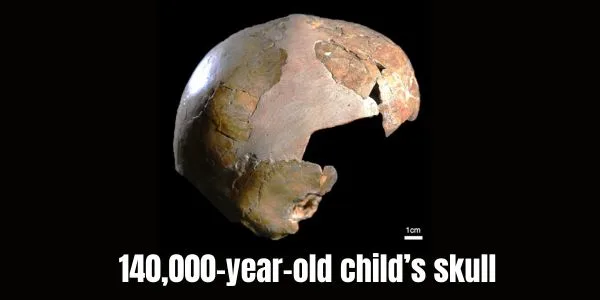
Scientists discover a 140,000-year-old child’s skull in Israel, offering the earliest evidence of Homo sapiens and Neanderthals interbreeding, reshaping evolution.
At a Glance
- Historic Discovery: Earliest physical evidence of Homo sapiens and Neanderthals interbreeding found in Israel.
- The Fossil: 140,000-year-old child’s skull unearthed in Skhul Cave, Mount Carmel.
- Hybrid Traits: Skull vault resembles Homo sapiens, while the jaw, inner ear, and cranial blood system show Neanderthal features.
- Earlier Than Believed: Pushes the timeline of interbreeding back over 100,000 years — earlier than the Lapedo Valley Child fossil.
- Migration Impact: Challenges old theories; shows Neanderthals lived in the Levant for 400,000 years, overlapping with migrating Homo sapiens.
- Genetic Legacy: Modern humans still carry 2–6% Neanderthal DNA, proving ancient interbreeding shaped us.
- Cultural Significance: Burial suggests shared customs and emotions between species.
- Research Leaders: Study led by Tel Aviv University and the French National Centre for Scientific Research.
- Scientific Debate: Lacks DNA proof, but morphological evidence strongly supports Homo sapiens and Neanderthals interbreeding.
- Levant as a Crossroads: Proves the region was a hub where early humans and Neanderthals coexisted, exchanged culture, and genes.
Introduction: A Historic Discovery in Human Evolution
Humanity’s story has just taken a fascinating turn. A team of international researchers led by Tel Aviv University and the French National Centre for Scientific Research has uncovered the earliest known evidence of Homo sapiens and Neanderthals interbreeding. The finding comes from the skull of a five-year-old child who lived about 140,000 years ago in Skhul Cave, Israel.
Unlike previous discoveries that dated interbreeding much later, this fossil proves that contact between Homo sapiens and Neanderthals took place over 100,000 years earlier than previously thought. The implications shake up established theories of evolution, migration, and the cultural encounters that shaped our species.
Homo Sapiens and Neanderthals Interbreeding: Evidence from the Skull
The skull of the child shows a fascinating mixture of features. Using advanced micro-CT scanning, researchers found that the skull’s vault — the rounded upper part — resembles modern Homo sapiens. At the same time, other parts of the anatomy, such as the lower jaw, the blood supply system in the brain, and the inner ear canals, closely match Neanderthal traits.
This anatomical blend provides what experts are calling the world’s earliest physical proof of Homo sapiens and Neanderthals interbreeding. It’s a biological marker that tells us our evolutionary past was not dominated by isolation but by interaction, contact, and fusion.
Must Read: World’s Oldest Human Fingerprint Unearthed in Spain: A 43,000-Year-Old Neanderthal Masterpiece
Earlier Than Previous Evidence
Until now, scientists linked interbreeding events between humans and Neanderthals mainly to the period 60,000–40,000 years ago, which coincided with the migration of modern humans into Europe and Asia. Genetic studies revealed that today, non-African populations carry between 2–6% Neanderthal DNA, pointing toward interbreeding in that later timeframe.
The new child’s skull from Israel pushes this story back dramatically, suggesting that Homo sapiens and Neanderthals interbreeding happened 140,000 years ago — much earlier than believed. For comparison, the well-known hybrid-like fossil called the Lapedo Valley Child from Portugal dates back only 28,000 years.
This discovery demonstrates that interbreeding was not a rare or accidental event but part of a much older and more interconnected human history.
Challenging Migration Theories
Another key impact of this discovery is the way it changes theories about Neanderthal migration. The traditional model suggested that Neanderthals evolved in Europe before spreading into the Middle East around 70,000 years ago. However, recent research in Israel points to an entirely different timeline.
Evidence of the so-called Nesher Ramla Homo suggests Neanderthals were already present in the Levant as early as 400,000 years ago. This means they had been living in the same region where early Homo sapiens began migrating from Africa around 200,000 years ago. Inevitably, the overlap created fertile ground for co-existence — and for Homo sapiens and Neanderthals interbreeding.
Must Read: Humans Emit Subtle Light: A Fascinating Discovery
Voices from the Scientific Community
While the skull presents strong physical evidence of hybridization, not every scholar is fully convinced. Chris Stringer, a paleoanthropologist at London’s Natural History Museum, noted that while the fossil displays mixed features, confirmation requires DNA analysis that is not yet possible from the sample.
Despite the lack of genetic testing, researchers argue that the child’s unique traits — especially the chinless jaw and rounded dental arch — cannot be explained by variation within Homo sapiens alone. Instead, they are consistent with Homo sapiens and Neanderthals interbreeding, making this child a likely example of hybrid ancestry.
A Crucial Crossroads in Human History
What makes the Levant so important, according to the researchers, is its role as a crossroads of evolution. Situated between Africa, Asia, and Europe, the region became a meeting point for multiple human lineages. Here, different groups would not only pass through but also share habitats, tools, and knowledge.
This child’s burial in Skhul Cave hints at more than biology. Scientists say rituals like deliberate burial suggest shared cultural values. If Homo sapiens and Neanderthals interbreeding occurred here, then so too might have bonds of emotion, culture, and cooperation that shaped both lineages.
Conclusion: Rewriting Our Origins Story
The discovery of the 140,000-year-old child’s skull rewrites our understanding of human evolution. It provides the earliest known evidence of Homo sapiens and Neanderthals interbreeding, proving these lineages met and mingled far earlier than scientists imagined.
Far from being separate stories, the histories of Homo sapiens and Neanderthals were intertwined for hundreds of thousands of years. This ancient child stands as a symbol of that shared ancestry, reminding us that humanity’s past is not a simple tree, but a complex web of connections.