
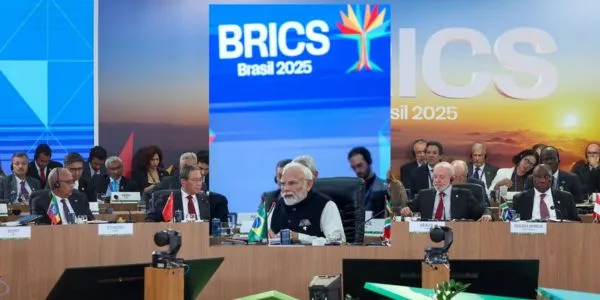
BRICS counters U.S. tariffs straining India and Brazil’s trade ties. Explore de-dollarization, Global South strategies, and BRICS expansion 2025 in this analysis by Mahendra Singh for TheInterviewTimes.com.
In a world shaped by economic and political rivalries, BRICS—a group of nations including Brazil, Russia, India, China, South Africa, and new members Egypt, Ethiopia, Iran, United Arab Emirates (UAE), and Indonesia—is emerging as a powerful voice for developing countries. Representing 37% of the world’s economy and nearly half its population, BRICS aims to challenge Western dominance and promote cooperation among emerging nations. However, recent U.S. tariffs, particularly targeting India and Brazil, have strained their relations with Washington, pushing them closer to BRICS’ goals. This article explains what BRICS is, why it matters, and how it must strategize to counter U.S. pressure, with a focus on the shifting dynamics of India and Brazil’s ties with the U.S. as of August 2025.
What is BRICS?
BRICS stands for Brazil, Russia, India, China, and South Africa, a group formed in 2009 to boost economic and political cooperation among fast-growing economies. In 2024, it expanded to include Egypt, Ethiopia, Iran, the UAE, and Indonesia (joining in 2025), often called BRICS+. Think of BRICS as a club of nations from the Global South—developing countries in Africa, Asia, and Latin America—working together to have a bigger say in global trade, finance, and politics.
The idea started in 2001 when banker Jim O’Neill predicted that Brazil, Russia, India, and China (BRIC) would become economic giants. These countries began meeting in 2006, held their first summit in 2009, and added South Africa in 2010. Today, BRICS is a platform to address issues like trade, climate change, and reducing reliance on Western systems, such as the U.S. dollar.
Must Read: How US Global Dominance in 2025 Is Redefining World Sovereignty
Why Does BRICS Matter?
BRICS is important because it represents a shift in global power. Here’s why:
- Economic Strength: BRICS accounts for 37% of global GDP, rivaling the G7 (wealthy nations like the U.S. and Japan). It also controls 44% of global oil production with members like Iran and the UAE.
- Voice for the Global South: BRICS pushes for fairer global rules, giving developing nations more influence in institutions like the World Bank and International Monetary Fund (IMF).
- Growing Influence: Over 40 countries, including Turkey and Malaysia, want to join, showing BRICS’ appeal as an alternative to Western-led systems.
U.S. Tariffs: Straining India and Brazil’s Relations
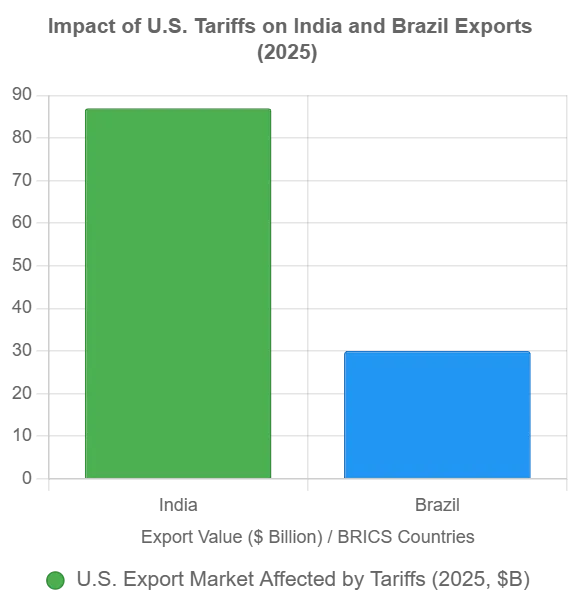
In July 2025, the U.S., under President Donald Trump, imposed steep tariffs on BRICS nations, citing trade imbalances and geopolitical concerns like India’s purchase of Russian oil. India faces a 25% tariff, potentially rising to 50% by late August, hitting its $87 billion export market to the U.S., especially textiles and gems (13% of exports). Brazil faces a 50% tariff, threatening its $30 billion export market, particularly coffee (16.7% of U.S. exports) and aircraft from Embraer.
These tariffs have significantly strained India and Brazil’s relations with the U.S., which were once strong. India aimed for $500 billion in U.S. trade by 2030, bolstered by strategic partnerships in technology and defence. Brazil enjoyed a $253 million trade surplus with the U.S. in 2024. However, the tariffs have sparked frustration:
- India: The tariffs, partly tied to India’s 35-40% reliance on Russian oil, have been called unfair by officials, as the EU and Turkey face no similar penalties. Economists warn of a 0.2-0.5% GDP loss, hitting export hubs like Gujarat. Prime Minister Narendra Modi has responded by planning deeper BRICS cooperation, including talks with Brazil and China in August 2025.
- Brazil: The tariffs threaten its agricultural sector, with coffee and orange juice exporters warning of “unsustainable” losses. President Luiz Inacio Lula da Silva, in an August 7, 2025, call with Modi, criticized U.S. “bullying” and committed to strengthening BRICS trade and defence ties.
These shifts have pushed India and Brazil to rely more on BRICS, aligning closer with members like China and Russia to counter U.S. pressure, despite their earlier balancing act with the West.
How BRICS Counters U.S. Pressure
BRICS faces growing Western pressure, especially from the U.S., which uses tariffs and sanctions to limit the group’s influence. For example, Russia and Iran face heavy sanctions, and the U.S. has pressured allies like Saudi Arabia, which paused full BRICS membership in 2025. To counter this, BRICS must focus on three key areas:
- Economic Cooperation:
- BRICS created the New Development Bank (NDB), which has funded over $30 billion in projects since 2015, offering loans for infrastructure without Western conditions. India and Brazil can use NDB funds to offset tariff losses, such as supporting India’s textile sector or Brazil’s agriculture.
- The Contingent Reserve Arrangement (CRA), with $100 billion, helps members during financial crises, reducing reliance on the IMF.
- BRICS is pushing de-dollarization, trading in local currencies like India’s rupee or China’s yuan. India’s rupee-based oil trade with the UAE is a step forward, and Brazil’s trade with China in reais could grow to counter U.S. tariffs.
- Reducing U.S. Dollar Reliance: The U.S. dollar’s dominance lets Washington impose sanctions and tariffs. By expanding local currency trade and exploring a BRICS digital payment system (proposed in 2024), the group can bypass dollar-based systems like SWIFT, protecting members like India and Brazil from U.S. economic pressure.
- Global Influence: BRICS wants a fairer world order where developing nations have more power. India and Brazil, now facing U.S. tariffs, can lead BRICS in promoting issues like climate finance and AI cooperation, discussed at the 2024 Kazan summit, to unite members and attract new ones.
Strategic Steps to Strengthen BRICS
To counter U.S. pressure and leverage India and Brazil’s shifting priorities, BRICS must act strategically:
- Boost Economic Resilience:
- Expand NDB funding to support tariff-hit sectors in India (textiles) and Brazil (coffee, aircraft).
- Redirect exports to Asia and Africa, building on China’s $282 billion trade with Africa in 2024.
- Scale up de-dollarization, using India and Brazil’s leadership to promote local currency trade across BRICS.
- Build a Unified Voice:
- Launch a BRICS media platform to counter Western narratives portraying the group as divided. India and Brazil’s global diplomatic clout can lead this effort.
- Emphasize shared goals like green industrialization, a focus of Brazil’s 2025 Rio summit, to unite members and appeal to the Global South.
- Strengthen Unity:
- India and Brazil, frustrated by U.S. tariffs, can bridge divides between China’s dominance and Russia’s anti-Western stance, ensuring BRICS remains inclusive.
- Use the Rio summit to align on climate and trade goals, reinforcing BRICS’ role as a global leader.
Challenges Facing BRICS
BRICS faces hurdles in countering U.S. pressure:
- Internal Divisions: India-China border tensions and Brazil’s pro-Western leanings create friction. India and Brazil’s tariff-driven frustrations can help unify the group.
- Economic Gaps: China’s economy dominates BRICS, risking perceptions of imbalance. India and Brazil must lead to balance influence.
- U.S. Retaliation: Tariffs and sanctions hit smaller economies like Ethiopia harder. BRICS must protect vulnerable members.
- Credibility Issues: Critics argue BRICS lacks concrete achievements. Delivering on NDB projects and trade deals is key.
Must Read: India-US Trade in 2025: How New Tariffs Impact the Economy
The Road Ahead
The 2025 Rio summit, led by Brazil, offers a chance to address U.S. tariffs and strengthen BRICS. India and Brazil, now distanced from the U.S., can drive cooperation on climate finance and trade, ensuring BRICS remains a united force. By focusing on economic resilience and a shared Global South vision, BRICS can counter U.S. pressure while maintaining global balance.
Why Should You Care?
BRICS’ actions affect global trade, prices, and policies. For readers in India, Brazil, or other BRICS nations, its push for de-dollarization and fairer global rules could impact your economy and future. As India and Brazil navigate strained U.S. ties, BRICS offers a path to greater independence and influence, shaping a world where developing nations have a stronger voice.
Mahendra Singh is a seasoned journalist and editor at TheInterviewTimes.com with over 28 years of experience. An alumnus of IIMC, he writes on international affairs, politics, education, environment, and key social issues.