
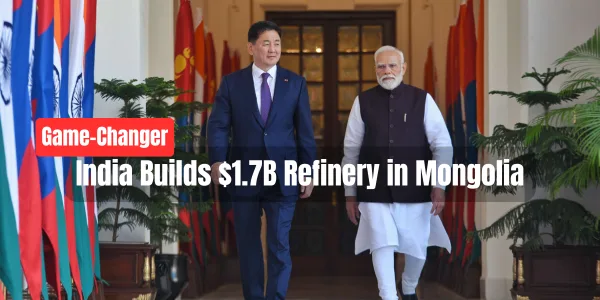
India’s $1.7 billion Mongolia Oil Refinery to start by 2028, boosting energy security and deepening India-Mongolia strategic cooperation in energy and minerals.
New Delhi | October 15, 2025 | The Interview Times— In a landmark step toward strengthening India-Mongolia relations, the ambitious $1.7 billion Mongolia Oil Refinery project in Dornogobi province is set to become operational by 2028. Announced during Mongolian President Khurelsukh Ukhnaa’s state visit to New Delhi, this initiative marks the largest overseas development project funded through an Indian Line of Credit, symbolizing a deepening partnership in the energy and mineral sectors.
Had a warm and wonderful conversation with my friend President Khurelsukh Ukhanaa in New Delhi. Exchanged views on efforts for diversification into new areas of cooperation, while also deepening existing programmes of shared interest. Reaffirmed our commitment to further… pic.twitter.com/vlgr4J3jPA
— Rajnath Singh (@rajnathsingh) October 14, 2025
Must Read: Bank of America Raises Gold Price Target 2026 to $5,000 Amid Global Economic Uncertainty
Mongolia Oil Refinery: A Strategic Energy Milestone
Located in Altanshiree, Dornogobi, southeastern Mongolia, the refinery is designed to process 1.5 million tonnes of crude oil annually, equivalent to around 30,000 barrels per day. Once operational, it will meet nearly 55% of Mongolia’s domestic fuel demand.
Currently, Mongolia imports nearly 95% of its petroleum products from Russia, while exporting most of its crude oil to China. The Mongolia Oil Refinery aims to change this dependence, producing petrol, diesel, LPG, and aviation fuel, thus propelling the nation toward energy independence.

Mongolia Oil Refinery: Project Progress and India’s Key Role
Despite facing initial delays due to the COVID-19 pandemic and Mongolia’s harsh winters with temperatures dropping to -35°C, the project has made remarkable progress. Most of the civil infrastructure is now complete.
Equipment manufactured by Indian engineering giants Megha Engineering and Infrastructure Limited (MEIL) and Engineers India Limited (EIL) will soon be transported to the site.
Around 2,700 skilled Indian professionals are contributing on-ground, reflecting India’s growing technical and industrial expertise in global energy infrastructure.
Initially valued at $1.2 billion, the project cost rose to $1.7 billion after capacity upgrades and modifications were added to suit Mongolia’s extreme climatic conditions.
The steady advancement highlights the resilience and strong bilateral commitment between New Delhi and Ulaanbaatar to strengthen economic cooperation and secure energy futures.
Happy to have welcomed President Khurelsukh and held extensive talks with him in Delhi today. His visit comes at a time when India and Mongolia are marking 70 years of diplomatic ties and a decade of our Strategic Partnership. We agreed to keep working together to further amplify… pic.twitter.com/FeIsEJxYh9
— Narendra Modi (@narendramodi) October 14, 2025
Mongolia Oil Refinery: Expanding Energy and Mineral Cooperation
Beyond oil refining, India and Mongolia are broadening collaboration in minerals and natural resources. Mongolia’s abundant coking coal reserves have drawn India’s attention, given coal’s crucial role in steel manufacturing.
While logistics remain challenging due to Mongolia’s landlocked geography, both nations are evaluating transport routes through China’s Tianjin Port and Russia’s Vladivostok, connected via the Trans-Siberian Railway. Currently, India imports coking coal mainly from Canada, Indonesia, and Australia — making Mongolia a potential strategic alternative supplier.
Must Read: IMF Global Growth Forecast 2025: Trade Tensions Threaten Recovery Despite Upgraded Outlook
Uranium, Copper, and Renewable Energy Prospects
Mongolia’s rich uranium reserves are another area of interest for India, especially as New Delhi scales up its nuclear energy program. The interest intensified after Mongolia signed a one-million-tonne-per-year uranium supply agreement with France.
Both countries are exploring opportunities for uranium trade and other minerals such as copper, gold, iron, and zinc. Additionally, collaboration in renewable energy is on the rise, with Mongolia’s sun-drenched southern regions — enjoying nearly 230 sunny days annually — offering vast potential for solar energy ventures.
Mongolia Oil Refinery: A Vision of Regional Stability and Shared Growth
The Mongolia Oil Refinery represents more than an industrial milestone; it embodies a strategic partnership for sustainable development. The initiative aligns with India’s vision of regional connectivity, economic diversification, and self-reliance, while Mongolia benefits from enhanced infrastructure, technology transfer, and employment opportunities.
By 2028, both nations expect to achieve significant economic and geopolitical gains, reinforcing their friendship and expanding India’s influence across Central Asia.
Conclusion
The $1.7 billion Dornogobi Oil Refinery project is set to transform Mongolia’s energy landscape and redefine India-Mongolia cooperation. As the facility nears completion, it stands as a symbol of shared prosperity, energy resilience, and regional stability — a true testament to the power of strategic partnership in a changing global energy order.