

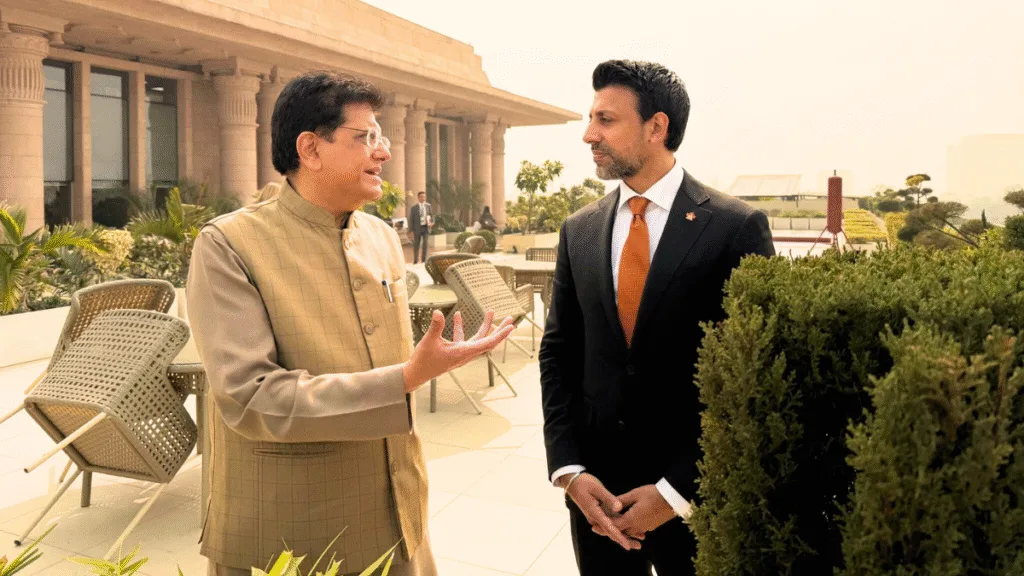
India-Canada Trade Dialogue: India and Canada held the 7th Ministerial Dialogue on Trade and Investment in New Delhi on November 13, 2025. Led by Piyush Goyal and Maninder Sidhu, the talks focused on expanding India-Canada trade, promoting investments, and enhancing cooperation in energy, technology, agriculture, and other key sectors.
India-Canada Trade Strengthened Through Ministerial Dialogue
TheInterviewTimes.com | New Delhi, November 13, 2025 — India and Canada marked a new phase in their economic partnership through the 7th India-Canada Ministerial Dialogue on Trade and Investment (MDTI) in New Delhi. Co-chaired by Union Minister Piyush Goyal and Canada’s Minister Maninder Sidhu, the meeting focused on boosting India-Canada trade and attracting investments under the framework of the New Roadmap 2025.
The dialogue aligns with the Joint Statement “Renewing Momentum towards a Stronger Partnership”, which emphasizes trade as a cornerstone for resilient bilateral growth and mutual prosperity.

Renewing Bilateral Economic Cooperation
Minister Piyush Goyal highlighted the dialogue’s importance in fostering a predictable and inclusive business environment:
It was a pleasure to co-chair the 7th India-Canada Ministerial Dialogue on Trade and Investment as part of the New Roadmap 2025 along with @MSidhuLiberal, Canada's Minister of International Trade.
— Piyush Goyal (@PiyushGoyal) November 13, 2025
Discussed avenues to strengthen bilateral trade, promote investments and deepen… pic.twitter.com/E6IlPMSk5k
“Our discussions focused on strengthening bilateral trade, promoting investments, and deepening cooperation across key sectors, supporting sustainable growth under the New Roadmap 2025.”
Canada’s Maninder Sidhu underscored India’s opportunities for Canadian businesses:
I sat down with my counterpart in India, Minister @PiyushGoyal, for a productive Ministerial Dialogue on Trade and Investment.
— Maninder Sidhu (@MSidhuLiberal) November 13, 2025
We discussed opportunities in complementary sectors, explored avenues to enhance two-way investment, and strengthen economic collaboration between… pic.twitter.com/fz5QKttqjn
“By expanding collaboration in energy, clean technology, artificial intelligence, and agriculture, we can unlock new opportunities and build resilient supply chains benefiting both nations.”
The meeting reinforced a shared commitment to creating a forward-looking economic agenda for India-Canada trade.
Must Read: Trump Signs Bill Ending the Longest U.S. Government Shutdown After 43 Days
Trade, Investment, and Diaspora Contributions
Bilateral India-Canada trade reached approximately USD 30.9 billion in 2024, up from USD 18.38 billion in 2023. Services dominate this exchange, with Canada exporting USD 16.1 billion and India exporting USD 3.5 billion in services. Goods trade remains balanced, with India’s exports at USD 4.22 billion and imports at USD 4.74 billion.
The ministers welcomed growing two-way investments and highlighted the Indian diaspora in Canada, which includes nearly 2.9 million people and 427,000 students, strengthening business, innovation, and cultural ties.
Strategic Sector Collaboration
The dialogue reviewed cooperation in nutritional security, healthcare, clean energy, and digital trade, while also addressing investment facilitation and policy developments. Both sides agreed to explore emerging opportunities in critical minerals, sustainable technologies, and other sectors that enhance the resilience of India-Canada trade and investment ties.
This engagement reflects progress after recent diplomatic setbacks and sets a strong foundation for a diversified and dynamic bilateral relationship.
Key Takeaways
The 7th India-Canada Ministerial Dialogue on Trade and Investment demonstrates a renewed commitment to expanding India-Canada trade through investments, sectoral cooperation, and resilient supply chains. By integrating technology, energy, agriculture, and services, both nations aim to create sustainable economic growth that benefits businesses and communities. The active participation of the Indian diaspora and students further strengthens bilateral relations. Looking ahead, this dialogue positions India and Canada to deepen strategic economic collaboration and explore new opportunities under the New Roadmap 2025.