TheInterviewTimes.com | February 28, 2026 | 02:22 PM IST | New Delhi
India EU FTA 2026 draft unveils 5 year MFN clause, 99.5% tariff cuts, digital trade rules, and new dispute system. Full strategic analysis.
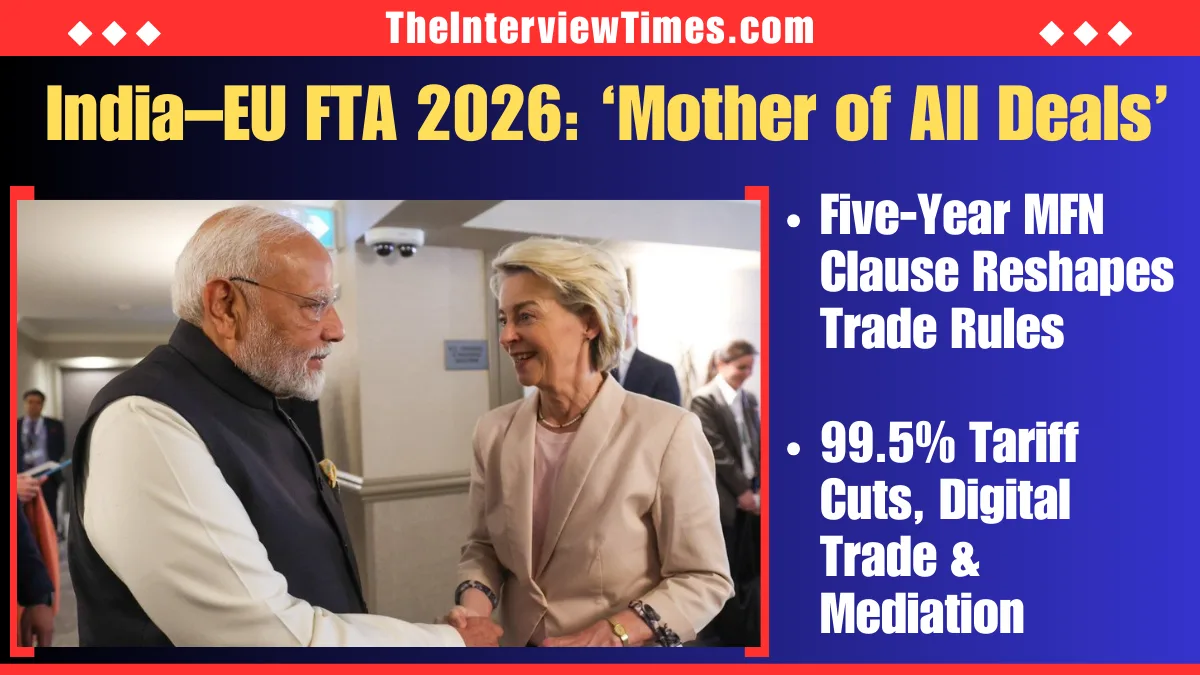
The India EU FTA 2026 draft text released on February 27, 2026 has unveiled a major provision that could reshape the future of bilateral trade. At the heart of the agreement is a five year Most Favoured Nation clause that prevents either side from offering better trade terms to other partners without extending the same benefits to each other.
The India EU FTA 2026 is being described as one of the most ambitious trade agreements negotiated by New Delhi and Brussels in recent decades. It combines deep tariff cuts, services liberalisation, digital trade rules, and a new mediation-based dispute framework.
India EU FTA 2026 and the 5 Year MFN Clause
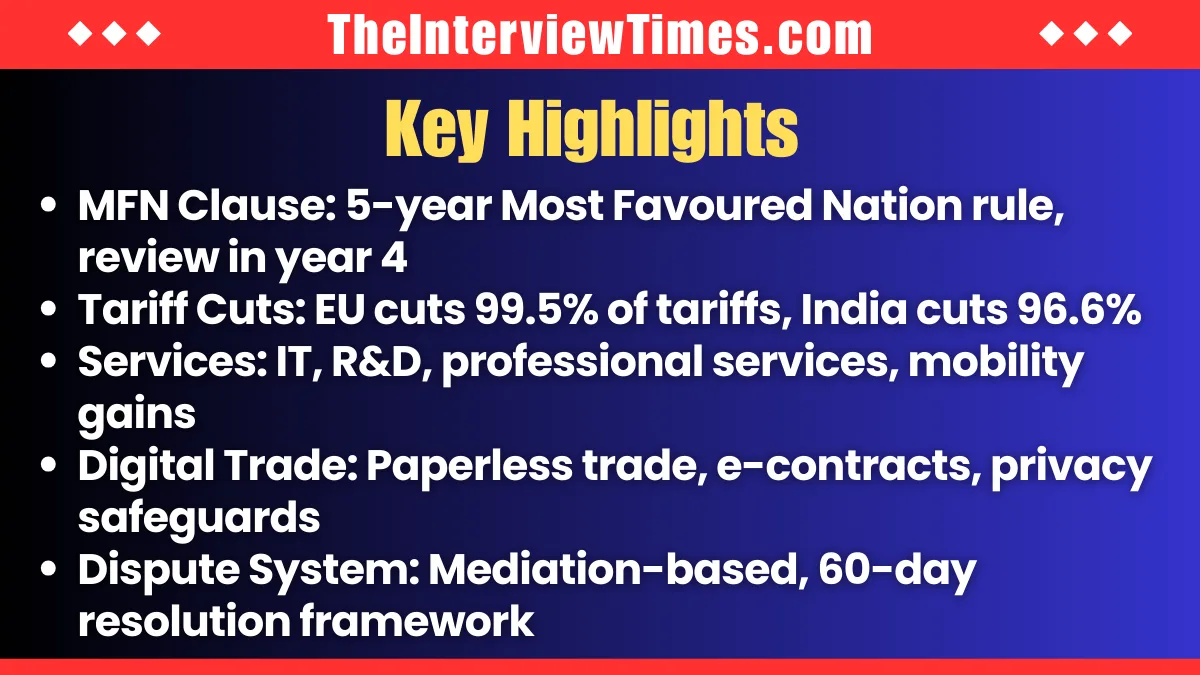
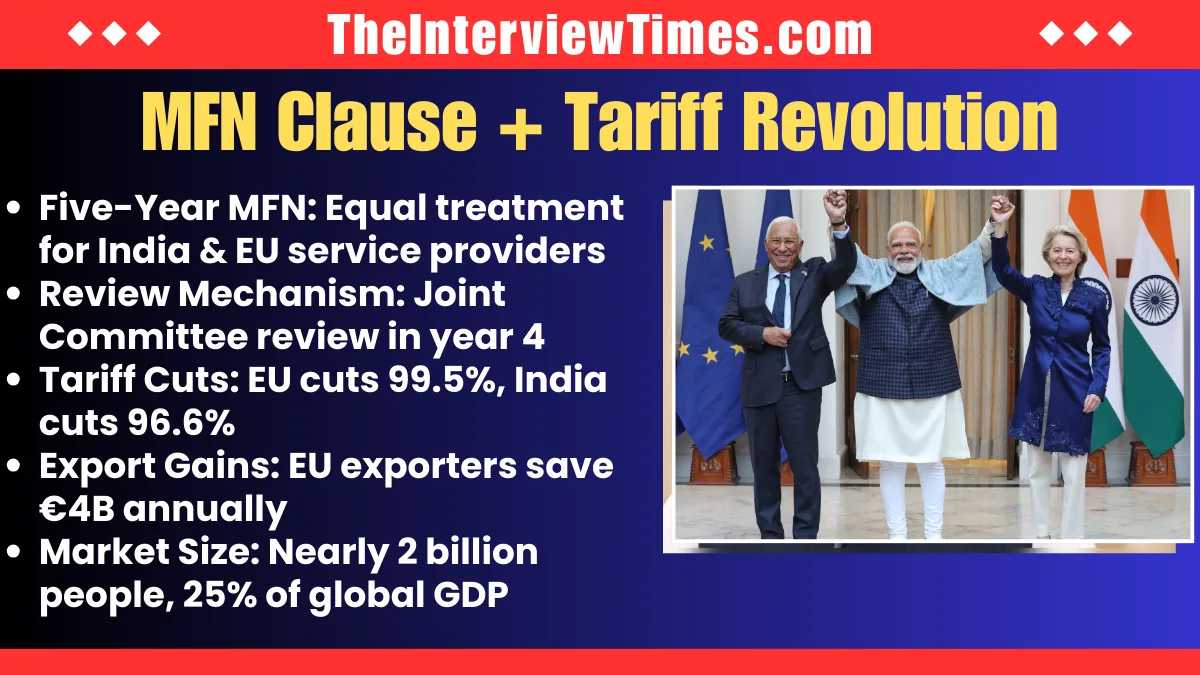
The most significant structural feature of the India EU FTA 2026 is the inclusion of a five year Most Favoured Nation clause. Under this provision, neither India nor the European Union can grant more favourable tariff or non tariff concessions to any third country in covered sectors without extending those same concessions to the other party.
The clause primarily applies to services and service providers. This ensures that Indian and European companies receive treatment at least as favourable as that granted to competitors from any other country in listed sectors.
However, certain areas are excluded from the MFN obligation. Tax treaties, mutual recognition agreements on standards and authorisations, and dispute settlement procedures are explicitly carved out.
Importantly, the MFN mechanism is time bound. It will automatically expire after five years unless both sides agree to extend it. A high level India–EU Joint Committee will conduct a formal review in the fourth year to determine whether the arrangement should continue.
Indian officials have linked the review process to student mobility and social security arrangements within the European Union, making labour mobility a key political and economic consideration.
Why It Is Called the ‘Mother of All Deals’
Ursula von der Leyen, President of the European Commission, has described the India EU FTA 2026 as the “mother of all deals.” The phrase reflects the scale and economic weight of the agreement.
The pact effectively connects India’s 1.4 billion population with the 27 member states of the European Union. Together, the two sides account for roughly 25 percent of global GDP and represent a combined market of nearly two billion people.
On tariffs, India has agreed to eliminate or reduce duties on 96.6 percent of EU exports by value, while the EU will cut tariffs on 99.5 percent of Indian goods, making it one of the most comprehensive tariff reductions in India’s FTA history.
The European Commission estimates that European exporters could save approximately 4 billion euros annually in duties once the agreement is fully implemented. EU goods exports to India could potentially double by 2032 if current projections hold.
Services, Mobility and Digital Trade Gains
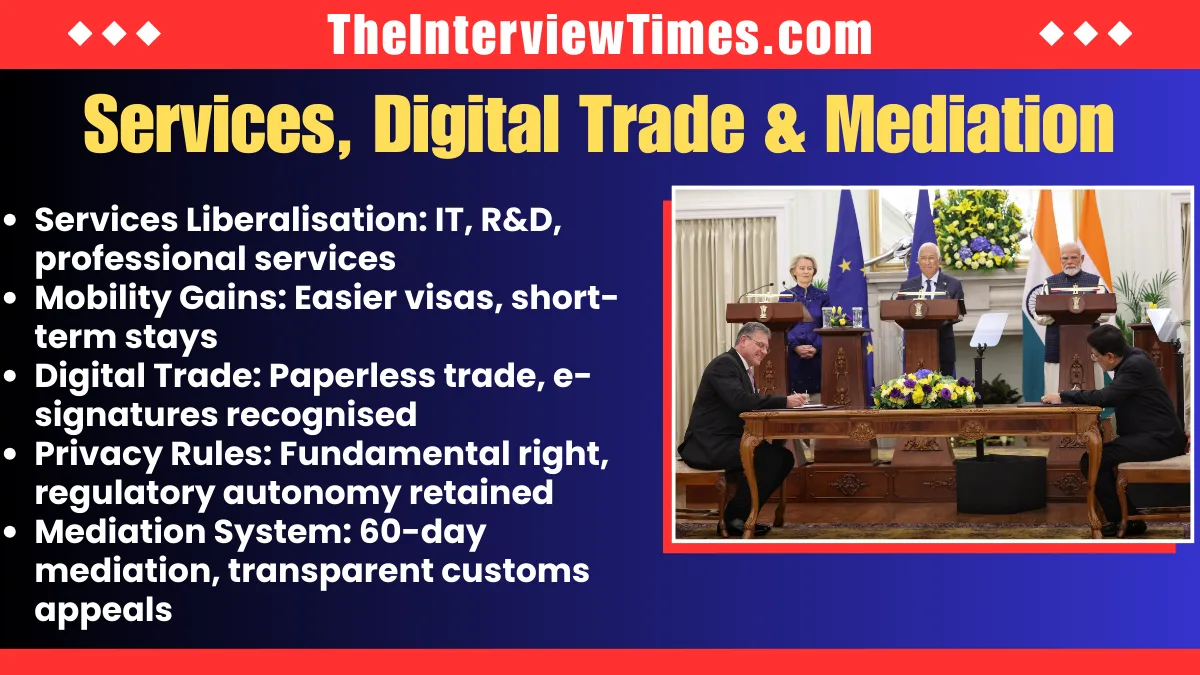
Beyond tariff cuts, the India EU FTA 2026 places strong emphasis on services trade. Commitments cover IT services, professional services, research and development, and skilled business mobility.
The draft foresees improved visa and short term stay arrangements for business related travel. This could benefit Indian professionals and companies seeking deeper access to European markets.
In digital trade, the agreement commits both sides to reducing unjustified barriers and promoting paperless trade. It recognises electronic contracts, digital signatures, and authentication systems as legally valid.
Privacy is acknowledged as a fundamental right. At the same time, both India and the European Union retain regulatory autonomy over data protection and cross border data flows. This reflects a balance between openness and sovereign control in the digital economy.
Mediation Based Dispute Architecture
The India EU FTA 2026 introduces a structured mediation mechanism to resolve trade disputes. While new in India’s trade agreements, this system is standard in EU trade deals with countries such as Singapore and Vietnam.
Either side can request mediation if a policy measure is believed to adversely affect bilateral trade. However, mediation can proceed only with mutual agreement.
The process must conclude within 60 days from the appointment of a mediator. This faster and less adversarial approach is designed to complement traditional dispute settlement procedures.
The agreement also strengthens customs appeal rights. Businesses affected by import or export decisions will have access to transparent and non-discriminatory review mechanisms.
Ratification Timeline and Strategic Impact
Following technical negotiations, the agreement will undergo legal review, a process expected to take five to six months. Formal signing could follow, with full implementation targeted for early 2027.
The India EU FTA 2026 still requires ratification by the European Parliament and completion of India’s domestic approval procedures, including Union Cabinet clearance and parliamentary processes.
Strategically, the agreement marks a deepening of economic ties at a time of shifting global trade alignments. For India, the deal offers expanded market access for goods and high value services. For the European Union, it strengthens engagement with one of the world’s fastest growing major economies and supports supply chain diversification and green transition objectives.
As negotiations conclude and ratification begins, the India EU FTA 2026 could become one of the most consequential trade agreements India has signed in a decade. With its five year MFN clause, deep tariff cuts, services liberalisation, and digital trade safeguards, the deal is set to redefine economic engagement between India and Europe in an increasingly competitive global trade environment.
Top News: BRICS De-Dollarization Accelerates as China, India, Brazil Dump $144 Billion in US Treasuries
