
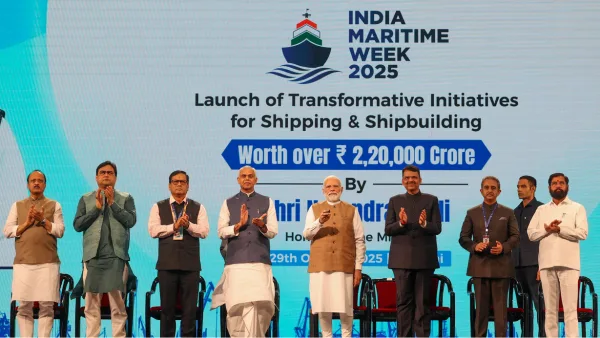
Prime Minister Modi unveiled ₹2.2 lakh crore projects at India Maritime Week 2025, positioning India as a global maritime and shipbuilding hub.
PM Modi Positions India as a Global Maritime Hub
Prime Minister Narendra Modi launched transformative initiatives worth ₹2.2 lakh crore ($26 billion) during India Maritime Week 2025 in Mumbai, marking a historic milestone for India’s maritime ambitions. Addressing the Maritime Leaders Conclave on October 28, Modi declared that “India is a steady lighthouse in rough global seas”, ready to lead in global maritime trade and the blue economy.
The Prime Minister emphasized that India’s ports are now among the most efficient in the developing world, outperforming many in developed nations. He noted that port capacity has nearly doubled over the past decade, vessel turnaround time has halved to 48 hours, and cargo handled in 2024–25 hit record highs.
Next-Generation Shipping Reforms Replace Colonial Laws
A key highlight of Modi’s address at India Maritime Week 2025 was the replacement of century-old colonial shipping laws with modern, futuristic maritime legislation. The new laws strengthen state maritime boards, enhance safety and sustainability standards, and accelerate digitalization in port management.
Under the revised Merchant Shipping Act, India’s regulations are now fully aligned with international maritime conventions, improving ease of doing business and boosting investor confidence. The new Coastal Shipping Act simplifies coastal trade, strengthens supply chains, and promotes balanced development along India’s 7,500 km coastline.
Must Wath Video: India Maritime Week 2025: Modi Launches ₹2.2 Lakh Crore Maritime Reforms
इस साल भारत के Maritime Sector में Next Generation Reforms के लिए कई बड़े कदम उठाए गए हैं। मुझे विश्वास है कि इनसे हमारे Investors का Confidence और अधिक बढ़ेगा। pic.twitter.com/7QSOuDmR3E
— Narendra Modi (@narendramodi) October 29, 2025
Vizhinjam Port and Green Hydrogen Milestones
Highlighting India’s growing global connectivity, Modi celebrated the operationalization of Vizhinjam Port, the country’s first deep-water international transshipment hub, which recently hosted the world’s largest container ship, MSC Irina.
He also announced that Kandla Port has become India’s first to launch a megawatt-scale indigenous green hydrogen facility, while JNPT’s Bharat Mumbai Container Terminal (Phase 2) has doubled its capacity through India’s largest-ever FDI in port infrastructure with support from Singapore.
Massive ₹70,000 Crore Boost for Shipbuilding
In a major policy breakthrough, Modi revealed that large ships have been granted infrastructure asset status, unlocking new financing opportunities for shipbuilders. To catalyze this reform, the government will invest nearly ₹70,000 crore in expanding domestic shipbuilding capacity, financing shipyards, and developing advanced maritime skills.
“Shipbuilding is now among India’s top priorities,” Modi said, recalling India’s ancient maritime legacy from the Ajanta Cave murals depicting three-masted ships. The move, he said, will generate millions of jobs and open the door to greenfield and brownfield shipyard expansion across India.
Must Read: NITI Aayog Report: India’s Services Sector Drives 55% of GVA, Sets Path to Viksit Bharat 2047
Mega Projects and International Investment Push
Modi also announced the construction of a new mega port at Vadhavan, Maharashtra, at a cost of ₹76,000 crore, designed to boost India’s container capacity fourfold. He reiterated that India permits 100% FDI in ports and shipping, with public-private partnerships (PPPs) driving rapid expansion.
At India Maritime Week 2025, over ₹56,000 crore worth of MoUs were signed for port expansion, logistics innovation, and sustainable transport projects. More than 100,000 delegates from 85 countries attended, including CEOs of global maritime giants, policymakers, and innovators, underscoring the forum’s global scale.
Maritime Amrit Kaal Vision 2047: Four Strategic Pillars
The Prime Minister outlined the Maritime Amrit Kaal Vision 2047, centered on four strategic pillars:
- Port-led development
- Growth in shipping and shipbuilding
- Seamless logistics integration
- Maritime skill-building and innovation
Under this vision, India aims to quadruple port capacity, enhance its share in containerized trade, and lead the world in green shipping and blue economy innovation.
Global Leadership and Sustainable Blue Economy
Calling India a “symbol of strategic autonomy, peace, and inclusive growth”, Modi reaffirmed the country’s commitment to strengthening global supply chains, building green logistics corridors, and supporting small island and least-developed nations through technology and training.
He referenced the India–Middle East–Europe Economic Corridor, calling it a transformative initiative that will redefine trade routes through clean energy and smart logistics.
India’s Maritime Decade: Data at a Glance
- Investment Announced: ₹2.2 lakh crore ($26 billion)
- Shipbuilding Investment: ₹70,000 crore
- Vadhavan Port Project: ₹76,000 crore
- FDI in JNPT: Largest in India’s port history
- Port Capacity Growth (10 years): Nearly doubled
- Inland Waterways Cargo Movement: ↑700%
- Operational Waterways: 3 → 32
- Indian Seafarers: 1.25 lakh → 3 lakh
A New Era for India’s Maritime Future
As India Maritime Week 2025 concluded under the inspiring theme “Uniting Oceans, One Maritime Vision,” Prime Minister Modi’s address outlined a transformative blueprint for the nation’s maritime growth. The initiatives announced at India Maritime Week 2025 mark a turning point in India’s global trade and blue economy strategy — combining bold reforms, technology-driven innovation, and sustainable port development.
From the launch of green hydrogen projects at Kandla to record foreign investments in shipbuilding and port infrastructure, India Maritime Week 2025 reaffirmed the country’s determination to emerge as a world leader in the maritime and logistics sector. The event showcased how India Maritime Week 2025 is not just a summit, but a symbol of India’s vision to lead the global maritime future with strength, stability, and sustainability.