

New Delhi| December 31, 2025, 7:30 AM (IST): India and New Zealand have finalized negotiations on a historic Free Trade Agreement (FTA) in December 2025, marking one of India’s fastest trade deals ever. Talks began in March 2025 and concluded on December 22, reflecting strong political will on both sides.
The agreement grants unprecedented zero-tariff access for Indian goods entering New Zealand, while India has carefully safeguarded its most sensitive sectors, particularly dairy. Once signed and ratified domestically, the FTA is expected to come into force in 2026.
This deal is being seen as a major step toward India’s long-term vision of Viksit Bharat 2047 and deeper economic integration in the Indo-Pacific region.
Negotiation Timeline and Economic Context
India-New Zealand trade talks moved at an unusually fast pace. Negotiations were completed in just nine months, underlining strong bilateral trust and economic complementarity.
Bilateral trade currently stands at NZ$3.68 billion annually, with New Zealand ranking as India’s second-largest trading partner in Oceania. The partnership is also supported by strong people-to-people ties. Around 300,000 people of Indian origin live in New Zealand, forming nearly 5% of its population.
The FTA creates a transparent framework covering goods, services, investment, and mobility, with legal texts expected to be released after the formal signing.
Must Read: Uniform Civil Code: Aspirations for Equality, Challenges of Diversity
Major Market Access Gains for India
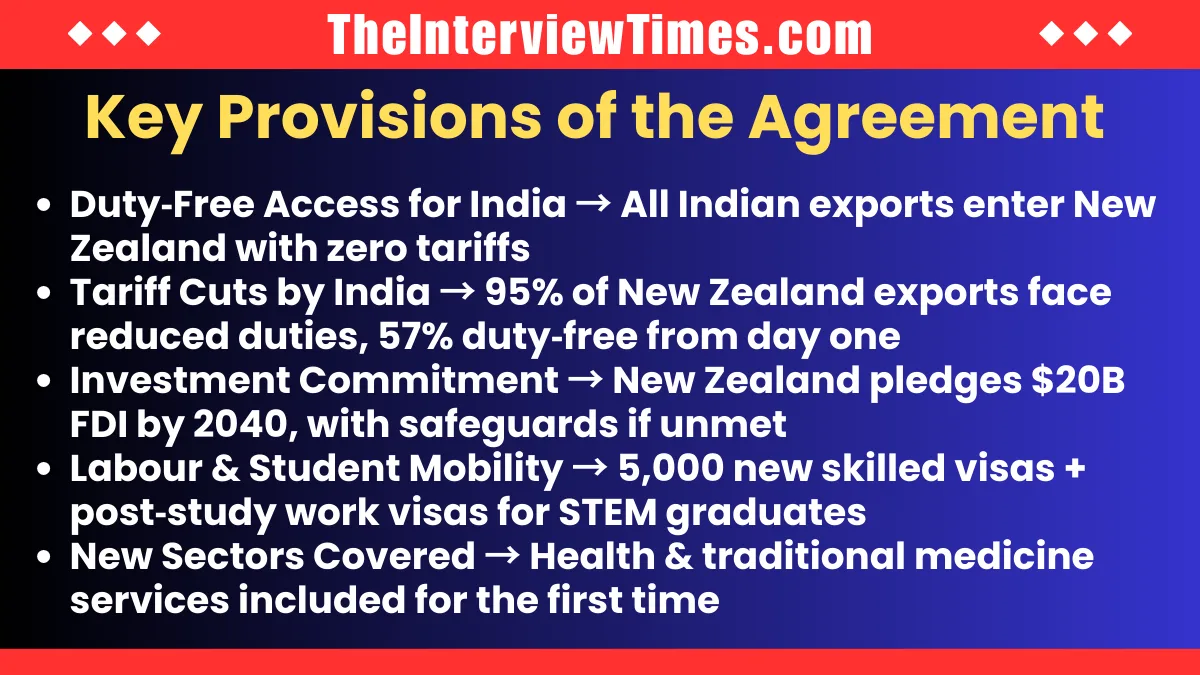
New Zealand has agreed to provide zero-duty access on 100% of Indian tariff lines, removing peak tariffs of up to 10%.
This is a significant boost for labour-intensive and export-driven sectors, including:
- Textiles and clothing: 1,057 tariff lines; FY25 exports at $36.9 billion
- Engineering goods: 1,396 lines; exports grew 20.3% to $77.5 billion
- Agriculture: 1,379 lines covering spices, fruits, coffee, and processed foods
- Leather and footwear: 181 lines; exports worth $5.5 billion
- Pharmaceuticals: 90 lines; exports at $24.5 billion
Indian exporters now gain preferential access to New Zealand’s $11 billion engineering imports market and $2.05 billion plastics and rubber imports from global suppliers.
Marine products, plastics, and rubber goods also receive full market access, opening new opportunities for coastal states and MSMEs.
Addressed the media on the conclusion of #IndiaNZFTA under the focused leadership and guidance of PM @NarendraModi ji.
— Piyush Goyal (@PiyushGoyal) December 22, 2025
Highlighted the unprecedented opportunities this FTA will bring for India and various sectors. Our traders, exporters, MSMEs, farmers, women-led enterprises,… pic.twitter.com/xHiizopRTM
India’s Concessions and Key Safeguards
India has liberalized around 70% of its tariff lines, covering nearly 95% of New Zealand’s exports by value.
About 30% of tariff lines including wood, wool, and sheep meat will see immediate zero-duty access. However, India has firmly protected its dairy sector, which remains either excluded or subject to strict tariff-rate quotas.
Other sensitive agricultural items will see phased tariff reductions, allowing Indian farmers and producers time to adjust. The government has described the FTA’s design as “high opportunity, low risk”, balancing growth with rural protection.
Services, Investment, and Mobility Advantages
The agreement significantly expands Indian access in services, including:
- Information Technology and engineering
- Healthcare and education
- Construction and professional services
- AYUSH practitioners, yoga instructors, chefs, and cultural professionals
New Zealand has committed up to USD 20 billion in investment over 15 years, focusing on manufacturing, infrastructure, and clean technologies.
The pact also includes eased visa rules, expanded working-holiday quotas, better student mobility pathways, and recognition frameworks for professionals.
Additional cooperation areas include organic certification, MSME partnerships, tourism, sports collaboration, and protection of traditional knowledge.
Strategic and Economic Impact
For India, the FTA helps diversify export markets beyond the US, EU, and China. It strengthens India’s role in global value chains, especially in textiles and engineering, and reinforces its position as a skilled workforce hub in Oceania.
For New Zealand, the agreement opens doors to India’s fast-growing consumer market, though limits on dairy imports have sparked debate at home.
Overall, the FTA deepens economic ties, boosts job creation, supports MSMEs and farmers, and strengthens Indo-Pacific economic cooperation.
