
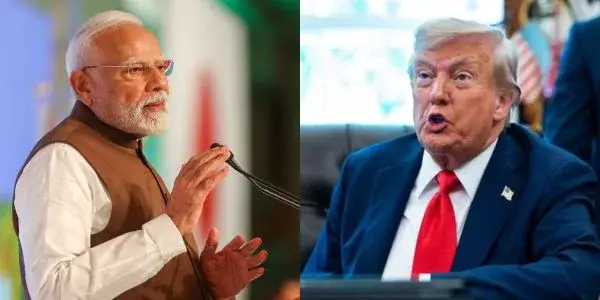
The US has imposed 50% tariffs on key Indian exports, triggering a new phase of India-US trade tensions. This article explores the sectors impacted, India’s strategic response, the role of WTO, and global implications for trade and geopolitics.
India-US Trade Tensions: At a Glance
- Washington imposes 50% tariffs on Indian exports across multiple sectors.
- Key industries hit include textiles, steel, agriculture, and technology equipment.
- India responds with export diversification, WTO challenges, and domestic support schemes.
- The dispute highlights the fragility of global trade amid protectionist trends.
- Long-term implications extend beyond India-US relations to global supply chains and multilateral institutions.
A New Phase in India-US Trade Relations
The decision by the United States to impose a sweeping 50% tariff on select Indian exports has triggered a wave of economic and political debate. For two of the world’s largest democracies, often described as strategic partners in defense, technology, and geopolitics, this move marks a sharp departure from cooperative trade diplomacy.
The US justified the tariffs as a corrective step to address its widening trade deficit with India and to protect domestic industries. India, however, views the measure as an act of economic aggression that undermines the spirit of free trade and fair competition.
This development comes at a time when the global economy is already under stress from slowing growth, inflationary pressures, and shifting supply chains. Against this backdrop, the escalation of India-US trade tensions could have far-reaching consequences.
India-US Trade Tensions: The Historical Context
India and the United States have not always seen eye-to-eye on trade issues. Key flashpoints in the past include:
- Generalized System of Preferences (GSP) Withdrawal (2019): The US ended India’s preferential trade benefits, citing lack of market access.
- IT Services Disputes: India’s dominance in IT services often clashed with US visa and outsourcing policies.
- Agricultural Disputes: India’s farm subsidies and tariffs on dairy, poultry, and grain imports were frequently challenged by Washington.
Despite these disputes, bilateral trade has expanded significantly, reaching over $190 billion in 2024, making the US India’s largest trading partner. However, the imposition of 50% tariffs in 2025 has revived questions about whether both nations can balance their strategic partnership with economic nationalism.
Which Indian Sectors Will Be Hit the Hardest?
The tariffs are not uniform; they target sectors where Indian exports are most competitive in the US market.
1. Textiles and Apparel
India is one of the largest exporters of garments, fabrics, and home textiles to the US. With tariffs doubling costs, Indian exporters face being undercut by Bangladesh, Vietnam, and Mexico, which already enjoy preferential or free trade access.
2. Steel and Metal Products
India’s steel exports, which have grown steadily in the last decade, face a heavy blow. US industries reliant on low-cost Indian steel may now look toward domestic producers or alternative suppliers like South Korea and Brazil.
3. Agriculture and Food Products
Indian exports of spices, rice, organic produce, and processed foods are directly hit. For items like Basmati rice, which command a niche premium, the tariffs may not kill demand entirely but will shrink market size.
4. Technology Equipment and Machinery
While India’s tech exports are dominated by services, recent growth in electronics and hardware shipments to the US faces disruption. This comes just as India is pushing its Make in India for Electronics initiative.
Must Read: What is the SCO? Shanghai Cooperation Organisation and 2025 Summit Explained
India-US Trade Tensions: India’s Strategic Response
The Indian government has rolled out a multi-layered response strategy:
- Diversification of Export Markets
- Strengthening trade ties with ASEAN, Africa, Latin America, and the EU.
- Negotiating bilateral trade deals with partners like the UK and Gulf nations.
- Government Support Schemes
- Financial packages for MSMEs hit by tariffs.
- Expanded subsidies for exporters under the Remission of Duties and Taxes on Exported Products (RoDTEP) scheme.
- Legal Challenge at WTO
- India is preparing to file a formal dispute settlement case at the World Trade Organization, arguing that the tariffs violate trade norms.
- However, given the WTO’s slowed dispute resolution mechanism, the outcome may take years.
- Retaliatory Measures?
- India could consider imposing mirror tariffs on select US imports.
- Yet, this carries the risk of escalating into a full-blown trade war.
India-US Trade Tensions: Global Trade Implications
The consequences of this dispute extend beyond bilateral trade.
- Supply Chain Realignments: US companies relying on Indian raw materials and goods may face higher costs, forcing them to restructure supply chains.
- Emerging Competitors: Countries like Vietnam, Bangladesh, and Brazil may seize India’s lost market share in the US.
- Pressure on Multilateralism: With WTO’s credibility already under strain, another major dispute tests the strength of rules-based global trade governance.
- Geopolitical Angle: The US risks alienating India at a time when Washington is seeking New Delhi’s partnership to counterbalance China in Asia.
A Test of India’s Economic Resilience
The resilience of India’s economy will depend on how quickly it can adapt to new realities:
- Expanding domestic demand to absorb surplus production.
- Enhancing value-added manufacturing to compete globally despite tariffs.
- Leveraging regional trade agreements to bypass over-dependence on the US market.
For the Modi government, the challenge lies in balancing domestic political pressures with long-term economic reforms that make Indian exports more competitive.
Looking Ahead: Possible Scenarios
- Negotiated Settlement – Backchannel talks lead to partial tariff rollbacks in exchange for concessions on market access or intellectual property.
- Extended Trade War – Both nations escalate tariffs, hurting industries on both sides and fueling global uncertainty.
- Diversified India – India succeeds in pivoting to new markets, reducing reliance on the US while strengthening ties with EU, ASEAN, and BRICS nations.
India-US Trade Tensions: Conclusion
The imposition of 50% tariffs by the United States has triggered one of the most serious episodes of India-US trade tensions in recent years. While the immediate impact will hurt Indian exporters in textiles, steel, and agriculture, the broader question is whether India can leverage this crisis to reshape its trade strategy for the future.
The episode underscores a larger trend: in a world where protectionism is rising, economic resilience requires diversification, competitiveness, and strategic diplomacy.
For India, this is not just about responding to the US. It is about positioning itself as a global trade power capable of weathering shocks and turning challenges into opportunities.