
TheInterviewTimes.com | March 01, 2026 | 07:10 PM IST | New Delhi
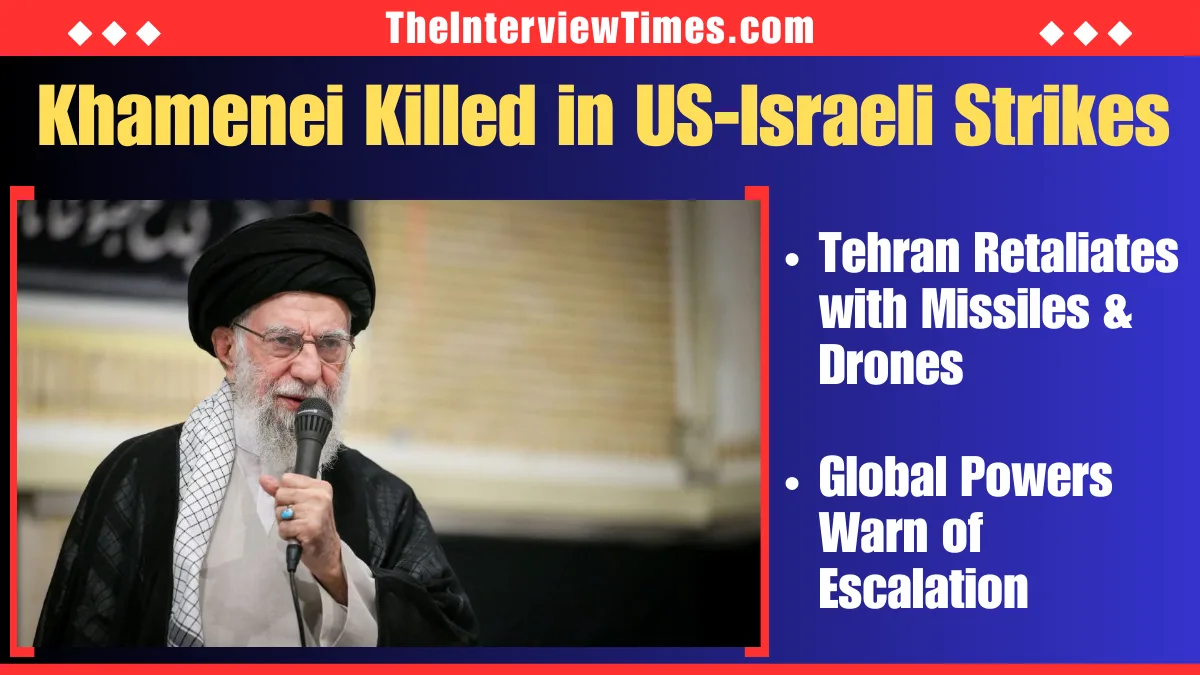
Iran’s Supreme Leader Ayatollah Ali Khamenei has been killed in joint US and Israeli airstrikes on Tehran, Iranian state media confirmed on Sunday, triggering immediate retaliatory missile and drone attacks across Israel and US-linked sites in the Gulf.
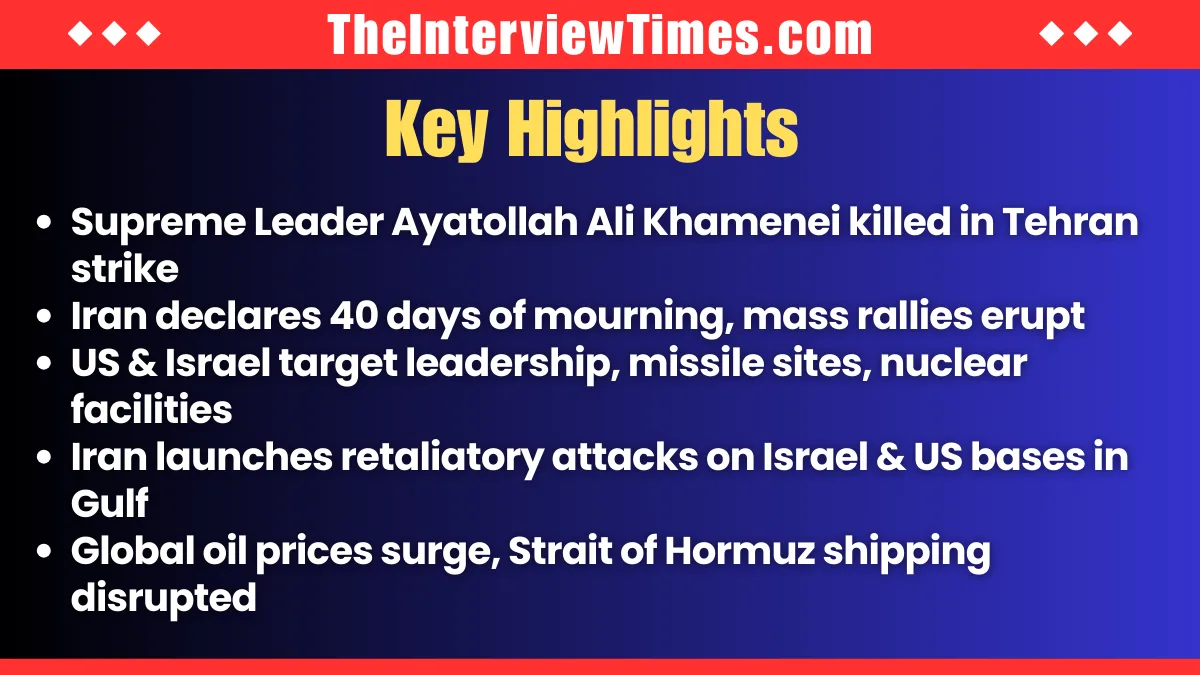
The 86-year-old cleric, who had ruled Iran since succeeding Ayatollah Ruhollah Khomeini in 1989, died when strikes hit his office compound in the capital late on Saturday local time. Iranian officials described the attack as a “great crime” and an act of war, while President Masoud Pezeshkian stated that revenge was Iran’s “legitimate right.”
Iran has declared 40 days of national mourning. Thousands gathered in Tehran’s Revolution Square and other cities on Sunday, holding portraits of Khamenei and chanting in support of the regime. State television broadcast images of mourners, with some weeping openly.
The US and Israel launched the operation amid failed nuclear negotiations and escalating tensions. US President Donald Trump announced Khamenei’s death on social media, calling him one of history’s most evil figures and urging Iranians to “take back their country.” Trump warned that any further Iranian retaliation would be met with “force never seen before.”
Israeli officials said the strikes targeted leadership, ballistic missile sites, air defenses, and nuclear-related facilities to establish air superiority and eliminate threats. Israel reported renewing attacks on central Tehran on Sunday, with explosions reported in the city center and smoke rising over the skyline.
Casualties remain unclear but are significant. Iran’s Red Crescent Society reported more than 200 deaths from the initial strikes, including civilians. One Iranian claim said over 100 girls were killed at an elementary school near a military site. In Israel, at least seven people died from Iranian missile strikes, including in Beit Shemesh, with dozens injured.
Iran’s response began swiftly, with barrages targeting Israeli cities and US military bases in Bahrain, Kuwait, Qatar, the UAE, Jordan, Iraq, and Oman. Explosions hit Dubai and other Gulf locations, disrupting airports and causing civilian injuries. Iran fired dozens of missiles at Qatar alone, with shrapnel reported. The Islamic Revolutionary Guard Corps (IRGC) vowed the “most devastating offensive” yet, with senior official Ali Larijani promising strikes “with a force never experienced before.”
Top News: Global Firepower Index 2025: U.S. Tops List, China and Russia Tie for Second, India Holds Fourth
Iran activated constitutional succession procedures. Senior cleric Ayatollah Alireza Arafi was named to head an interim Leadership Council or transitional body to govern until the Assembly of Experts selects a permanent supreme leader. Pragmatist figures like Ali Larijani have gained prominence in the power vacuum.
International reactions split sharply. Russian President Vladimir Putin condemned the killing as a “cynical violation of human morality.” China’s foreign ministry called for an immediate ceasefire. EU foreign policy chief Kaja Kallas described it as a “defining moment” for Iran. French President Emmanuel Macron warned of grave global consequences.
The UN Security Council is expected to meet urgently. US Congress plans a vote on a war powers resolution soon. Anti-war protests targeted US and Israeli embassies in several cities.
The conflict has disrupted global energy markets, with oil prices surging amid threats to the Strait of Hormuz. Shipping halted in parts of the Gulf, leaving hundreds of tankers idle, and Gulf stock markets fell sharply.
The killing of Khamenei marks one of the most consequential events for Iran since the 1979 Islamic Revolution. As strikes continue into a second day and both sides signal no immediate de-escalation, the risk of a broader regional war remains high.
Top News: The Strait of Hormuz: The World’s Most Critical Oil Chokepoint and Iran’s Threats Explained
