
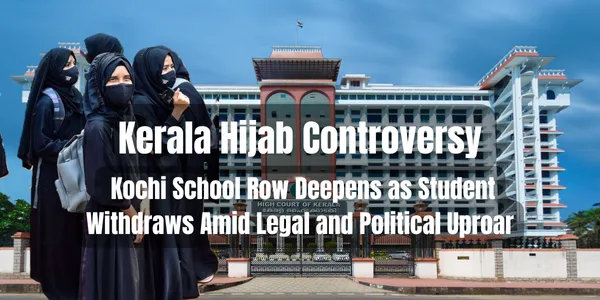
Kerala Hijab Controversy intensifies as a Class 8 Muslim student withdraws from St. Rita’s Public School, Kochi, citing stress amid a legal tussle over religious freedom and uniform policy.
Kerala Hijab Controversy Overview
The Kerala Hijab Controversy deepened this week after a Class 8 Muslim student withdrew from St. Rita’s Public School in Palluruthy, Kochi, citing severe mental distress from the ongoing dispute over wearing a hijab in class. The development followed the Kerala High Court’s refusal to grant an interim stay on the Deputy Director of Education’s (DDE) directive permitting the student to wear a headscarf that matches her school uniform.
While the court maintained the DDE’s order temporarily, it also directed the state government to file a detailed response, keeping the matter alive in public and legal debate.
Must Read: Dhanteras 2025: Date, Significance, Puja Muhurat, Rituals and Dhanvantari Mantra
Background: How the Kerala Hijab Controversy Began
The Kerala Hijab Controversy began on October 10, 2025, when the student—whose identity has been withheld for privacy reasons—attended class wearing a headscarf. The Christian minority-run CBSE-affiliated school, managed by the Catholic Church, viewed this as a violation of its strict uniform policy.
The school cited the 2018 Kerala High Court ruling in Fathima Thasneem v. State of Kerala, which upheld the right of educational institutions to enforce uniform codes even when they conflict with individual religious attire. Consequently, the student was denied entry to class, prompting her father, Anas Naina, to lodge a complaint with the Deputy Director of Education (Ernakulam), alleging discrimination and a violation of the Right to Education Act.
Following an inquiry, the DDE issued an order on October 14, terming the school’s action a “serious violation of conduct” and directing it to allow the student to attend classes with a hijab in uniform colors. Kerala Education Minister V. Sivankutty endorsed the directive, asserting that “a child’s educational rights cannot be denied under any circumstances.”
Amid protests and heightened tension, the school briefly shut down for two days and resumed operations under police protection on October 16. The management denied expelling the student, claiming her absence was due to illness, and criticized the DDE for failing to consult all stakeholders, including the Parent-Teacher Association (PTA).
Kerala Hijab Controversy: Kerala High Court’s Interim Decision
On October 17, the school management filed a writ petition before the Kerala High Court, challenging the DDE’s directive. The school argued that the order exceeded the education department’s jurisdiction over CBSE institutions and infringed upon their constitutional rights as a Christian minority-run institution under Article 30.
Justice Shobha Annamma Eapen, presiding over the single bench, declined to grant an interim stay. The court noted that there was no imminent coercive action and asked the State Attorney to obtain government instructions before the next hearing scheduled for October 24, 2025.
Legal observers describe this as a temporary setback for the school, maintaining the student’s right to wear a hijab in line with the DDE’s ruling. The court’s eventual decision could set a major precedent by balancing Article 25 (freedom of religion) with the autonomy of minority institutions.
Must Read: Dhanteras Mantras 2025: The Most Powerful Mantras for Prosperity, Health, and Protection
Student Withdraws from School
In a surprising turn, the student’s father announced their decision to withdraw her admission on October 17, citing prolonged stress and disruption to her education. “She was under immense mental pressure. We don’t want to continue this battle at the cost of her well-being,” said Anas Naina, speaking to reporters.
Family sources revealed that the issue had escalated beyond expectations, with social media debates amplifying the emotional toll. The family plans to enroll the student in another local school where she can continue her education peacefully.
St. Rita’s management held an urgent PTA meeting and reiterated its stance on maintaining uniform discipline while denying any coercion. Police personnel remain stationed at the school to ensure safety amid the ongoing Kerala Hijab Controversy.
Political and Public Reactions
The Kerala Hijab Controversy has reignited debates around religious freedom and secularism in India’s education system. Comparisons are being drawn to the 2022 Karnataka Hijab Ban Case, where the courts ruled that wearing a hijab is not an essential religious practice under Islam.
In Kerala, the state government’s intervention has drawn mixed reactions. While some political voices accuse the CPI(M) government of “appeasement politics,” others view the move as a necessary step to protect students’ fundamental rights.
BJP State Vice President Shaun George alleged that such controversies are part of “a wider pattern involving religious influence in schools,” while Minister Sivankutty defended the DDE’s order as being “in line with constitutional principles.”
Social media platforms like X (formerly Twitter) have seen divided reactions—some users demand strict adherence to school dress codes, while others emphasize the right to religious expression.
What Lies Ahead
As the Kerala High Court prepares for its next hearing on October 24, educationists warn that the outcome could influence policy decisions for minority and private schools nationwide. The Kerala Hijab Controversy not only highlights a clash between institutional regulations and personal freedoms but also underscores the emotional and educational impact such disputes have on students.
For now, the young student’s withdrawal from St. Rita’s Public School marks a somber pause in this legal and social battle—one that continues to test Kerala’s ideals of inclusivity and secular education.