
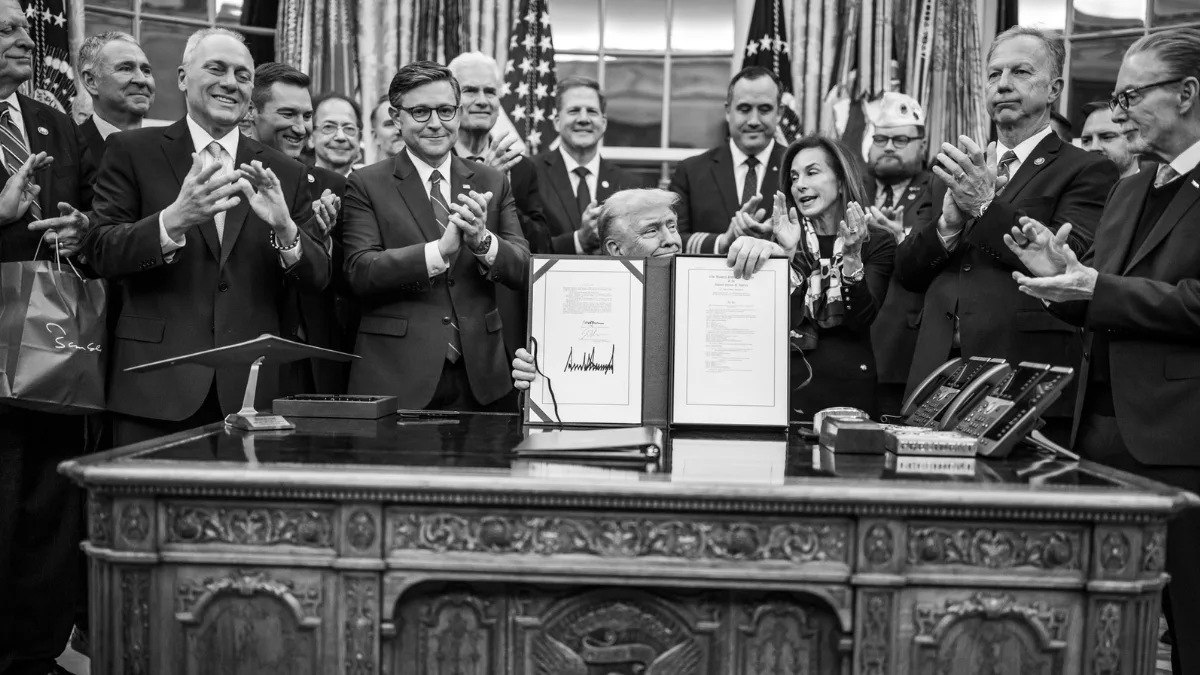
President Trump ends the Longest U.S. Government Shutdown after 43 days, reopening agencies, restoring worker pay, and easing economic strain.
Government Reopens After Record 43-Day Shutdown
TheInterviewTimes.com | November 13, 2025 — The United States government reopened on Thursday after President Donald Trump signed a short-term funding bill into law, ending the Longest U.S. Government Shutdown in history. The 43-day impasse disrupted essential services, left 1.4 million federal workers without pay, and imposed a heavy economic toll on the nation.
The shutdown began on October 1, 2025, when Congress failed to approve new funding at the start of the fiscal year. The main dispute centered on Democratic demands in the Senate to extend enhanced Affordable Care Act (ACA) subsidies, which support health insurance for 24 million Americans.
After 43 days of federal paralysis, President Donald Trump signed a bipartisan measure restoring government operations and officially ending the Longest U.S. Government Shutdown in American history. The standoff cost billions, delayed paychecks, and reshaped the political landscape ahead of the 2026 midterms.
Highlights
- President Trump signs a short-term funding bill, ending the Longest U.S. Government Shutdown after 43 days.
- Shutdown caused an estimated $11 billion permanent loss to GDP.
- Federal employees to receive full back pay and return to work immediately.
- The Affordable Care Act subsidy extension remains unresolved.
- Another funding deadline looms on January 30, 2026.
Political Battle Over Health Subsidies
Republicans, who controlled both chambers and the White House, accused Democrats of leveraging the Longest U.S. Government Shutdown for political gain. Democrats argued they were fighting to preserve affordable healthcare.
After weeks of negotiations, a compromise emerged when eight Senate Democrats joined Republicans to advance a continuing resolution. The final bill passed 222–209 in the House and extended funding through January 30, 2026. It includes full-year appropriations for SNAP, veterans’ programs, military construction, and agriculture—while guaranteeing back pay for furloughed employees.
Trump Signs the Bill in the Oval Office
At a late-night ceremony in the Oval Office, surrounded by cabinet officials and congressional allies, President Trump signed the legislation, declaring,
“The Democrats tried to extort our country. We’re sending a clear message that we will never give in to extortion. This is no way to run a nation.”
The White House emphasized that the Longest U.S. Government Shutdown must “never happen again,” highlighting the damage caused to public trust and the economy.
President Trump signs bill to OFFICIALLY reopen the government, ending the Democrat Shutdown.
— The White House (@WhiteHouse) November 13, 2025
Let's get our country WORKING again. 🇺🇸 pic.twitter.com/QJqX90k9sC
Impact on Federal Workers and Services
Federal agencies have been instructed to resume operations immediately. The Office of Management and Budget directed furloughed employees to return on November 13, ensuring back pay within the next payroll cycle.
Air travel disruptions that worsened during the Longest U.S. Government Shutdown will gradually ease as air traffic controllers and TSA staff return. SNAP benefits, delayed for millions, will also resume within 24 hours.
The economic fallout is significant: according to the Congressional Budget Office, the shutdown caused a permanent GDP loss of $11 billion, surpassing the previous record set in 2019.
Historical Timeline of U.S. Government Shutdowns
To understand the scale of the 2025 event, here’s a complete historical overview of every U.S. government shutdown since the modern budget process began in 1976 — underscoring how the Longest U.S. Government Shutdown redefined political brinkmanship.
| # | Dates | Duration | President | Congress Control | Primary Cause | Key Details |
| 1 | Sep 30 – Oct 11, 1976 | 10 days | Gerald Ford (R) | Dem House & Senate | Abortion funding in Medicaid | First modern shutdown |
| 2 | Sep 30 – Oct 13, 1977 | 12 days | Jimmy Carter (D) | Dem House & Senate | Abortion + pay raise | Affected 5 agencies |
| 3 | Oct 31 – Nov 9, 1977 | 8 days | Jimmy Carter | Dem House & Senate | Abortion funding again | 2nd of 3 in 1977 |
| 4 | Nov 30 – Dec 9, 1977 | 9 days | Jimmy Carter | Dem House & Senate | Abortion + energy policy | 3rd consecutive |
| 5 | Sep 30 – Oct 18, 1978 | 18 days | Jimmy Carter | Dem House & Senate | Pay + defense spending | Longest until 1995 |
| 6 | Sep 30 – Oct 12, 1979 | 11 days | Jimmy Carter | Dem House & Senate | Pay + abortion | Partial |
| 7 | Nov 20 – Nov 23, 1981 | 3 days | Ronald Reagan (R) | Dem House, Rep Senate | Defense vs. social programs | First Reagan |
| 8 | Sep 30 – Oct 2, 1982 | 2 days | Ronald Reagan | Dem House, Rep Senate | Spending levels | Weekend closure |
| 9 | Dec 17 – Dec 21, 1982 | 4 days | Ronald Reagan | Dem House, Rep Senate | Highway + MX missile | Partial |
| 10 | Nov 10 – Nov 14, 1983 | 4 days | Ronald Reagan | Dem House, Rep Senate | Education funding | Partial |
| 11 | Sep 30 – Oct 3, 1984 | 3 days | Ronald Reagan | Dem House, Rep Senate | Crime bill | Partial |
| 12 | Oct 3 – Oct 5, 1984 | 2 days | Ronald Reagan | Dem House, Rep Senate | Resolution delay | 2nd in 5 days |
| 13 | Oct 16 – Oct 18, 1986 | 2 days | Ronald Reagan | Dem House, Rep Senate | Budget timing | Weekend shutdown |
| 14 | Dec 18 – Dec 20, 1987 | 2 days | Ronald Reagan | Dem House & Senate | Nicaragua aid | Partial |
| 15 | Oct 5 – Oct 9, 1990 | 4 days | George H.W. Bush (R) | Dem House & Senate | Deficit deal | Gramm-Rudman |
| 16 | Nov 19, 1995 – Jan 6, 1996 | 21 days | Bill Clinton (D) | Rep House & Senate | Balanced budget | Gingrich-Clinton standoff |
| 17 | Dec 16, 1995 – Jan 6, 1996 | 5 days | Bill Clinton | Rep House & Senate | Same issue | Often combined |
| 18 | Sep 30 – Oct 17, 2013 | 16 days | Barack Obama (D) | Dem Senate, Rep House | ACA defunding | Tea Party-driven |
| 19 | Jan 20 – Jan 23, 2018 | 3 days | Donald Trump (R) | Rep House & Senate | DACA + CHIP | “Schumer Shutdown” |
| 20 | Dec 22, 2018 – Jan 25, 2019 | 35 days | Donald Trump | Dem House, Rep Senate | Border wall | Longest until 2025 |
| 21 | Oct 1 – Nov 13, 2025 | 43 days | Donald Trump | Rep House & Senate | ACA subsidy expiration | Longest U.S. Government Shutdown |
Must Read: India e-Arrival Card 2025 for Foreigners: Step-by-Step Process, Rules, and Key Benefits
Aftermath and Political Fallout
Polls showed mixed public reaction, but most Americans blamed the governing party for the Longest U.S. Government Shutdown. Analysts suggest that while the government has reopened, the political scars remain deep, and healthcare policy will dominate upcoming fiscal debates.
The next major challenge arrives on January 30, 2026, when the short-term funding expires — setting up another potential showdown in Washington.
Conclusion
The Longest U.S. Government Shutdown in American history has ended, but its consequences will linger for months — from lost productivity to shaken public confidence. As the U.S. government returns to full function, all eyes are now on Congress to prevent another crisis before the next deadline.