
Mars Climate Change: IIT Bombay Scientists Trace Ancient Shift Using Valley Networks
Mars climate change is traced by IIT Bombay scientists using ancient valley networks, revealing how Mars shifted from warm and wet to cold and icy.
Key Highlights
- IIT Bombay researchers mapped over 150 Martian valley networks to study long-term climate evolution
- Findings show Mars transitioned from a warm, wet climate to a colder, ice-dominated environment
- Valley shapes indicate a shift from river-driven erosion to glacial and fluvioglacial processes
- Study focuses on the Thaumasia Highlands, a geologically diverse region in Mars’ southern hemisphere
Mars Climate Change Evidence Found in Ancient Martian Valleys
Scientists from the Indian Institute of Technology (IIT) Bombay have presented new geological evidence explaining Mars climate change over billions of years, showing how the planet evolved from a water-rich world into the cold, arid environment seen today. The study analyzes ancient valley networks in the Thaumasia Highlands region of Mars and traces a gradual climate transition between approximately 4 billion and 3 billion years ago.
The research was led by Professor Alok Porwal and relies entirely on high-resolution orbital data from international Mars missions. By examining valley shapes, drainage patterns, and geological ages, the team reconstructed how surface water activity declined as temperatures fell and ice increasingly shaped the Martian landscape.
Must Read: The Future of Space Farming: Can We Grow Food on Mars?
Why the Thaumasia Highlands Matter for Mars Climate Change
The Thaumasia Highlands lie in Mars’ southern hemisphere, southeast of the Tharsis volcanic plateau and southwest of the Valles Marineris canyon system. The region extends from near-equatorial latitudes to higher southern latitudes, making it ideal for studying how climate conditions varied across Mars.
According to the researchers, this latitudinal spread allows scientists to observe how Mars climate change affected erosion processes differently across the planet. The area also contains some of Mars’ oldest geological surfaces, dating back to the Noachian period, alongside younger terrains from the Hesperian era.
This combination makes the Thaumasia Highlands a natural archive of Martian climate history.
How Scientists Studied Mars Climate Change
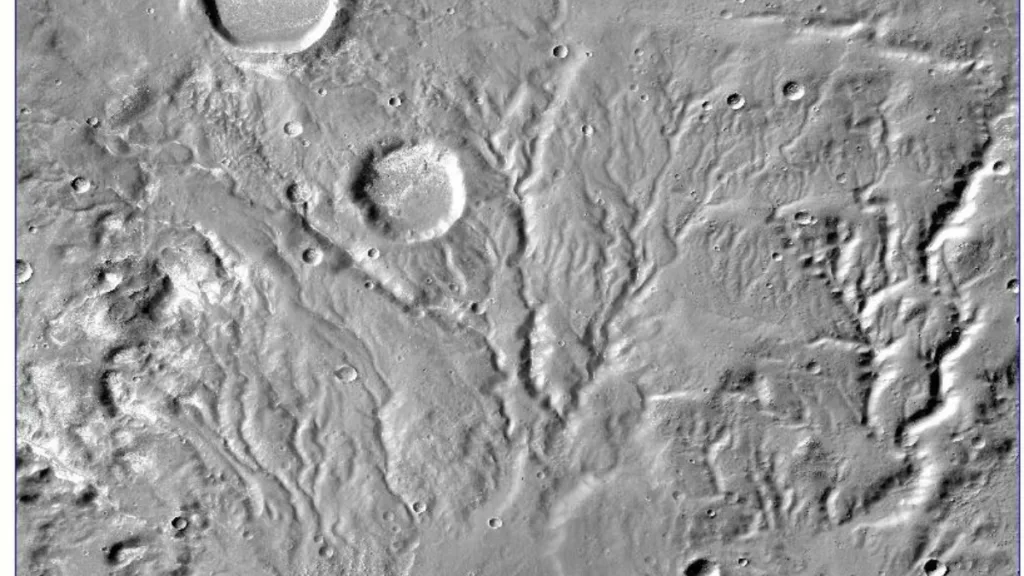
The IIT Bombay team mapped more than 150 valley networks using data from NASA’s Mars Reconnaissance Orbiter, including the Context Camera imagery and Mars Orbiter Laser Altimeter elevation models. They also used datasets from the European Space Agency’s High Resolution Stereo Camera aboard Mars Express, along with other global mosaics.
Valleys were classified based on their cross-sectional shapes, junction angles, and associated landforms. V-shaped valleys typically indicate erosion by flowing surface water, while U-shaped valleys are commonly formed by glacial movement. These distinctions are well-established in planetary and terrestrial geology.
The researchers also examined the geological age of surrounding terrain to link valley formation with specific periods in Mars’ history.
From Flowing Rivers to Frozen Ice
The analysis shows that low-latitude valleys near the Martian equator are predominantly V-shaped. These valleys formed mainly during the Noachian period, roughly 4.1 to 3.7 billion years ago, when liquid water could flow across the surface.
As Mars climate change progressed, valleys at higher latitudes began to show U-shaped profiles and other features linked to glacial or fluvioglacial erosion. This indicates that ice increasingly replaced liquid water as the dominant agent shaping the surface.
During the transition from the Noachian to the Hesperian period, valley formation declined sharply. Existing valleys were modified by ice movement and groundwater processes, reflecting a colder environment with frozen subsurface water.
What This Means for Mars’ Past Habitability
The findings reinforce the idea that early Mars was capable of sustaining surface water for extended periods. Rivers, runoff, and possibly lakes were common before the planet lost much of its atmosphere and heat.
By tracking Mars climate change through valley networks, scientists gain insight into when and where habitable conditions may have existed. These results help narrow down time windows and locations that future Mars missions could target in the search for signs of ancient microbial life.
The study also demonstrates how planetary-scale climate transitions can be reconstructed without direct surface sampling, using orbital data alone.
India’s Growing Role in Planetary Science
The IIT Bombay research highlights India’s increasing contribution to global planetary science. The study integrates data from international missions, including NASA and the European Space Agency, and builds on observations from ISRO’s Mars Orbiter Mission.
Researchers emphasize that future progress will depend on combining orbital analysis with lander-based geophysical measurements and higher-resolution imaging to further refine models of Mars climate change.
As Mars exploration continues, studies like this provide a clearer understanding of how planetary environments evolve—and why Mars and Earth, despite similar beginnings, followed dramatically different paths.