
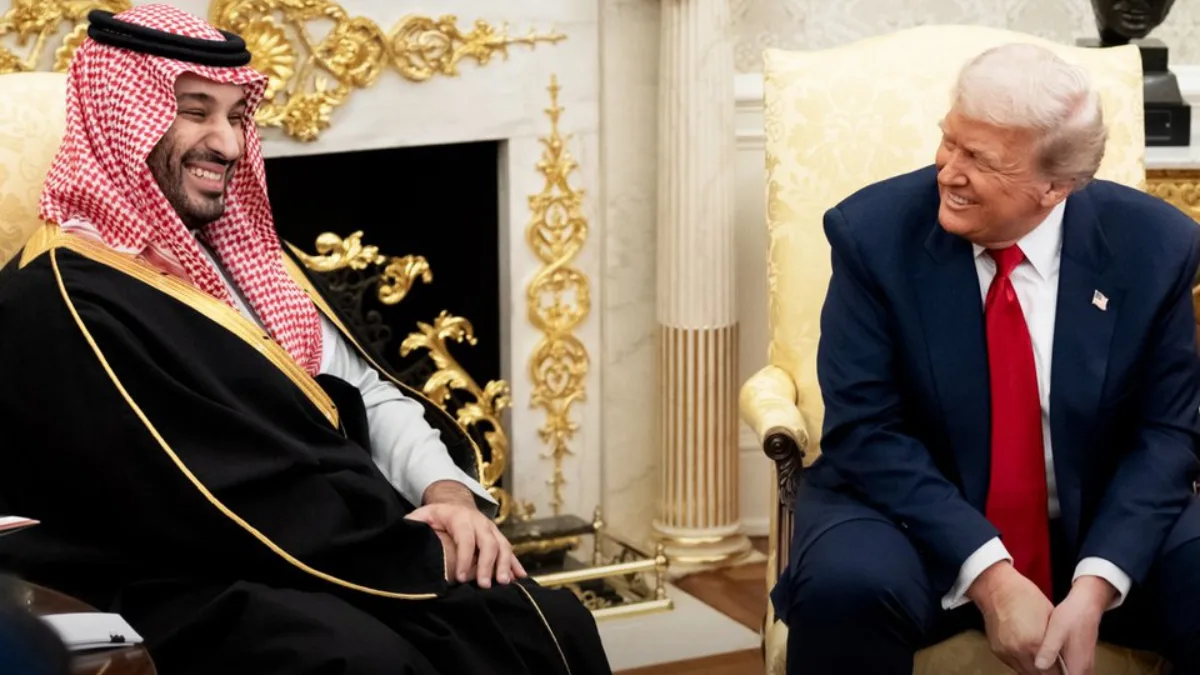
The MBS Trump Meeting at the White House reopened a new era in US–Saudi relations as President Donald Trump and Crown Prince Mohammed bin Salman announced nearly $1 trillion in investments, major defense deals, AI partnerships, and fresh talks on Middle East peace. The high-stakes summit set the stage for a strategic shift across global politics, security, and technology.
MBS Trump Meeting Sets Stage for a New Era in US–Saudi Relations
TheInterviewTimes.com | November 18, 2025: The MBS Trump Meeting at the White House has reshaped the global conversation on US–Saudi relations. On November 18, 2025, U.S. President Donald Trump welcomed Saudi Crown Prince Mohammed bin Salman (MBS) for a landmark visit that combined symbolism, diplomacy, and massive economic agreements.
It marked MBS’s first trip to the United States in seven years. The day-long summit featured a red-carpet welcome, a state luncheon, high-level talks, and a black-tie dinner attended by political leaders, global CEOs, and celebrities.
The meeting aimed to reset the relationship after years of tension, particularly following the 2018 murder of journalist Jamal Khashoggi and political disputes over the Saudi role in regional conflicts. The White House presented the visit as a “fresh start,” while Saudi Arabia framed it as a strategic partnership for the future.
This summit was not only ceremonial. It signaled a significant pivot in global geopolitics, regional security, energy markets, and the emerging competition in AI and advanced technologies.
A Historic Reset: Addressing the Past, Prioritizing the Future
The relationship between Washington and Riyadh has experienced deep strains. The Khashoggi killing in 2018 turned MBS into an international pariah. U.S. intelligence agencies concluded that the crown prince approved the operation. Trump, however, has consistently defended him. During the MBS Trump Meeting, when a reporter asked Trump about Khashoggi, the president notably replied, “Things happen,” while MBS called it a “huge mistake.”
Human rights groups condemned the dismissive tone, but both leaders kept the focus on strategic cooperation and future investments.
The summit also revisited the emotional scars of the September 11, 2001 terrorist attacks, in which 15 of the 19 hijackers were Saudi nationals. Families of the victims urged Trump to demand accountability. During a tense moment in the Oval Office, ABC News journalist Mary Bruce asked MBS about these concerns. MBS responded carefully, expressing sympathy for families and reiterating Saudi Arabia’s denial of government involvement. Trump interrupted to defend his guest, accusing the reporter of “fake news.”
While many 9/11 families criticized MBS for “rewriting history,” the moment demonstrated his attempt to rebuild trust and close unresolved chapters.

A Grand Welcome: Symbolism and Diplomacy on Full Display
The White House staged a show of strength and unity for the visit. Cannon fire echoed across the South Lawn, fighter jets performed a ceremonial flyover, and crowds watched the two leaders shake hands on a red carpet.
Trump introduced MBS as “one of the greatest leaders in the world,” emphasizing the long-standing strategic relationship between the two nations. The leaders held private talks in the Oval Office before joining Cabinet officials and industry heads for deeper discussions on defense, technology, and energy.
The evening’s black-tie dinner included tech executives, senators, and global sports personalities, including football star Cristiano Ronaldo, currently playing in the Saudi Pro League. The following morning, both leaders attended an investment summit at the Kennedy Center to sign additional agreements.
Massive Deals: The $1 Trillion Investment and Strategic Pact
The MBS Trump Meeting produced one of the largest economic partnership packages in US–Saudi history. The agreements span investments, defense cooperation, energy, AI, and critical minerals.
1. Nearly $1 Trillion Investment Pledge
Saudi Arabia committed to investing almost $1 trillion into U.S. industries and infrastructure over the coming years. This surpasses the $600 billion pledge from Trump’s earlier 2025 visit to Riyadh. The funds will support:
- Advanced manufacturing
- Semiconductor plants
- Green energy projects
- Roads, ports, and logistics
- Tech startups and innovation hubs
MBS framed the investments as part of Vision 2030, Saudi Arabia’s plan to diversify away from oil. Trump called the move a “historic boost” for American workers.
2. Defense and Security Cooperation
A major breakthrough was the U.S. decision to designate Saudi Arabia as a Major Non-NATO Ally (MNNA). This special status enhances military cooperation without requiring a defense treaty.
Key defense agreements included:
- U.S. sale of F-35 fighter jets to Saudi Arabia for the first time
- Sale of 300 advanced tanks
- Creation of a Strategic Defense Agreement to coordinate responses to regional threats
Israel previously opposed any F-35 sales to Arab nations. Intelligence officials also worried about technology transfer to China. Despite this, Trump affirmed that the deal would “strengthen stability” in the region.
3. AI, Nuclear Energy, and Critical Minerals
Both nations signed technology-heavy agreements aimed at shaping the future of global tech and energy.
- Civil Nuclear Cooperation: U.S. firms will help Saudi Arabia develop peaceful nuclear power plants.
- AI Partnership: Saudi Arabia will gain access to advanced U.S. computing chips under strict security protocols.
- Critical Minerals Agreement: Joint mining and supply chain projects will reduce U.S. dependency on China for rare earth metals.
Both leaders framed these agreements as essential in securing economic leadership in the decades to come.
MBS Trump Meeting 2025: Regional Diplomacy
Beyond business, the MBS Trump Meeting focused on the region’s most sensitive political issues.
Expanding the Abraham Accords
Trump revived the Abraham Accords, his signature 2020 achievements that normalized ties between Israel and several Arab states. He pressed Saudi Arabia to formally join.
MBS said Saudi Arabia was open to joining the Accords on one condition: a clear, credible path to a two-state solution for Palestinians, with 1967 borders and East Jerusalem as its capital.
Trump responded that both “one-state and two-state” solutions were on the table.
Other Regional Files
The leaders also discussed:
- Iran’s regional influence
- Ending the war in Yemen
- Stabilizing Lebanon and Syria
- Counter-terrorism coordination
Experts say Saudi participation in the Abraham Accords would reshape the Middle East’s security landscape, though Israeli political divisions may slow progress.
Why the MBS Trump Meeting Matters
The MBS Trump Meeting has reshaped the conversation on strategic alliances. After years of freeze under the Biden administration, Trump’s return to office restored warm ties between Washington and Riyadh.
For the United States, benefits include:
- More exports and industrial growth
- A stronger energy partnership
- Access to Saudi financing for major projects
- A stable ally in a turbulent region
For Saudi Arabia, gains include:
- Advanced military technology
- A pathway into AI leadership
- Nuclear energy support
- A stable long-term relationship with Washington
Online reaction was mixed. Trump supporters praised the agreements as “historic” for American jobs, while critics condemned the dismissal of human rights issues. Social media also buzzed over Ronaldo’s surprise appearance at the White House.
Key Takeaways
- The MBS Trump Meeting delivered nearly $1 trillion in Saudi investments for U.S. industries.
- The U.S. granted Saudi Arabia Major Non-NATO Ally status, deepening military ties.
- Major deals include F-35 jets, AI cooperation, nuclear energy, and critical minerals partnerships.
- Middle East peace talks were revived, though major challenges remain.
- The summit marks a decisive reset in U.S.–Saudi relations with global consequences.