
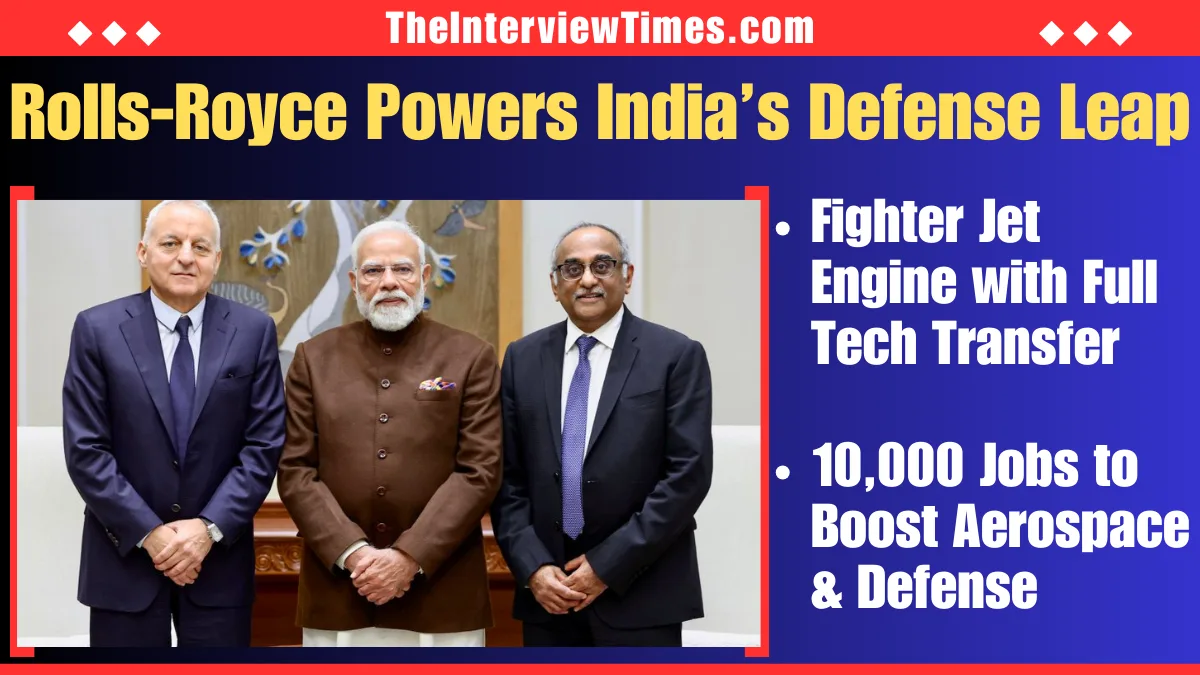
Rolls-Royce unveils major India expansion with AMCA fighter jet engine offer, full technology transfer, and 10,000 new jobs across defense and aviation sectors.
Key Highlights
- Rolls-Royce India expansion centers on a 120 kN AMCA fighter jet engine proposal with full technology transfer.
- Plan includes complete intellectual property rights for India and local design and manufacturing hubs.
- Company aims to create up to 10,000 high-skill jobs across defense and aerospace sectors.
- Proposal supports Atmanirbhar Bharat and aligns with the India-UK Vision 2030 roadmap.
- Over 1,400 Rolls-Royce engines already power Indian military platforms.
Rolls-Royce India Expansion Gains Momentum After PM Modi Meeting
The Rolls-Royce India expansion has taken a major step forward after CEO Tufan Erginbilgic met Prime Minister Narendra Modi to discuss deeper collaboration in defense, aviation, and energy.
The British aerospace giant announced ambitious plans that could transform India into a strategic manufacturing and technology hub. At the center of this announcement is a fighter jet engine proposal linked to India’s Advanced Medium Combat Aircraft program.
The move signals growing confidence in India’s defense manufacturing ecosystem and reinforces the country’s push toward indigenous capability development.
Our CEO Tufan Erginbilgic met Hon’ble PM Shri @narendramodi today to discuss how Rolls-Royce is scaling up to be a part of Viksit Bharat, including expanding its GCC to be the largest globally, co-creating complex manufacturing and building high-value engineering capabilities. pic.twitter.com/zTm5NcwL6Q
— Rolls-Royce India (@RollsRoyceIndia) February 11, 2026
AMCA Fighter Jet Engine with Full Technology Transfer

A core element of the Rolls-Royce India expansion is the proposal to co-develop a 120 kilonewton class engine for India’s Advanced Medium Combat Aircraft. The AMCA is India’s next-generation stealth fighter currently under development.
Rolls-Royce has offered complete intellectual property rights to India under this partnership. This is a significant development, as access to full technology rights would allow India to design, upgrade, and export the engine independently in the future.
The company has also proposed setting up dedicated design, development, and manufacturing facilities in India. These facilities would help build local expertise in advanced propulsion systems, an area where India has historically depended on foreign suppliers.
Currently, more than 1,400 Rolls-Royce engines power Indian platforms. These include Jaguar fighter aircraft, Hawk advanced jet trainers, Arjun main battle tanks, and several Indian naval vessels. This long-standing presence strengthens the foundation for deeper collaboration.
10,000 Jobs and Major Supply Chain Expansion
Another key pillar of the Rolls-Royce India expansion is job creation. The company plans to expand its Indian workforce to around 10,000 employees, focusing primarily on high-skill engineering, research, and advanced manufacturing roles.
This expansion is expected to provide opportunities for Indian youth in aerospace design, digital engineering, materials science, and precision manufacturing.
Rolls-Royce also aims for a tenfold increase in sourcing from Indian suppliers. This would significantly boost the domestic aerospace supply chain, particularly benefiting small and medium enterprises.
By increasing local sourcing, India could become a global export base for engine components and subsystems, strengthening its position in the global aerospace value chain.
Alignment with Atmanirbhar Bharat and Vision 2030
The Rolls-Royce India expansion strongly aligns with the Indian government’s Atmanirbhar Bharat initiative, which focuses on self-reliance in defense production.
Prime Minister Narendra Modi has emphasized the importance of indigenous defense manufacturing to reduce import dependency and enhance strategic autonomy. The proposed engine collaboration fits directly into this framework.
The initiative also supports the India-UK Vision 2030 roadmap, which aims to deepen cooperation in defense, trade, innovation, and technology. British High Commissioner Lindy Cameron described the development as a major step in strengthening bilateral ties and boosting investment-led growth.
In addition to the AMCA engine proposal, Rolls-Royce is exploring opportunities in engines for the Indian Army, Navy, and Coast Guard. The company also plans to further expand its Global Capability Centre in Bengaluru, which is already one of its largest worldwide.
Must Read: What Is International Law During War and Who Enforces It Globally?
Strategic and Global Implications
The Rolls-Royce India expansion draws on the company’s experience from advanced programs such as Tempest, the United Kingdom’s next-generation fighter initiative. Leveraging that expertise could accelerate ecosystem development in India.
If implemented successfully, the partnership could mark a turning point in India’s aerospace journey. Indigenous engine capability has long been considered one of the most challenging aspects of defense technology development.
By offering full technology transfer and local manufacturing, Rolls-Royce has positioned itself as a long-term strategic partner. For India, the proposal could significantly strengthen self-sufficiency in critical military technology while opening new export opportunities.
As India advances toward becoming a major global defense manufacturing hub, the Rolls-Royce India expansion may prove to be a defining milestone in its aerospace transformation.
Top News: Anthropic Upgrades Free Claude as OpenAI Rolls Out ChatGPT Ads in AI Showdown
