
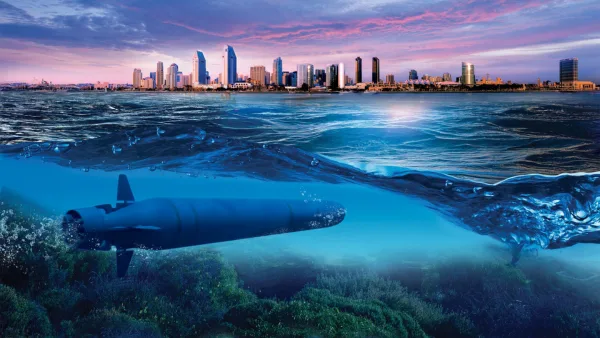
Russia tests its nuclear-powered Poseidon underwater drone for the first time. Putin hails it as an unmatched weapon with global strategic implications.
TheInterviewTimes.com | MOSCOW | October 30, 2025 — In a historic move that signals a new era in underwater warfare, Russian President Vladimir Putin announced that Russia has successfully tested its nuclear-powered Poseidon underwater drone for the first time. The Kremlin hailed the test as a “milestone achievement” in advancing Russia’s next-generation strategic weapons.
Speaking to wounded soldiers at the Mandryka Central Military Clinical Hospital in Moscow, Putin confirmed that the Poseidon test took place on October 28, involving the activation of the drone’s nuclear propulsion system after it was launched from a submarine.
“The nuclear power unit of the Poseidon unmanned underwater vehicle was activated after launch and worked for a certain amount of time,” Putin told servicemen, according to a Kremlin transcript. “This is a huge success.”
Putin Says Poseidon Has “No Equals” Globally
Putin emphasized the system’s extraordinary power and resilience:
“In terms of speed, depth, and the ability to overcome any interference, it has no equals in the world.”
The Poseidon, also known as “Status-6” in Russia and “Kanyon” by NATO, is a long-range, nuclear-armed autonomous torpedo capable of traveling thousands of kilometers underwater at speeds unmatched by conventional submarines.
Russian defence officials claim it can carry a nuclear warhead with a yield greater than that of the RS-28 Sarmat intercontinental ballistic missile.
According to Putin, the Poseidon’s nuclear reactor is “100 times smaller than the reactors installed on submarines” while providing “unlimited operational range.” He described the system as “absolutely invulnerable to any enemy countermeasures.”
⚡️ Vladimir Putin announces successful tests of 'Poseidon' nuclear-powered underwater drone
— RT (@RT_com) October 29, 2025
Its capabilities 'significantly surpass' the 'Sarmat' missile pic.twitter.com/JZAFMJzbyh
Strategic Context of the Poseidon Test
The latest Poseidon test comes shortly after Russia announced the successful trial of its nuclear-powered Burevestnik cruise missile — another key component of the 2018 “next-generation strategic arsenal.” Deputy Prime Minister Dmitry Rogozin told state television that the production of Poseidon-carrying submarines is already underway, with the Belgorod and Saratov vessels entering active service.
Meanwhile, U.S. intelligence sources cited by The New York Times reported increased activity at Russian Arctic test sites consistent with preparations for a Poseidon launch.
European and American media outlets, including Euronews and ABC News, reported that the test lasted several hours at depths exceeding 1,000 meters, with the drone reaching speeds up to 200 kilometers per hour.
However, no independent verification or footage of the Poseidon test has been made public, and Russia’s Defence Ministry has not released any telemetry data.
Western military analysts remain cautious, noting that while the Poseidon system has been in development since 2015, its operational reliability remains unproven.
Must Read: Russia Successfully Tests Nuclear-Powered Burevestnik Cruise Missile with ‘Unlimited Range’
Global Reactions
Western defence officials have long viewed the Poseidon project as destabilizing. Belgian Defence Minister Theo Francken described it as a “doomsday weapon.” In response, former Russian President Dmitry Medvedev wrote on Telegram:
“Yes, it is a doomsday weapon. And it works.”
In Washington, U.S. President Donald Trump criticized Russia’s renewed nuclear testing efforts, calling them “not appropriate” amid ongoing tensions and stalled arms control negotiations over Ukraine.
Despite Western criticism, Putin insisted the Poseidon system is defensive in nature, aimed solely at ensuring Russia’s strategic deterrence.
“We are not threatening anyone,” Putin said. “We are simply ensuring our security.”
What Makes It Different
The Poseidon drone stands apart from traditional nuclear delivery systems due to its combination of autonomy, nuclear propulsion, and stealth. Its key attributes include:
- Unlimited range: Enabled by its compact nuclear reactor.
- Extreme depth capability: Can reportedly operate over 1,000 meters underwater.
- High speed: Estimated at up to 200 km/h underwater.
- Massive payload capacity: Capable of carrying multi-megaton nuclear warheads.
Military experts say these features allow it to bypass conventional missile defences, potentially enabling it to deliver devastating strikes against coastal targets.
Must Read: NITI Aayog Report: India’s Services Sector Drives 55% of GVA, Sets Path to Viksit Bharat 2047
Future of Russia’s Nuclear Strategy
U.S. Admiral Charles Richard, former head of Strategic Command, testified in 2023 that Russia had made “significant progress” on the Poseidon program, confirming U.S. intelligence assessments that the system had reached advanced testing stages.
Analysts believe that the deployment of Poseidon could mark a new phase in global strategic deterrence — one that complicates existing arms control frameworks such as New START, which does not cover underwater autonomous systems.
As geopolitical tensions escalate and arms control talks remain frozen, the successful test underscores Moscow’s intent to maintain strategic parity — or superiority — in the nuclear domain.