
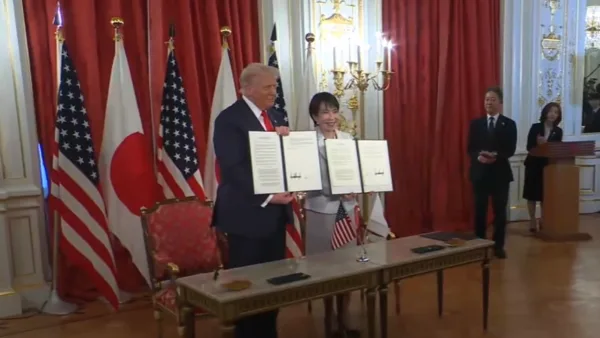
President Trump and Prime Minister Takaichi sign major U.S.-Japan strategic investments and critical minerals agreements to boost economic and defense ties.
TheInterviewTimes.com | Tokyo, Japan | October 28, 2025 — In a landmark development for Indo-Pacific cooperation, U.S. President Donald J. Trump and Japanese Prime Minister Sanae Takaichi signed two historic pacts on U.S.-Japan Strategic Investments and Critical Minerals Security on Tuesday in Tokyo. The agreements aim to enhance bilateral economic resilience, defense collaboration, and supply chain independence amid global geopolitical shifts.
The signing took place at Akasaka Palace, marking President Trump’s first official visit to Japan during his second term and Prime Minister Takaichi’s debut on the global stage since becoming Japan’s first female leader earlier this month.
$550 Billion Framework on U.S.-Japan Strategic Investments
The U.S.-Japan Strategic Investments Framework forms part of a sweeping $550 billion economic initiative unveiled by the White House. The plan promotes joint ventures in shipbuilding, defense infrastructure, advanced manufacturing, and energy security.
According to a joint fact sheet from the U.S. Embassy in Tokyo and Japan’s Ministry of Foreign Affairs, the framework includes:
- Coordinated public-private investments in commercial shipbuilding across both nations.
- Expansion of defense-industrial cooperation under the U.S.-Japan Security Treaty.
- Joint research initiatives in next-generation energy technologies.
This strategic investment framework positions both nations as anchors of economic and military stability in the Indo-Pacific, strengthening deterrence and mutual prosperity.
President Trump Participates in a Signing Ceremony with the Prime Minister of Japan https://t.co/Vwo8a77mId
— The White House (@WhiteHouse) October 28, 2025
U.S.-Japan Critical Minerals Security Partnership
The second accord, titled the U.S.-Japan Critical Minerals and Rare Earth Elements Security Partnership, addresses urgent supply chain vulnerabilities affecting semiconductors, EV batteries, and defense systems.
Key highlights of the Critical Minerals Partnership include:
- Establishment of a Rapid Response Group for supply chain and policy coordination.
- Mutual stockpiling of critical minerals and rare earth elements.
- Joint investments in third-country mining and refining projects — particularly in Australia, Canada, and Vietnam — to reduce dependency on Chinese processing dominance.
Data from Japan’s Cabinet Office show that China currently handles over 80% of global rare earth processing and 60% of lithium refining. The new partnership aims to reduce this reliance and achieve 30% non-Chinese sourcing by 2030.
Strategic Implications and Defense Cooperation
Both leaders emphasized that the U.S.-Japan Strategic Investments and Critical Minerals Agreements represent a “new phase” in bilateral relations, reinforcing their alliance in the context of intensifying U.S.-China trade competition.
Prime Minister Takaichi reaffirmed Japan’s plan to raise defense spending to 2% of GDP by 2027, aligning with NATO standards. The defense-industrial cooperation under these agreements complements Japan’s long-term modernization agenda.
The U.S. Department of State confirmed a $120 billion U.S. federal incentive package for Japanese firms investing in American shipyards and mineral processing, matched by $430 billion in Japanese commitments over the next decade.
Quad and Indo-Pacific Context
White House Press Secretary Karoline Leavitt said the agreements build upon ongoing cooperation within the Quad alliance (U.S., Japan, India, Australia) and the Indo-Pacific Economic Framework for Prosperity (IPEF).
Implementation teams are set to convene in Washington and Tokyo within 60 days, signaling rapid operational rollout.
Following the signing ceremony, President Trump and Prime Minister Takaichi visited U.S. Fleet Activities Yokosuka, where they addressed service members aboard the USS George Washington, emphasizing unity and shared democratic values in the Indo-Pacific.
Regional Diplomacy and Next Steps
President Trump is scheduled to meet Chinese President Xi Jinping in Seoul on October 30, where critical minerals trade will feature prominently on the agenda. Observers note that the U.S.-Japan Strategic Investments and Critical Minerals Partnership could influence upcoming trade talks and reshape global mineral supply dynamics.
The Tokyo visit concludes with a state dinner hosted by Emperor Naruhito, underscoring the diplomatic and symbolic importance of this strengthened alliance.
Conclusion
The U.S.-Japan Strategic Investments and Critical Minerals Agreements signal a new chapter in the alliance between Washington and Tokyo — one grounded in shared values, mutual economic growth, and strategic resilience. As both nations pivot toward a future defined by technological competition and energy transition, these agreements stand as pillars of a rebalanced, secure Indo-Pacific order.