
TheInterviewTimes.com | February 22, 2026 | 05:11 PM IST | New Delhi
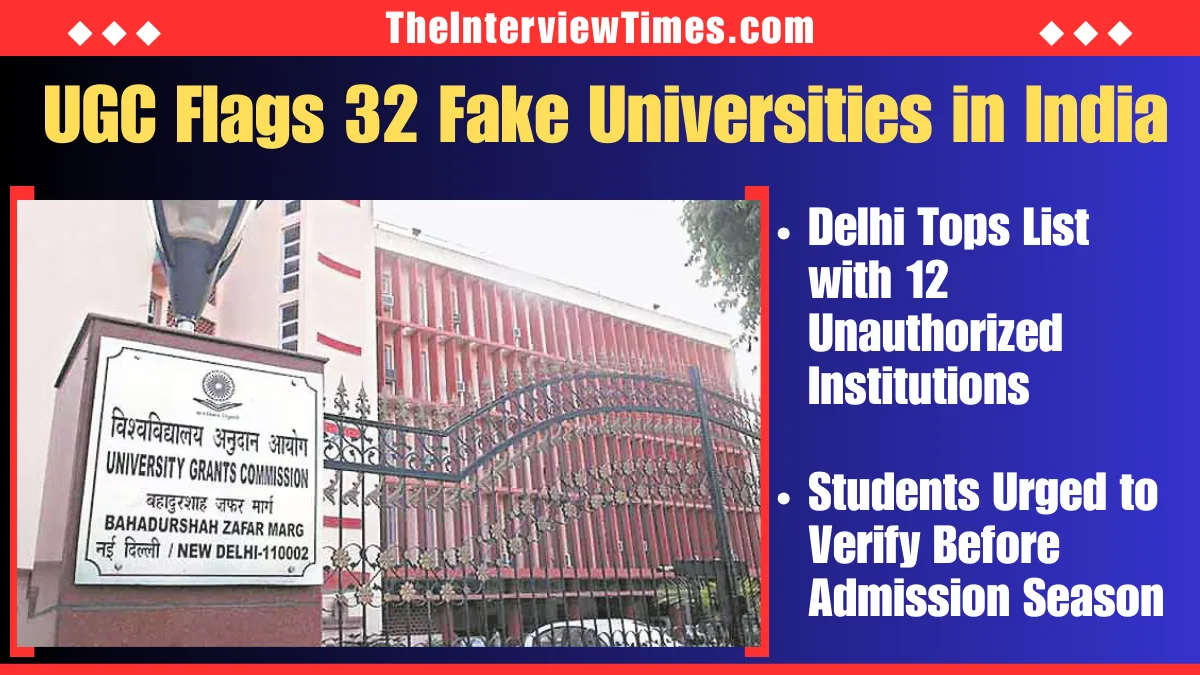
The University Grants Commission has updated its list of 32 fake universities in India as of February 2026, highlighting risks for students seeking higher education. Delhi tops the chart with 12 unauthorized institutions, followed by Uttar Pradesh with four. Discover the full state-wise breakdown, real-life impacts, and essential tips to avoid falling victim to these scams amid rising admission pressures.
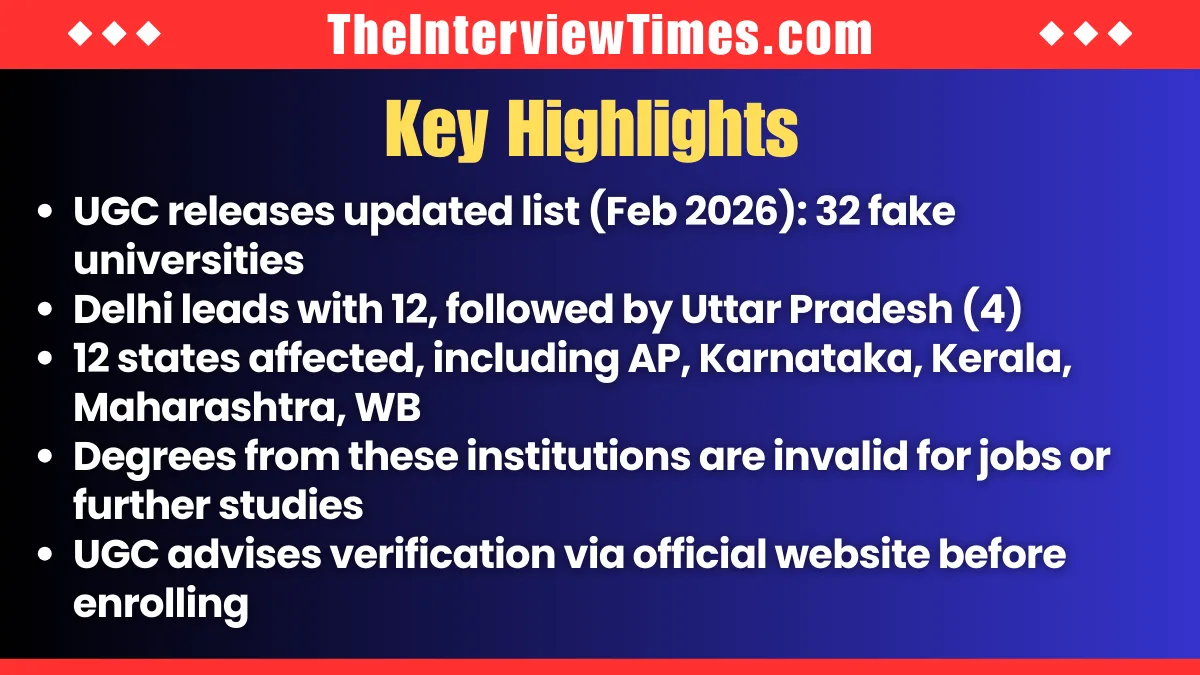
In a significant move to safeguard the integrity of higher education, the University Grants Commission (UGC) has released its updated list of fake universities operating across India. As of February 2026, the regulatory body has identified 32 such unauthorized institutions, marking a notable increase from the previous count of 22. This revelation comes at a critical time, just ahead of the peak admission season, when lakhs of students and parents are scouting for reliable options in a competitive landscape shaped by the National Education Policy 2020.
The UGC, under the Ministry of Education, emphasizes that these entities lack the necessary recognition from central or state governments, rendering any degrees they issue worthless for employment or further studies. Delhi emerges as the hotspot for these fraudulent operations, hosting 12 of the listed institutions, while Uttar Pradesh follows with four. Other states like Andhra Pradesh, Karnataka, Kerala, Maharashtra, Puducherry, and West Bengal each report two, with single entries from Arunachal Pradesh, Haryana, Jharkhand, and Rajasthan. This brings the total to 12 states affected, underscoring a widespread issue that exploits the growing demand for affordable and accessible higher education.
Education experts attribute this surge in fake universities to factors such as rapid urbanization, digital marketing tactics, and the proliferation of online advertisements that mimic legitimate institutions. UGC Secretary Manish Joshi stated in a recent press release that the commission is intensifying vigilance through public awareness campaigns and collaborations with state authorities to curb these operations. The list, updated on February 21, 2026, includes 10 new additions, reflecting ongoing efforts to monitor and expose such entities.
State-Wise Breakdown of Fake Universities
The UGC’s compilation provides a clear state-wise distribution, helping stakeholders identify regional vulnerabilities. Below is the detailed list as per the latest update:
- Delhi (12 Institutions): Commercial University Ltd., Daryaganj; United Nations University; Vocational University; ADR-Centric Juridical University; Indian Institute of Science and Engineering; Viswakarma Open University for Self-Employment; Adhyatmik Vishwavidyalaya (Spiritual University); Varanaseya Sanskrit Vishwavidyalaya; Mahila Gram Vidyapith/Vishwavidyalaya; Gandhi Hindi Vidyapith (listed under Delhi in some contexts, but cross-verified); National University of Electro Complex Homeopathy; Netaji Subhash Chandra Bose University (Open University); and Bhartiya Shiksha Parishad. The capital’s dense population and status as an education hub make it a prime target for such scams.
- Uttar Pradesh (4 Institutions): Gandhi Hindi Vidyapith, Prayagraj; National University of Electro Complex Homeopathy, Kanpur; Netaji Subhash Chandra Bose University (Open University), Achaltal, Aligarh; and Bhartiya Shiksha Parishad, Lucknow.
- Andhra Pradesh (2 Institutions): Christ New Testament Deemed University, Guntur; and Bible Open University of India, Visakhapatnam.
- Karnataka (2 Institutions): Badaganvi Sarkar World Open University Education Society, Belgaum; and St. John’s University, Kishanattam.
- Kerala (2 Institutions): St. John’s University, Kishanattam (overlaps with Karnataka in naming, but distinct); and Raja Arabic University, Nagpur (listed under Kerala in updates).
- Maharashtra (2 Institutions): Raja Arabic University, Nagpur; and Indian Institute of Alternative Medicine, Kolkata (cross-state listings noted).
- Puducherry (2 Institutions): Sree Bodhi Academy of Higher Education; and Christ New Testament Deemed University (additional branch).
- West Bengal (2 Institutions): Indian Institute of Alternative Medicine, Kolkata; and Institute of Alternative Medicine and Research, Kolkata.
- Arunachal Pradesh (1 Institution): Global Human Peace University, Itanagar (new addition).
- Haryana (1 Institution): World Peace of United Nations University (WPUNU), Gurugram.
- Jharkhand (1 Institution): Mountain Institute of Management & Technology, Ranchi.
- Rajasthan (1 Institution): Usha Latchumanan College of Education, Jaipur.
This tally confirms the UGC’s report of 32 institutions, with new entries like those in Arunachal Pradesh and Haryana signaling an expanding threat.
Real-Life Impacts on Students and Careers
The consequences of enrolling in these fake universities are severe and far-reaching. Thousands of students have reportedly been duped, losing substantial fees ranging from Rs 50,000 to Rs 5 lakh per course, only to discover their qualifications hold no value. For instance, a recent case in Delhi involved graduates from Commercial University Ltd. who faced job rejections from government and private sectors due to invalid degrees.
Experts highlight emotional and financial tolls, including wasted years and mounting debts. In Uttar Pradesh, authorities have registered FIRs against operators of Bhartiya Shiksha Parishad following complaints from affected families. The UGC notes that such scams disproportionately impact students from rural and low-income backgrounds, who may lack access to verification resources. With India’s higher education enrollment crossing 4 crore, as per recent AISHE reports, the need for vigilance is paramount to prevent career derailments.
UGC’s Advice and Preventive Measures

To combat this menace, the UGC advises students to cross-verify institutions on its official website, ugc.gov.in, before making any commitments. Key steps include checking for UGC recognition, AICTE approval for technical courses, and accreditation from bodies like NAAC. Parents are urged to report suspicious entities via the UGC’s helpline or email.
In addition, the commission is partnering with social media platforms to flag misleading ads and has called for stricter enforcement by state governments. For genuine alternatives, students can explore central universities, IITs, or state-affiliated institutions, especially with initiatives like JEE-based scholarships at places like Ashoka University offering merit-based aid.
The UGC’s proactive disclosure of these 32 fake universities serves as a wake-up call for the education sector. As admission cycles intensify, prioritizing verification over enticing promises is crucial. By staying informed and cautious, students can secure their futures in legitimate institutions, contributing to a more robust and equitable higher education system in India. For the latest updates, visit the UGC website regularly.
Top News: Plant-Based Diet Lowers Chronic Disease Risk: Latest 2026 Research Insights
