
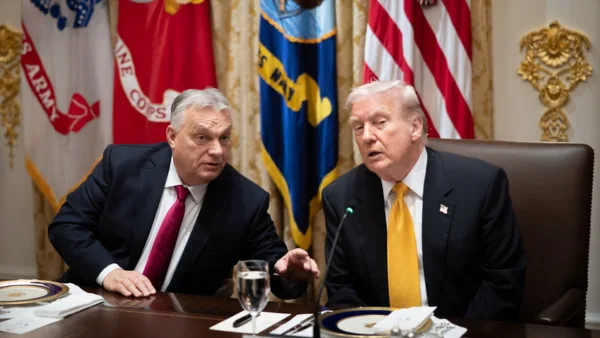
US-Hungary Clash Over Sanctions Waiver: Budapest Wins Russian Energy Exemption Amid Geopolitical Tensions
US-Hungary Clash deepens as Budapest secures a sanctions waiver for Russian energy imports, sparking tensions over energy security and political stakes.
TheInterviewTimes.com | Budapest | November 9, 2025 — The US-Hungary Clash has intensified after Hungary secured a controversial waiver from American sanctions, allowing it to continue importing Russian oil and gas indefinitely. The move has reignited diplomatic friction between Washington and Budapest, exposing deeper political and economic tensions as Hungary heads toward a decisive 2026 election.
Key Points
- US-Hungary Clash escalates after Budapest claims an “indefinite” U.S. sanctions waiver for Russian energy imports.
- The White House disputes the claim, saying the waiver lasts only one year.
- Hungary relies on Russia for over 80% of its energy needs, making the deal vital for stability.
- The U.S. gains energy and nuclear trade concessions worth billions in return.
- The issue could reshape Hungary’s 2026 elections and regional energy geopolitics.
Sanctions Waiver Sparks US-Hungary Clash
The US-Hungary Clash erupted when Prime Minister Viktor Orban announced that his government had secured an “indefinite exemption” from U.S. sanctions on Russian energy imports. The White House swiftly contradicted the statement, clarifying that the waiver is valid for only one year. This discrepancy reflects growing diplomatic mistrust between Washington and Budapest.
Hungary, which imports about 74% of its natural gas and 86% of its oil from Russia, views the exemption as critical to its economic survival. According to IMF data, a sudden cutoff of Russian gas could trigger GDP losses of more than 4%, severely damaging Hungary’s economy.
Orban defended the deal, claiming it would prevent “unbearable” energy price spikes and protect both households and businesses. “Without this agreement, energy prices would have skyrocketed, leading to unemployment and economic instability,” he said.
Must Read: Afghanistan-Pakistan Peace Talks Collapse in Istanbul Over ‘Beyond Capacity’ Demand

Strategic Bargain Behind the US-Hungary Clash
The US-Hungary Clash is not merely about sanctions but also about energy strategy. In exchange for the waiver, Hungary agreed to purchase roughly $600 million worth of U.S. liquefied natural gas and nuclear fuel from Westinghouse Electric Company. Additionally, both countries signed a memorandum of understanding for potential acquisition of up to 10 small modular nuclear reactors — a deal estimated at $20 billion.
Analysts suggest these commitments give Washington leverage over Hungary while helping Orban diversify the nation’s energy sources. Yet critics argue that the deal simply replaces dependency on Moscow with reliance on Washington.
Must Read: Ahmed al-Sharaa: From Militant Leader to Syrian President Cleared by U.S. Terrorism Blacklist
US Pressure and Hungary’s Political Stakes
The US-Hungary Clash intensified after President Donald Trump’s administration imposed fresh sanctions in late October on Russian oil companies Lukoil and Rosneft. These measures aimed to pressure Moscow amid the ongoing Ukraine conflict, now entering its fourth year.
Orban, however, has used the sanctions waiver to project political strength at home. Facing Hungary’s most competitive election in 15 years, he has framed the deal as a triumph of sovereignty and pragmatic diplomacy. His foreign minister, Peter Szijjarto, posted on social media that “there are no sanctions affecting oil and gas deliveries to Hungary for an unlimited time,” emphasizing Budapest’s intent to cement the deal as permanent.
Energy Geography Fuels the US-Hungary Clash
Hungary’s landlocked geography adds complexity to the US-Hungary Clash. During his White House visit, Orban argued that seaport-based alternatives are unrealistic for Hungary, making Russian pipeline deliveries essential. Trump acknowledged these logistical constraints, distinguishing Hungary’s situation from that of other European nations that have diversified away from Russian energy.
Energy experts say this pragmatic approach underscores the delicate balance between survival and sovereignty for small nations caught in great power rivalries.
Regional and Global Reactions
The US-Hungary Clash has drawn varied responses. Ukrainian President Volodymyr Zelenskyy cautiously welcomed the idea of a Trump-Putin summit in Budapest but insisted that any talks must advance peace and reduce Europe’s dependence on Russian energy. European critics, however, warn that Hungary’s exemption undermines the broader Western sanctions regime and emboldens Moscow.
Meanwhile, Budapest maintains that the deal strengthens Hungary’s resilience by ensuring stable energy supplies while transitioning gradually toward diversification.

Political and Geopolitical Implications
As Hungary approaches its 2026 election, the US-Hungary Clash will likely dominate political discourse. Domestically, Orban’s government is expected to tout the deal as a safeguard for national interests. Internationally, it may deepen rifts between Washington and its European allies, testing the limits of unity on Russia policy.
Beyond politics, the episode underscores a broader reality: in an era of sanctions, energy remains the ultimate instrument of power. For Hungary, navigating between Washington and Moscow is not merely diplomacy — it is economic survival.