
Donald Trump finalizes a $350 billion South Korea trade deal and signals a historic US-India Deal during his Asia tour to boost American trade influence.
US-India Deal: Trump Eyes Major Trade Pact After $350 Billion South Korea Agreement
TheInterviewTimes.com | Gyeongju, South Korea | October 29, 2025 — In a major shift in U.S.-Asia economic relations, U.S. President Donald Trump has finalized a $350 billion trade deal with South Korea, paving the way for what he called a “powerful and mutually beneficial” US-India Deal. The announcement came during Trump’s Asia-Pacific Economic Cooperation (APEC) tour, underscoring his administration’s renewed focus on strengthening American trade alliances across the region.
Trump Finalizes South Korea Trade Agreement
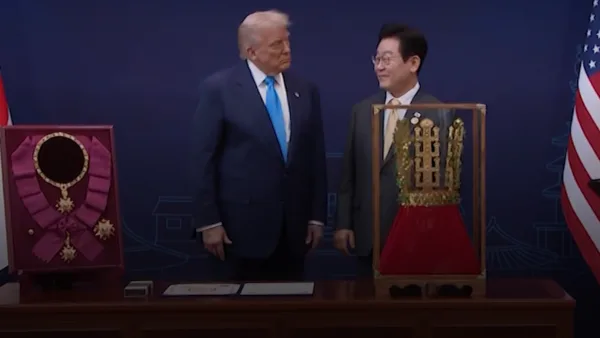
Following an 87-minute summit with South Korean President Lee Jae Myung, President Trump confirmed that the trade deal was “pretty much finalized.” The pact includes $350 billion in South Korean investments in the United States, while Washington agreed to reduce tariffs from 25% to 15% on key South Korean exports.
“We did reach a deal. We accomplished a lot of different things,” Trump said at a dinner hosted by President Lee.
Markets responded positively, with the South Korean won rising 0.54% against the U.S. dollar, signaling strong investor confidence in Asia’s trade outlook. The final agreement had faced months of delay over differences in investment structure and payment schedules, but both sides eventually reached a resolution after careful negotiation.
President Trump Participates in a Dinner Hosted by the President of the Republic of Korea https://t.co/4k9uOzOqur
— The White House (@WhiteHouse) October 29, 2025
Must Read: NITI Aayog Report: India’s Services Sector Drives 55% of GVA, Sets Path to Viksit Bharat 2047
Focus Shifts Toward a US-India Deal
Amid celebrations of the South Korea breakthrough, President Trump hinted that his next target is a US-India Deal, signaling a new chapter in economic cooperation between Washington and New Delhi. Addressing APEC business leaders, Trump praised Prime Minister Narendra Modi, calling him “the nicest looking guy” and “tough as hell.”
“I’m doing a trade deal with India, and I have great respect and love for Prime Minister Modi,” Trump said.
The potential US-India Deal would focus on reducing U.S. tariffs on Indian exports—currently around 50%—to a proposed 15%. In exchange, India may expand its investment commitments and market access for U.S. products in defense, technology, and energy sectors.
Geopolitical Challenges Around the US-India Deal
However, the path to a US-India Deal remains complex. Recent U.S. tariffs targeting Indian oil imports from Russia have created friction, while Trump’s claims of having “prevented a war” between India and Pakistan through tariff diplomacy continue to draw controversy.
Although India has denied these assertions, the remarks underscore the delicate geopolitical landscape shaping the trade talks. Analysts suggest that resolving tariff disputes and aligning energy import policies will be key to advancing the US-India Deal.
Asia Diplomacy Push and Economic Vision
The US-India Deal fits into Trump’s broader vision to restore American economic dominance across Asia. His tour has already produced trade frameworks with Japan ($550 billion), Malaysia, and Cambodia, signaling a region-wide reorientation toward U.S. partnerships.
According to administration estimates, total Asian investment in the U.S. could reach $22 trillion by the end of Trump’s first year back in office—a target that would mark the largest capital inflow in U.S. history.
Strategic Context and North Korea Tensions
The announcement of the US-India Deal comes amid heightened regional tensions. North Korea’s latest cruise missile tests have raised alarm, but Trump downplayed the threat, stating he remains open to a meeting with Kim Jong Un.
Meanwhile, Trump’s upcoming meeting with Chinese President Xi Jinping will likely focus on resolving the prolonged U.S.-China trade war. Analysts suggest that if the US-India Deal materializes, it could strengthen the U.S. position against China’s growing economic influence in the Indo-Pacific.
Market and Diplomatic Implications
Economists view the combined impact of the South Korea agreement and the prospective US-India Deal as transformative for global trade. The moves are expected to stimulate bilateral investments, reduce tariff barriers, and reposition the United States as a central player in Asia-Pacific commerce.
Trade observers also note that the US-India Deal could serve as a geopolitical counterweight to China’s Belt and Road Initiative, enhancing India’s manufacturing and export capabilities while deepening U.S.-India strategic alignment.
What Lies Ahead
As the Asia tour continues, the world will be watching Trump’s next move. With the US-India Deal now at the center of Washington’s trade agenda, both nations have the opportunity to redefine 21st-century economic cooperation.
If successfully concluded, the US-India Deal could symbolize not only renewed trade momentum but also a strategic partnership shaping the balance of power in Asia for decades to come.