

New Delhi | January 28, 2026, 10:13 p.m. (IST)
USS Abraham Lincoln deployment raises Iran war fears as the US warns Tehran over deadly protest crackdown and rising regional tensions in the Middle East.
Key Highlights
- USS Abraham Lincoln Carrier Strike Group enters Arabian Sea amid Iran unrest
- Donald Trump warns Tehran over deadly protest crackdown and executions
- Human rights groups report over 6,100 confirmed deaths across Iran
- Gulf allies refuse to support any US military strike on Iran
- Oil prices jump as Iran announces drills near Strait of Hormuz
The United States has sharply expanded its military footprint in the Middle East with the deployment of the USS Abraham Lincoln Carrier Strike Group to the Arabian Sea, placing powerful naval and air assets within operational reach of Iran. President Donald Trump confirmed the move on Tuesday, warning Tehran over its violent suppression of nationwide protests and signalling that Washington is prepared to escalate pressure if executions continue.
Trump described the deployment as a “massive armada” moving toward Iran, stressing that the show of force is intended to deter further bloodshed while also creating leverage for potential diplomatic talks. The development comes as human rights monitors report that Iran’s protest crackdown has crossed 6,000 confirmed deaths, making it one of the deadliest internal security operations in the country’s recent history.
US Military Assets Strengthen Regional Posture
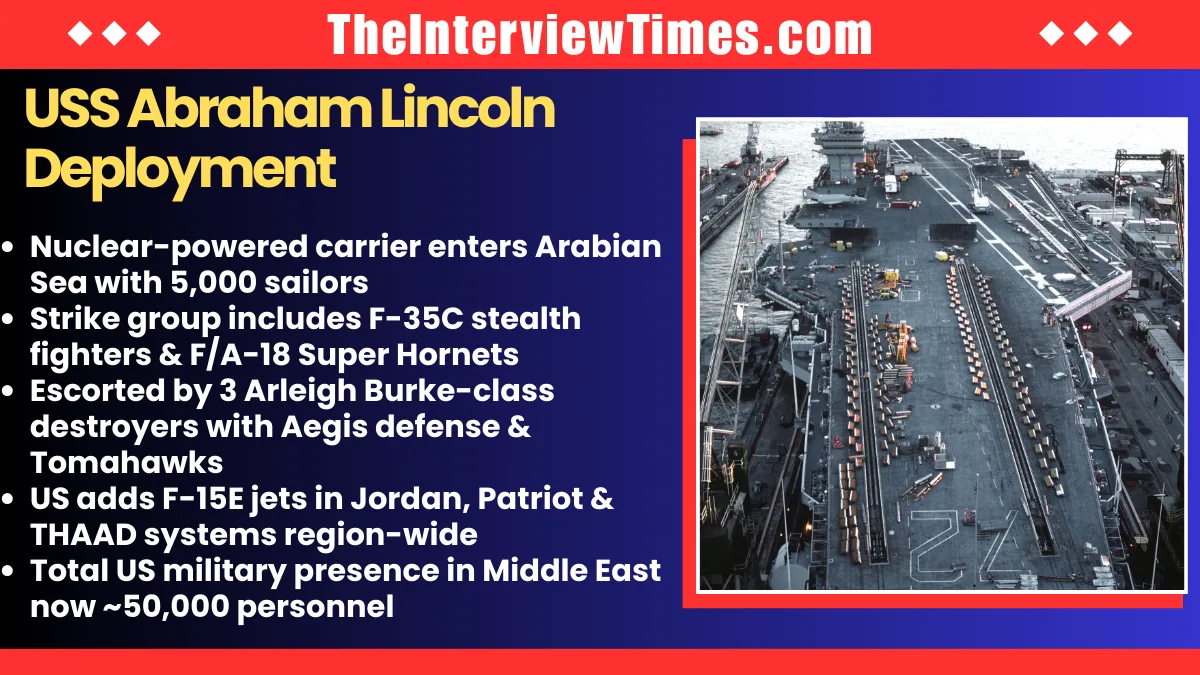
At the center of the deployment is the nuclear-powered USS Abraham Lincoln aircraft carrier, which carries nearly 5,000 sailors and a full carrier air wing. The group includes F-35C stealth fighters, F/A-18 Super Hornets, and EA-18G Growler aircraft designed for electronic warfare and radar suppression.
The carrier is escorted by three Arleigh Burke class guided missile destroyers, USS Frank E. Petersen Jr., USS Spruance, and USS Michael Murphy. These ships are equipped with advanced Aegis missile defense systems and Tomahawk cruise missiles capable of long range precision strikes.
In addition to naval forces, the US has deployed F-15E Strike Eagle fighter jets to Jordan and reinforced Patriot and THAAD air defense systems across the region. US Central Command estimates that total American military personnel in the Middle East now stands at approximately 50,000.
US Central Command said the buildup is part of multi day readiness exercises aimed at improving asset dispersal, regional coordination, and rapid response capabilities. The carrier strike group arrived after transiting from the South China Sea and entered Central Command’s operational area last week.
Protests and Rising Death Toll in Iran
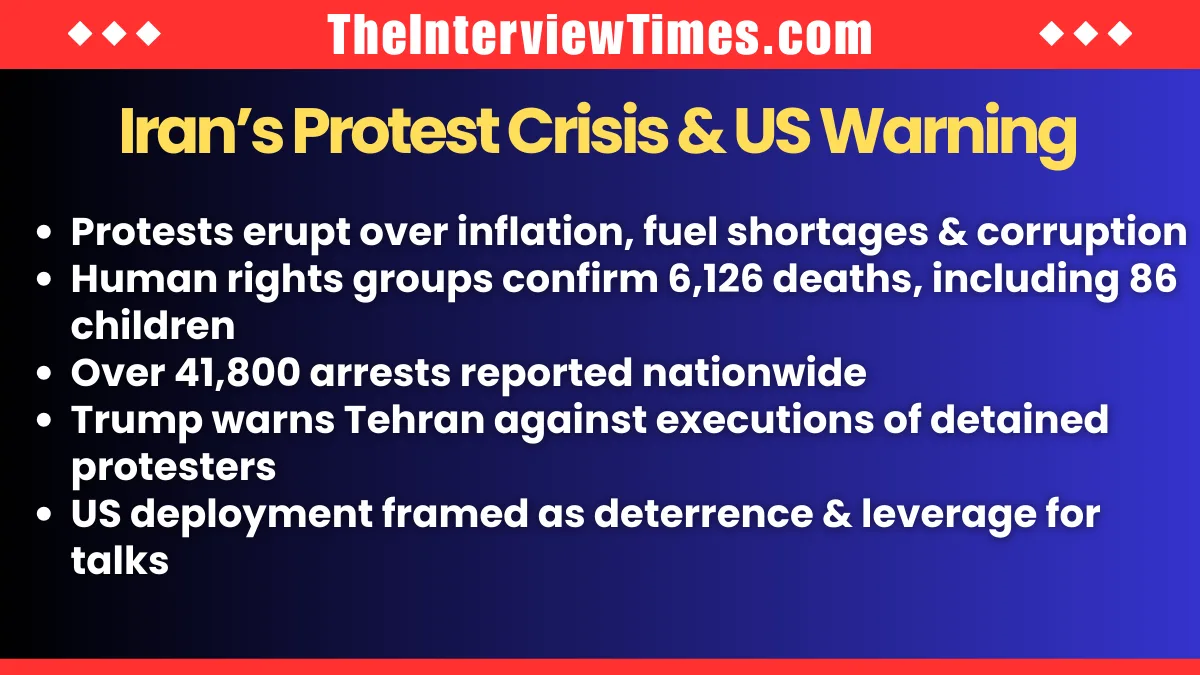
The military escalation is closely tied to Iran’s internal crisis. Protests erupted across multiple Iranian cities in late December, driven by soaring inflation, fuel shortages, unemployment, and allegations of systemic corruption. Security forces responded with lethal force, including live ammunition, mass arrests, and reported executions.
According to the US based Human Rights Activists News Agency, at least 6,126 people have been killed so far. The confirmed death toll includes 5,777 protesters, 214 members of government forces, 86 children, and 49 non demonstrators. The group also reports more than 41,800 arrests nationwide.
Trump has repeatedly warned Iran against carrying out executions of detained protesters. Speaking last week, he claimed Tehran had paused some planned hangings and suggested that Iranian officials “want to talk” as international pressure mounts.
Gulf Allies Reject Military Escalation
Despite the US buildup, key regional allies have declined to support any direct military action against Iran. Saudi Crown Prince Mohammed bin Salman reportedly assured Iranian President Masoud Pezeshkian that Saudi Arabia would not allow its airspace or territory to be used for attacks on Iran, urging restraint and dialogue instead.
The United Arab Emirates echoed this position on Monday, warning that any conflict could spiral into a wider regional war with severe economic consequences. Other countries, including Egypt and Turkey, have also cautioned against escalation, while Israel has publicly emphasized readiness but stopped short of endorsing immediate strikes.
This regional pushback significantly limits US operational options and highlights a growing preference among Middle Eastern states for de-escalation rather than confrontation.

Iran Issues Warnings and Conducts Military Drills
Iran responded defiantly to the US deployment by issuing a Notice to Airmen announcing live fire military drills near the Strait of Hormuz through January 29. The drills include temporary airspace closures up to 25,000 feet within a five nautical mile radius.
A senior Iranian official warned that any US attack would be treated as “total war,” adding that Iranian forces are on the highest level of alert. State media broadcast images of new murals in Tehran depicting downed American warships, reinforcing the government’s hardline messaging.
Iran also claimed “complete control” over the Strait of Hormuz, a critical chokepoint through which nearly 20 percent of global oil supplies pass each day. Following the announcement, global oil prices rose nearly 3 percent on fears of potential disruptions to energy flows.
Top News: The Strait of Hormuz: The World’s Most Critical Oil Chokepoint and Iran’s Threats Explained
Diplomatic Signals and Market Reactions
While tensions remain high, Trump softened his tone during a rally in Iowa, saying he hopes Iran “makes a deal” and revealing that multiple diplomatic outreach attempts have taken place behind the scenes. Analysts believe the military buildup is intended more as leverage than an indication of imminent strikes.
Markets are closely watching developments, particularly any signs of escalation around the Strait of Hormuz. As of January 28, no US military action has been confirmed, but the situation remains volatile.
The deployment underscores a shifting regional landscape where US allies increasingly prioritize stability and economic security over military confrontation. With protests ongoing inside Iran and diplomatic channels still uncertain, the coming days are likely to be critical for both regional security and global energy markets.
