

WHO launches the Traditional Medicine Global Library in New Delhi as India hosts the Second WHO Global Summit, advancing evidence-based traditional medicine worldwide.
Key Highlights
- WHO unveiled the Traditional Medicine Global Library at the Second Global Summit in New Delhi.
- The digital library hosts over 1.6 million scientific records on traditional medicine.
- India hosted delegates from 100+ countries at Bharat Mandapam from December 17–19, 2025.
- The summit advanced the WHO Global Traditional Medicine Strategy 2025–2034.
The World Health Organization (WHO) has launched the Traditional Medicine Global Library at the Second WHO Global Summit on Traditional Medicine in New Delhi, marking a major step toward integrating traditional healthcare systems into global public health frameworks. The three-day summit was held from December 17 to 19, 2025, at Bharat Mandapam and was co-organized with India’s Ministry of Ayush.
The high-level event brought together more than 500 in-person delegates from over 100 countries, including health ministers, scientists, Indigenous leaders, and traditional medicine practitioners. Around 5,000 participants joined virtually, underlining the growing global focus on evidence-based traditional healthcare systems.
The summit was held under the theme “Restoring Balance for People and Planet: The Science and Practice of Well-Being.” It aimed to accelerate implementation of the WHO Global Traditional Medicine Strategy 2025–2034 and address healthcare access gaps worldwide.
Traditional, complementary and integrative medicine – or TCIM – strengthens health systems and makes them more people-centred and resilient.
— Tedros Adhanom Ghebreyesus (@DrTedros) December 17, 2025
The benefits of this powerful field of health is taking centre stage at the 2nd Global Summit on Traditional Medicine, which @WHO is proud… pic.twitter.com/VTxKtyf02v
Traditional Medicine Global Library Unveiled
The launch of the Traditional Medicine Global Library was the central highlight of the summit. The digital platform is now the world’s largest repository of traditional medicine knowledge, housing over 1.6 million scientific records.
The library includes research studies, national policies, regulatory frameworks, evidence maps, peer-reviewed journals, and multimedia resources. It is designed to support evidence-based decision-making for governments, researchers, and healthcare professionals.
To ensure equity, WHO announced free access to the Traditional Medicine Global Library through the Research4Life platform for low- and middle-income countries. The platform features six regional portals and 194 country-specific pages, enabling localized research and policy development.
Global Commitments and Leadership Messages
Union Health Minister JP Nadda formally inaugurated the summit alongside senior WHO officials. Leaders highlighted that nearly 4.6 billion people globally still lack access to essential health services, making traditional medicine a critical bridge in healthcare delivery.
WHO Director-General Dr. Tedros Adhanom Ghebreyesus, addressing the summit via video message, called for uniting ancient healing wisdom with modern science. He emphasized the responsible use of emerging tools such as artificial intelligence and genomics to strengthen traditional medicine systems while ensuring safety and effectiveness.
Several new commitments were announced, including the formation of a global consortium to scale implementation of the WHO strategy. Key focus areas include regulation, ethical use of Indigenous knowledge, biodiversity conservation, and fair benefit-sharing mechanisms.
International dignitaries from across the globe share their first-day impressions and experiences at the Second @WHO Global Summit on #TraditionalMedicine. @WHOSEARO #Ayush #AyushForGlobalHealth #HealthForAll #2ndglobaltmsummit @PIBAYUSH @mpprataprao @PIB_India pic.twitter.com/5IGPDbj3kc
— Ministry of Ayush (@moayush) December 18, 2025
WHO Global Traditional Medicine Strategy 2025–2034
The WHO Global Traditional Medicine Strategy 2025–2034 was formally adopted at the 78th World Health Assembly in May 2025. The strategy is built around four core objectives.
These include strengthening scientific evidence, ensuring safety through robust regulation, integrating traditional medicine into national health systems, and empowering communities through informed healthcare choices.
Despite serving 40–90% of populations in many WHO member states, traditional medicine currently receives less than 1% of global research funding. Speakers at the summit stressed the urgent need to correct this imbalance to improve global health equity.
Indigenous Knowledge and Biodiversity
Indigenous communities played a central role in summit discussions. Although Indigenous Peoples make up only 6% of the global population, they safeguard nearly 40% of the world’s biodiversity.
Sessions focused on ethical research practices, intellectual property protection, and equitable benefit-sharing. WHO officials stressed that respecting Indigenous systems is essential for sustainable healthcare development and environmental protection.
Must Read: India GDP Growth Forecast FY26 Raised to 7–7.5% on Strong Domestic Demand
India’s Expanding Global Role
India’s leadership in traditional medicine was a recurring theme throughout the summit. A Memorandum of Understanding signed in September 2025 between WHO and the Ministry of Ayush paved the way for hosting the event.
The summit also built upon the work of the WHO Global Centre for Traditional Medicine in Jamnagar, Gujarat. Prime Minister Narendra Modi has repeatedly advocated for a global traditional medicine repository, a vision now realized through the Traditional Medicine Global Library, which may eventually expand to 2.5 million publications.
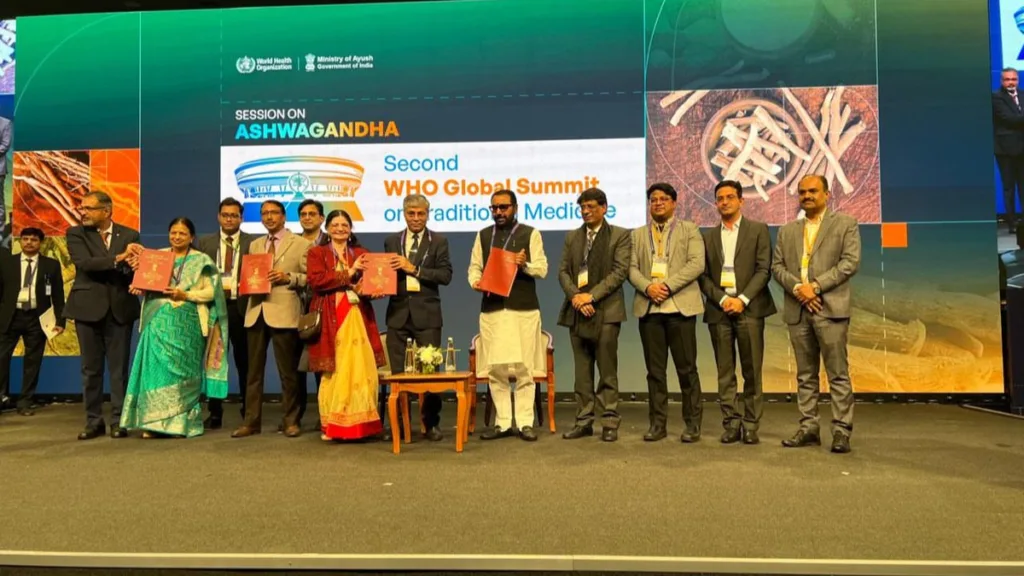
Over 170 speakers participated in more than 25 sessions, addressing topics ranging from regulatory innovation to research on Ashwagandha and other traditional remedies. A global exhibition showcased traditional practices from multiple regions.
Addressing Global Healthcare Challenges
WHO data indicates that nearly 90% of member states report widespread reliance on traditional medicine, particularly during economic hardship. More than 2 billion people face financial barriers to accessing modern healthcare.
Dr. Shyama Kuruvilla, Acting Director of the WHO Global Traditional Medicine Centre, described the initiative as an “evidence-based, ethical, and environmental imperative.” Experts agreed that context-sensitive research respecting cultural systems is essential for long-term sustainability.
The New Delhi summit has reinforced momentum toward mainstreaming traditional medicine as a credible, regulated, and science-backed component of global health systems.