

New Delhi/Seoul, January 2026, 8:23 p.m. IST
South Korea is preparing to deliver its first homegrown fighter jet, the KF-21 Boramae, to the Republic of Korea Air Force later this year. More than a technological achievement, the aircraft represents Seoul’s determination to stand shoulder-to-shoulder with the world’s leading aerospace powers.
The KF-21, nicknamed Boramae or “young hawk,” has been in development for over a decade. Built by Korea Aerospace Industries (KAI) with support from the Agency for Defence Development (ADD), the jet is designed to replace ageing F-4 Phantom II and F-5 Tiger II aircraft. Its maiden flight in 2022 marked a turning point, and after thousands of hours of testing, the program is now entering production.
A Fighter Between Generations
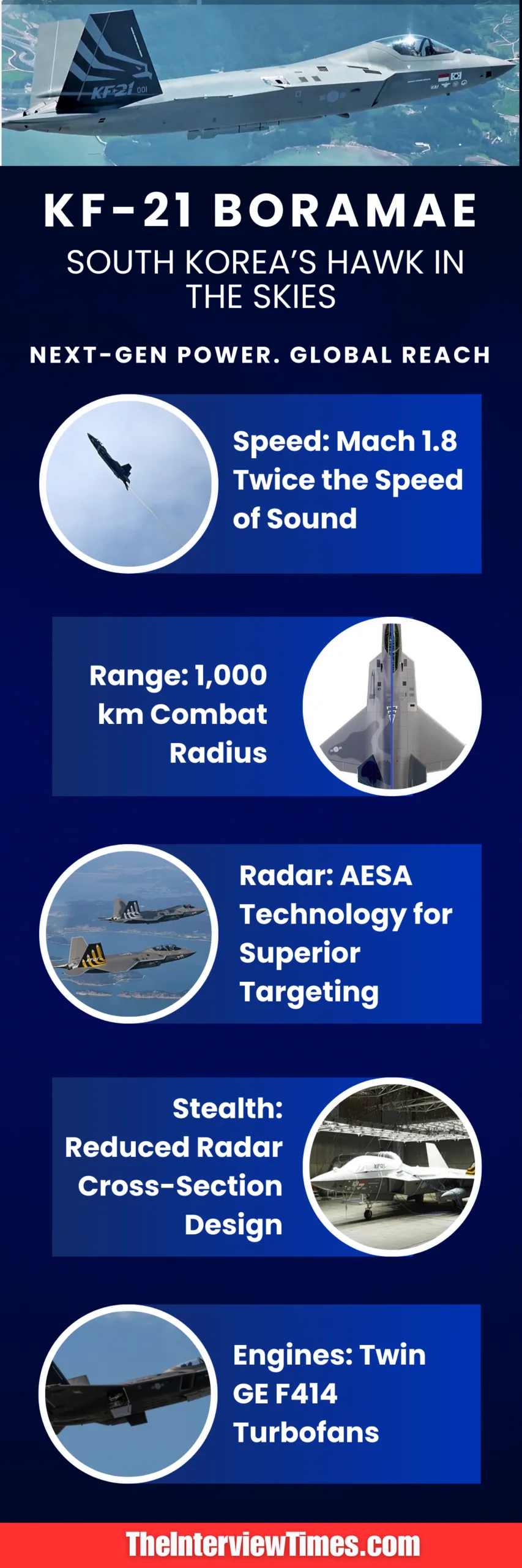
The KF-21 Boramae is often described as a 4.5-generation aircraft, more advanced than traditional fourth-generation fighters but not as stealthy as fifth-generation platforms like the American F-35 Lightning II or China’s J-20 Mighty Dragon. Powered by twin General Electric F414 engines, it can reach speeds close to Mach 1.8, giving it the agility needed for modern air combat.
Its design incorporates radar-absorbing materials and sleek contours to reduce visibility, though it stops short of full stealth. Advanced avionics, including an AESA radar and electronic warfare systems, give pilots a technological edge. Future upgrades are expected to expand its role from air superiority missions to precision strike capabilities.
Global Comparisons
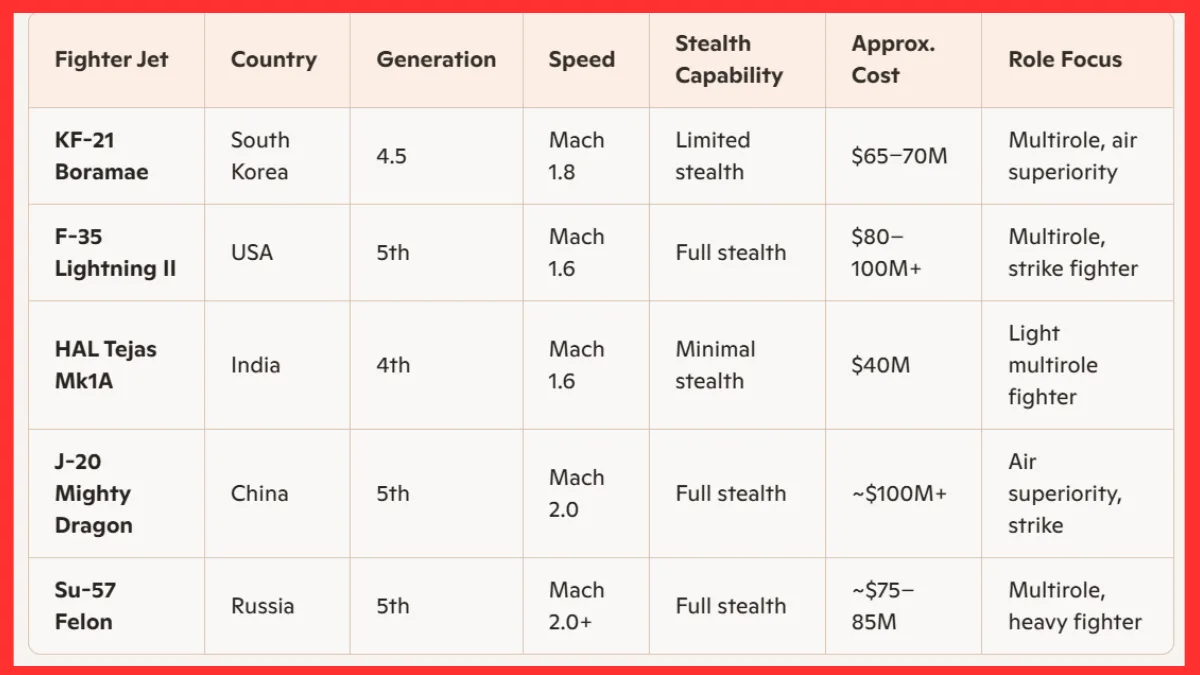
The KF-21 enters a crowded field of modern fighters. The F-35, widely adopted by NATO allies, offers full stealth but comes with a hefty price tag exceeding $80 million per unit. China’s J-20 emphasizes stealth and speed, while Russia’s Su-57 Felon markets itself as a heavy multirole fighter. India’s HAL Tejas, meanwhile, provides a lighter, budget-friendly option for nations with smaller defence budgets.
At roughly $65-70 million per aircraft, the KF-21 positions itself as a cost-conscious rival. It offers advanced features without the political strings or financial burden often tied to Western procurement deals.
Defence analysts suggest that Southeast Asian and Middle Eastern nations could be prime customers once exports begin.
Strategic Significance
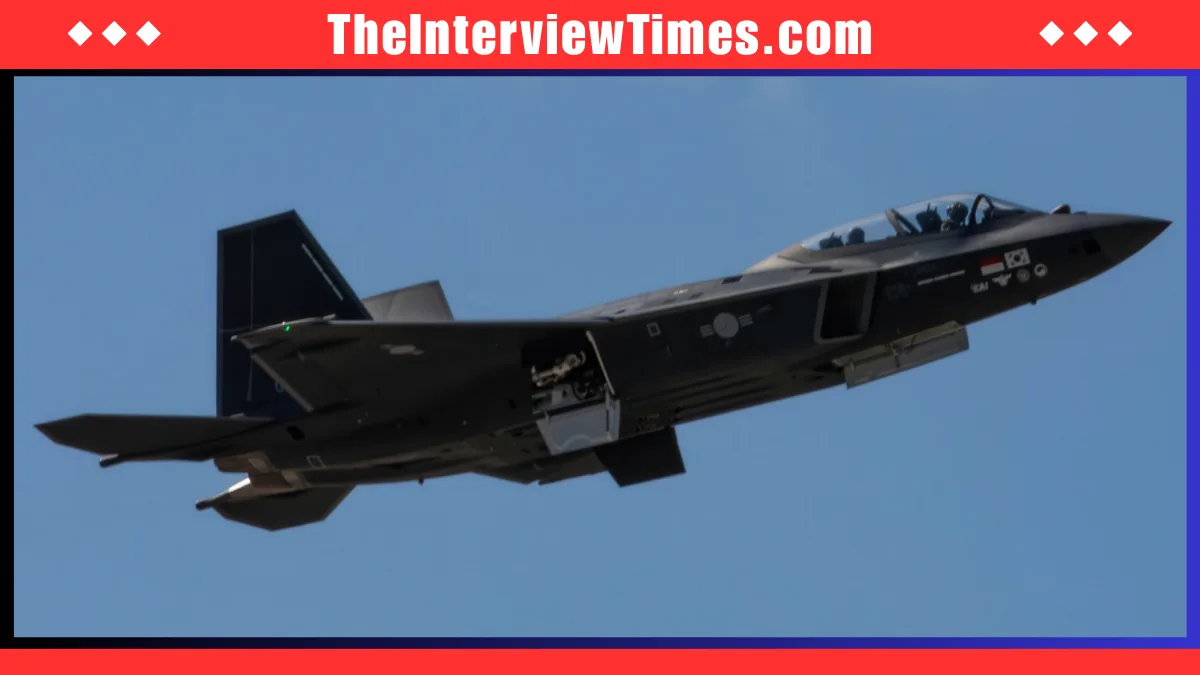
For South Korea, the KF-21 Boramae is more than hardware. It is a symbol of strategic independence in a region where air power plays a decisive role. With North Korea’s missile tests and China’s expanding military presence, Seoul’s ability to field its own advanced fighter strengthens deterrence and national pride.
Must Read: Fifth-Generation Fighter Jets: How Advanced Warplanes Are Redefining Air Superiority
Looking Ahead
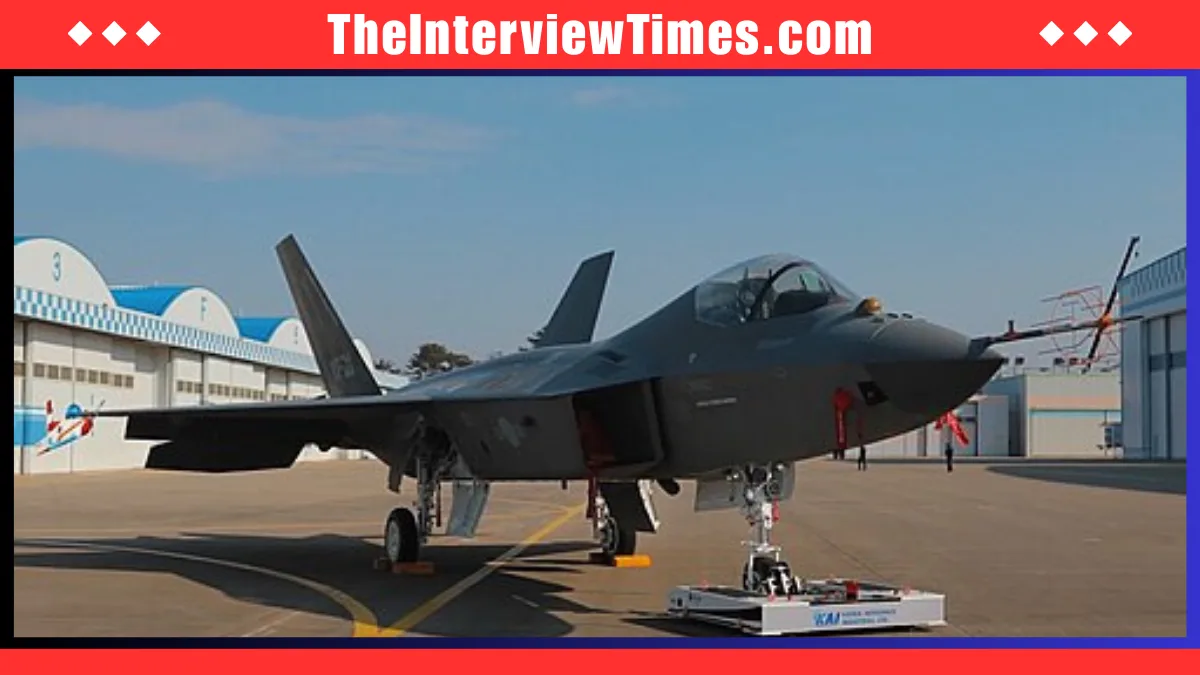
The Republic of Korea Air Force is expected to receive its first batch of 40 aircraft in 2026, with additional orders likely to follow. Challenges remain particularly in developing indigenous engines and missile systems but the KF-21 Boramae has already secured its place as a new contender in the global fighter jet market.
