
New Delhi, January 10, 2026, 07:14 p.m. IST
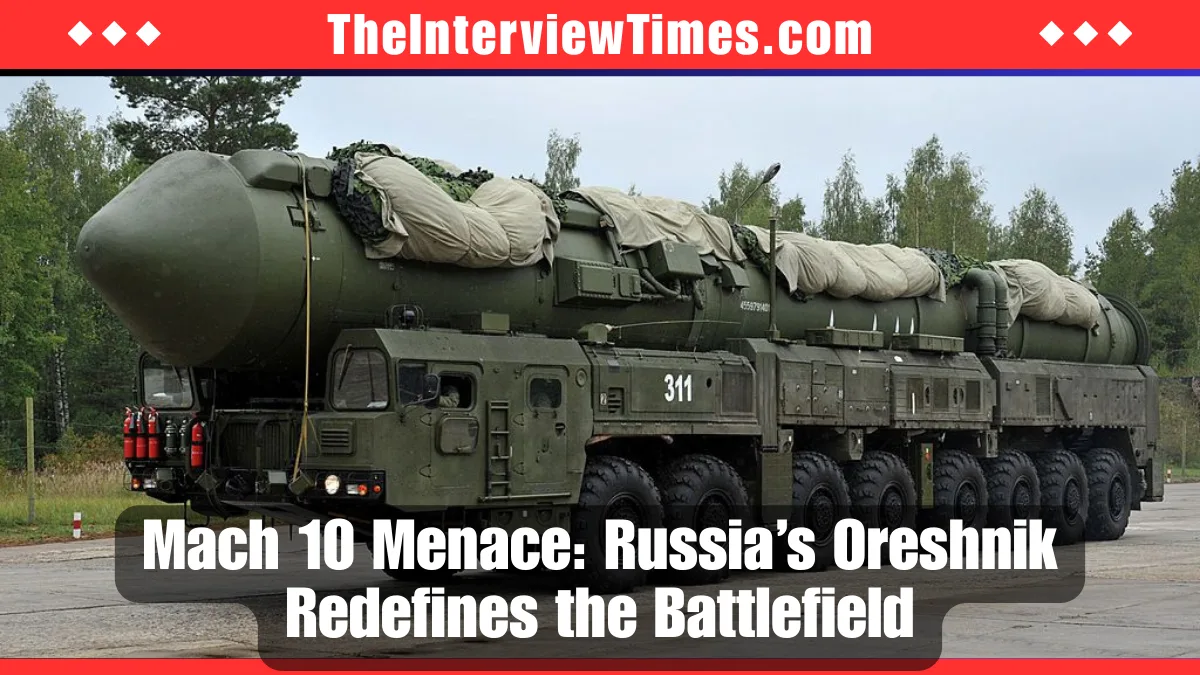
Russia’s Oreshnik intermediate-range ballistic missile system marks a bold leap in modern weaponry, blending nuclear potential with hypersonic speed. First combat-tested in late 2024, it has reemerged in early 2026 strikes on Ukraine, signaling Moscow’s intent to deter Western escalation. This dual-capable system challenges global defences and treaty norms alike.
Technical Design and Capabilities
The Oreshnik operates as a road-mobile, two-stage solid-fuel missile launched from a Transporter-Erector-Launcher (TEL) vehicle. Measuring 15-18.5 meters long and 1.86 meters in diameter, it achieves terminal speeds beyond Mach 10 roughly 13,000 km/h via advanced propulsion derived from RS-26 Rubezh technology.
Guidance relies on inertial navigation augmented by Russia’s GLONASS satellites, enabling precise midcourse corrections and terminal maneuvers even in jammed environments.
Payload flexibility defines its menace: up to six Multiple Independently Targetable Reentry Vehicles (MIRVs), each potentially splitting into submunitions for a total of 36 strike points. A 1.5-ton conventional warhead leverages kinetic energy alone to crater bunkers, while nuclear yields remain classified but low-to-medium. Range spans 3,000-5,500 km, covering Europe from Russian soil, with hypersonic glide vehicles (HGVs) adding 1,500 km post-release maneuverability. Thermal shielding withstands reentry heat, rendering it elusive to radar.
☝️“There is no chance of shooting down the "Oreshnik." If any Western experts doubt it, let's conduct a high-tech duel of the 21st century. Let them pick a target to hit—say, in Kyiv—let them concentrate all their air and missile defenses there, and we will strike that target… pic.twitter.com/wd7DMMgHYS
— 🇷🇺Russia is not Enemy (@RussiaIsntEnemy) January 9, 2026
Must Read: Explained: Why the United States Wants Greenland
Development Origins
Post-2019 INF Treaty collapse, Russia accelerated Oreshnik to fill the 500-5,500 km gap once banned. It adapts proven Yars and RS-26 elements for rapid deployment, emphasizing mobility to evade preemptive strikes. President Putin announced its activation in November 2024 after Dnipro testing, framing it as a response to Ukrainian deep strikes enabled by Western arms. Serial production followed swiftly, with combat readiness confirmed by early 2026.

Combat History in Ukraine
Debuting November 21, 2024, against Dnipro’s defence facilities, Oreshnik demonstrated non-nuclear kinetic effects. Its January 8, 2026, barrage on Lviv province paired one missile with 35 others and 242 drones, overwhelming Ukrainian Patriot systems. No nuclear use occurred, yet the strikes destroyed hardened targets via speed-generated impacts, per Moscow’s claims. Ukraine reported limited damage but heightened alerts, as MIRVs fragmented mid-descent.
Western analysts view these as escalatory “tests,” with U.S. notifications possibly preceding launches to prevent miscalculation. Putin touted its uninterceptability, entering it into service amid NATO debates.
Must Read: Oman Introduces New Citizenship Fees and Relaxed Nationality Rules: What It Means for Indian Expats
Russia hit Ukraine during the night with the Oreshnik missile. This is a warning to NATO as we rush up the escalation ladder. In May 2024, NATO attacked Russia's strategic nuclear early-warning radar; in June 2025, NATO attacked Russia's nuclear bombers as a key part of its… pic.twitter.com/YE7cpG4uR0
— Glenn Diesen (@Glenn_Diesen) January 9, 2026
Interception Challenges
Current defences struggle against Oreshnik’s profile. Ukraine’s Patriots track to 150 km range at Mach 8.2, but MIRV saturation and Mach 11 speeds saturate them. U.S. THAAD offers exo-atmospheric hits via AN/TPY-2 radar, yet experts question single-battery efficacy against decoys. Israel’s Arrow-3, proven on Iranian threats, boasts multi-warhead handling but untested on Oreshnik-scale hypersonics. No system fully counters its suborbital path and terminal fragmentation.
Strategic Global Impact
Oreshnik revives Cold War fears, skirting ICBM thresholds while targeting NATO edges. Deployable against Asia or Europe, it counters ATACMS and Storm Shadow incursions into Russia. Nuclear ambiguity deters aid to Kyiv, as conventional use mimics atomic blasts kinetically. Arms control talks stalled, with the U.S. eyeing similar systems.
