

New Delhi, January 13, 2026, 07:27 p.m. IST
The Shaksgam Valley dispute highlights renewed tensions between India and China, with Pakistan’s 1963 boundary agreement and China’s infrastructure projects fueling strategic concerns in the Himalayan region.
The recent diplomatic exchange between India and China over the Shaksgam Valley has once again underscored one of the most enduring and strategically sensitive border disputes in the Himalayan region.
On January 12, 2026, China’s Foreign Ministry spokesperson Mao Ning firmly rejected India’s territorial claims, asserting that the valley “belongs to China.” She defended Beijing’s ongoing infrastructure projects in the area as “fully justified” and “beyond reproach,” insisting they were being carried out on sovereign Chinese territory.
Responding to Indian media's inquiries about border issues and the China‑Pakistan Economic Corridor (CPEC), Chinese Foreign Ministry spokesperson Mao Ning said on Monday that the area in question "belongs to China," adding that "there is nothing wrong with China carrying out… pic.twitter.com/8M4i4xuFsN
— Global Times (@globaltimesnews) January 12, 2026
This statement followed India’s objections raised on January 9, 2026, when Ministry of External Affairs spokesperson Randhir Jaiswal described the Shaksgam Valley as an integral part of India. He dismissed the 1963 China-Pakistan boundary agreement as “illegal and invalid,” stressing that New Delhi has consistently protested Chinese attempts to alter ground realities in the region. Jaiswal reiterated that the Union Territories of Jammu and Kashmir and Ladakh remain “inalienable” parts of India and emphasized India’s right to take necessary measures to safeguard its interests.
The dispute escalated further on January 13, 2026, when India’s Chief of Army Staff, General Upendra Dwivedi, addressed the issue in a press conference. He declared that India considers the 1963 agreement between Pakistan and China illegal, does not recognize any activities in the Shaksgam Valley, and views the China-Pakistan Economic Corridor (CPEC)—which includes infrastructure projects in the region—as an illegitimate initiative passing through disputed territory.
Annual Press Conference#GeneralUpendraDwivedi, #COAS addressed the media on critical aspects concerning national security. Focusing on the current situation along the Northern Front, he emphasized that the situation along the LAC remains stable and confidence building measures… pic.twitter.com/GvU2JUc7jz
— ADG PI – INDIAN ARMY (@adgpi) January 13, 2026
What Is the Shaksgam Valley?
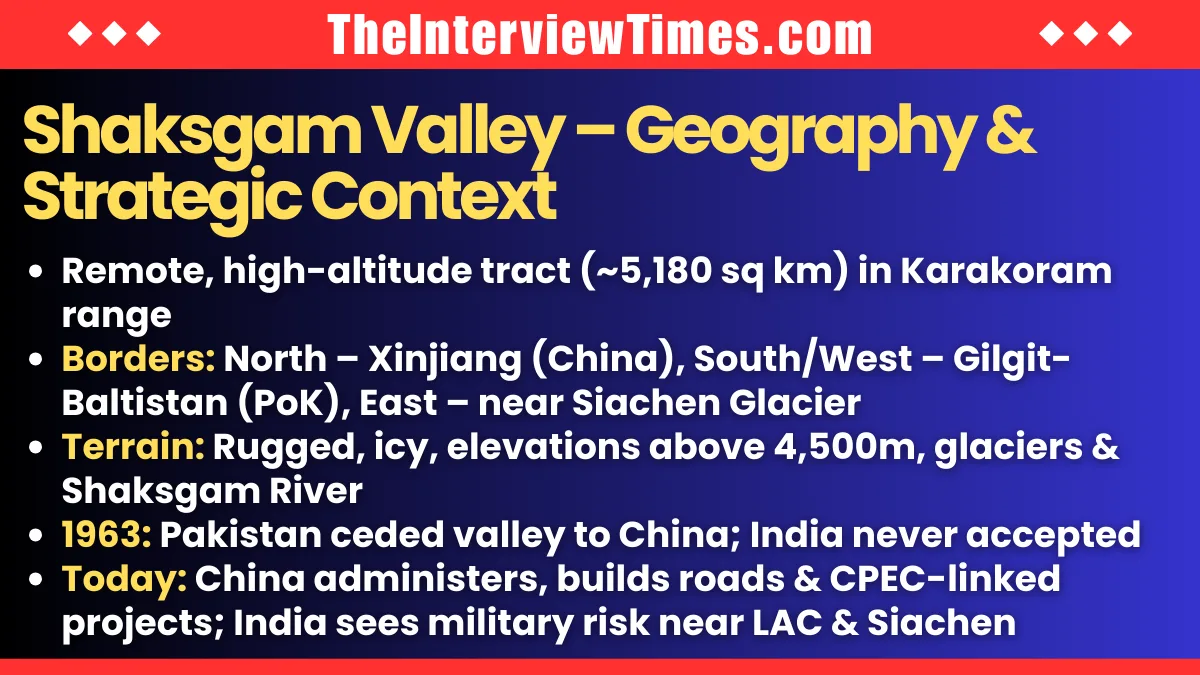
The Shaksgam Valley, also known as the Trans-Karakoram Tract or Shaksgam Tract is a remote, high-altitude mountainous area spanning roughly 5,180 square kilometers in the Karakoram range.
- Terrain: Rugged, cold, and largely uninhabited, with elevations exceeding 4,500 meters, harsh weather conditions, glaciers, and rivers such as the Shaksgam River.
- Location:
- North: Borders China’s Xinjiang Province
- South & West: Adjacent to Pakistan-administered Gilgit-Baltistan (Pakistan-occupied Kashmir)
- East: Close to the Siachen Glacier, a long-standing military flashpoint between India and Pakistan
Historical Context
- Pre-1947: The valley was part of the princely state of Jammu and Kashmir.
- Post-Partition: Following the 1947–48 war, Pakistan occupied parts of Kashmir, including areas leading to Shaksgam.
- 1963 Agreement: Pakistan ceded control of the valley to China under a boundary agreement aimed at settling their mutual border claims. India rejected the deal, arguing that Pakistan had no authority to cede territory that legally belonged to India. Notably, the agreement included a clause allowing for renegotiation if the Kashmir dispute were resolved.
Present-Day Dynamics
China currently administers the valley and has accelerated infrastructure development, often linked to the China-Pakistan Economic Corridor (CPEC)—a flagship project connecting Xinjiang to Pakistan’s Gwadar port. India views these activities as attempts to consolidate Chinese control and alter facts on the ground in disputed territory.
Strategically, the valley’s proximity to the Siachen Glacier and the Line of Actual Control (LAC) heightens India’s concerns about potential military implications.
Must Read: Trump Slaps 25% Tariff on Nations Trading with Iran Amid Deadly Protests
Broader Implications
This latest flare-up reflects the deeper tensions within the India-China-Pakistan triangle. While the current dispute remains confined to diplomatic statements, the Shaksgam Valley continues to symbolize the complex and unresolved Himalayan border puzzle—where sovereignty claims, infrastructure ambitions, and strategic interests collide.
