
New Delhi, January 17, 2026, 01:08 a.m. (IST)
Trump threatens steep tariffs on NATO allies over Greenland as U.S. lawmakers rush to Denmark to calm tensions and prevent a wider trade and security crisis.
A bipartisan United States congressional delegation arrived in Copenhagen on January 17, 2026, in a high-stakes diplomatic effort to defuse rising tensions triggered by President Donald Trump’s renewed push for control over Greenland. The visit comes amid European troop deployments to the Arctic island and growing public protests across Denmark and Greenland.
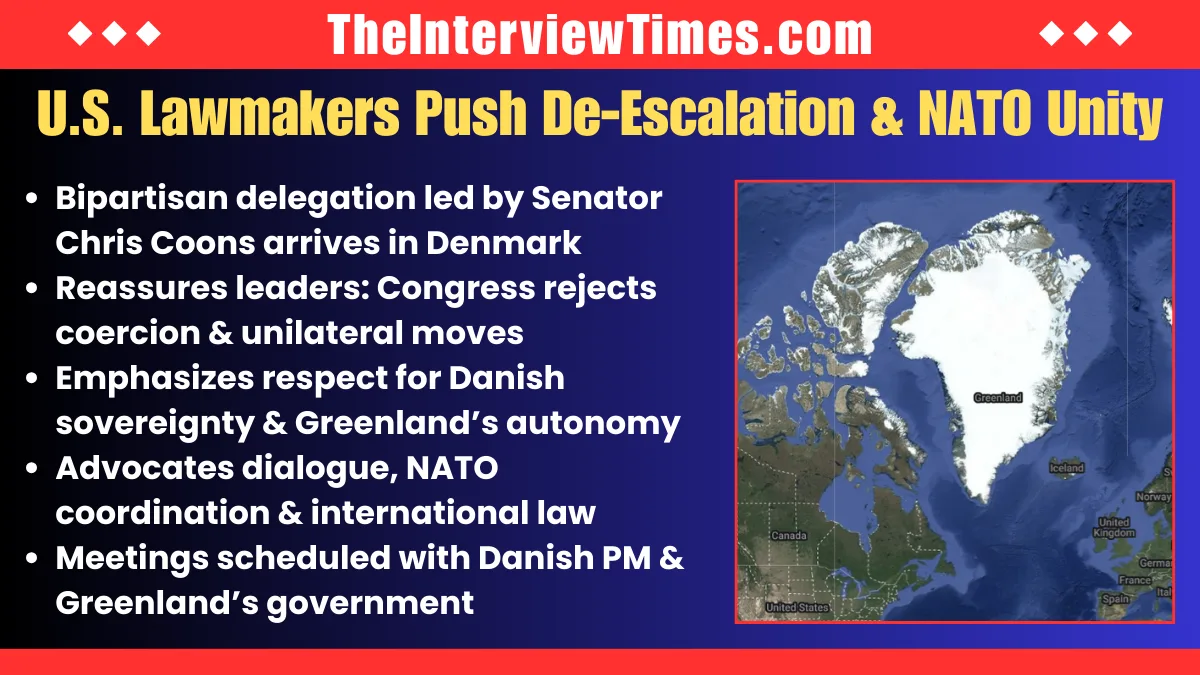
The delegation, led by Senator Chris Coons (D-Delaware), aims to reassure Danish leaders that Congress and much of the American public do not support coercive or unilateral moves regarding Greenland. Lawmakers stressed that the White House’s rhetoric does not represent the broader U.S. political consensus or America’s long-standing NATO commitments.
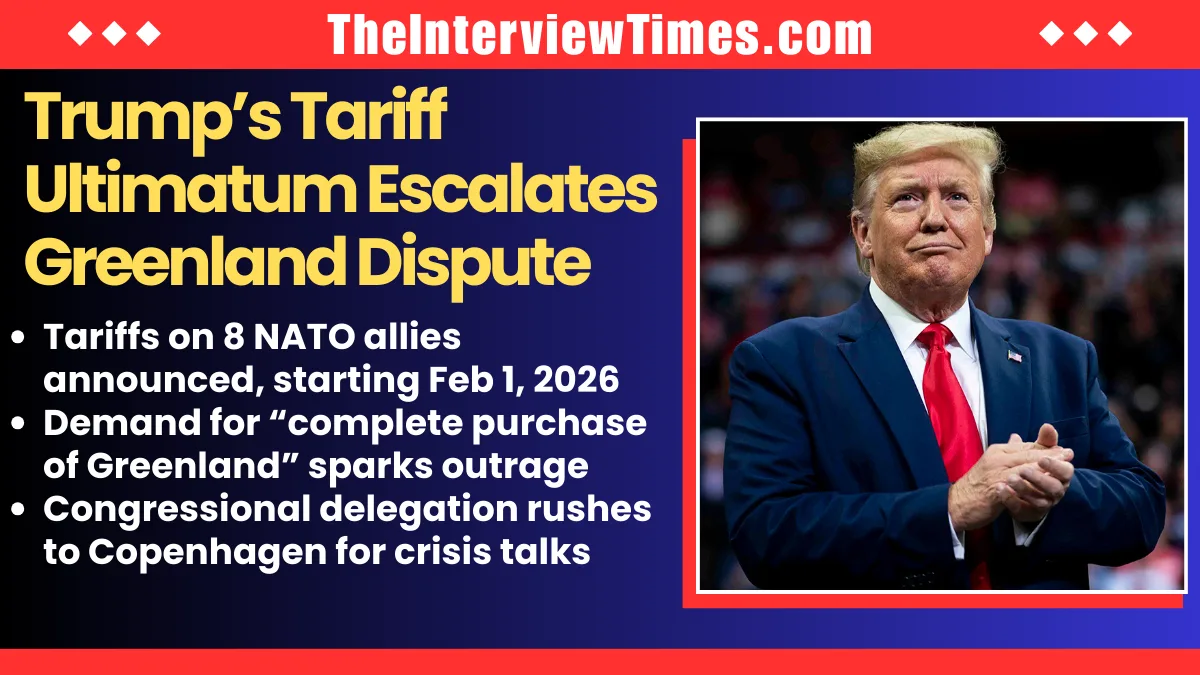
President Trump posted a message declaring that Denmark should “give back” Greenland, framing it as a matter of world peace. He claimed that China and Russia want Greenland, and that Denmark is powerless to stop them.
“Now, after Centuries, it is time for Denmark to give back — World Peace is at stake! China & Russia want Greenland, & there is not a thing that Denmark can do about it… The United States of America is immediately open to negotiation with Denmark and/or any of these… pic.twitter.com/y6iZGQJxdP
— The White House (@WhiteHouse) January 17, 2026
U.S. Lawmakers Push De-Escalation and NATO Unity
Speaking to reporters outside a Copenhagen hotel, Senator Coons acknowledged the anxiety created by recent U.S. statements. He emphasized respect for Danish sovereignty and Greenland’s self-governance.
“The current rhetoric around Greenland is causing concern across the Danish kingdom,” Coons said. “I hope the people of the Kingdom of Denmark do not abandon their faith in the American people.”
Coons underlined that Congress opposes any use of military pressure or economic coercion against allies. He rejected claims of an immediate security crisis in Greenland, saying Arctic stability should be managed through dialogue, NATO coordination, and international law.
The delegation is scheduled to meet Danish Prime Minister Mette Frederiksen, Foreign Minister Lars Lokke Rasmussen, and representatives from Greenland’s autonomous government. Republican members of Congress have also voiced support for a cooperative Arctic security framework rather than a confrontational approach.
Trump’s Tariff Threats Deepen Transatlantic Rift
Just hours before the delegation landed, President Trump announced new tariffs on imports from eight NATO allies, escalating tensions further. The proposed tariffs would begin at 10% on February 1 and rise to 25% by June 1, 2026, unless a “complete and total purchase of Greenland” is negotiated.
Countries targeted include Denmark, France, Germany, the United Kingdom, the Netherlands, Norway, Sweden, and Finland, all of which have recently sent small military contingents to Greenland.
In a post on Truth Social, Trump framed Greenland’s mineral resources and strategic Arctic location as essential to U.S. and NATO security, arguing American control would strengthen the alliance.
Danish officials dismissed the tariff threats as counterproductive. Defense Minister Troels Lund Poulsen described any U.S. attack on Greenland as “completely hypothetical,” warning that trade pressure between allies only weakens NATO during a sensitive geopolitical moment marked by Russia’s ongoing war in Ukraine.
Must Read: PM Modi Launches New Amrit Bharat Express Trains, Boosting Affordable Rail Connectivity Across India
European Troops Arrive in Nuuk as Symbolic Support
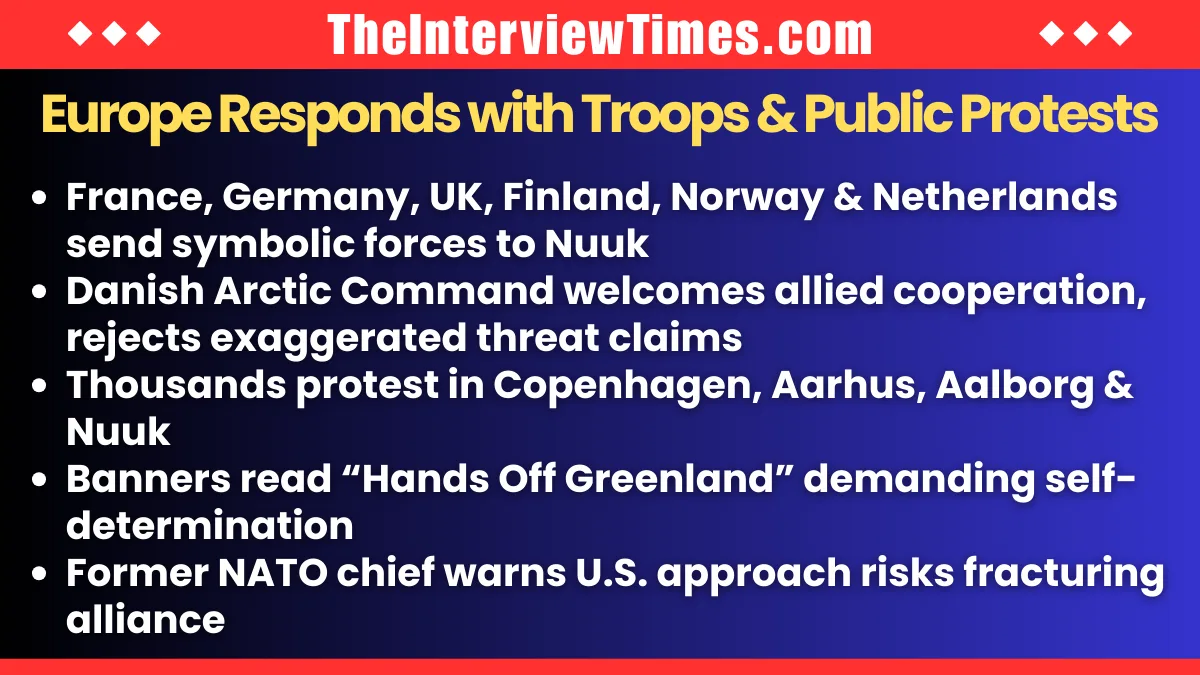
Several European nations have deployed limited military personnel to Nuuk, Greenland’s capital, stressing that the moves are symbolic and defensive.
- France sent 15 soldiers from its 27th Mountain Infantry Brigade, with President Emmanuel Macron pledging additional air and naval support if required.
- Germany deployed 13 personnel via an A400M transport aircraft for a short reconnaissance mission.
- Smaller teams arrived from the UK, Finland, Norway, and the Netherlands, all citing NATO solidarity.
Danish Major General Soren Andersen, head of the Joint Arctic Command, welcomed allied cooperation and invited the U.S. to participate in joint exercises. However, he rejected claims of imminent Chinese or Russian threats near Greenland, calling such narratives exaggerated.
Mass Protests Sweep Denmark and Greenland
Public anger over U.S. rhetoric spilled into the streets on January 17. Thousands of protesters gathered in Copenhagen’s City Hall Square, waving Greenlandic flags and holding banners reading “Hands Off Greenland.”
Demonstrations also took place in Aarhus, Aalborg, and Nuuk, demanding respect for Greenland’s right to self-determination. Protesters criticized what they described as “colonial-era thinking” driven by Greenland’s mineral wealth and Arctic location.
Former NATO Secretary General Anders Fogh Rasmussen strongly condemned the U.S. approach, warning it risks fracturing the alliance. He compared the strategy to tactics used by Moscow, cautioning that internal NATO conflict only benefits rival powers.
Top News: Explained: Why the United States Wants Greenland
NATO Faces a Critical Unity Test
The Greenland dispute has become a major test for NATO cohesion two years into President Trump’s second term. European allies are attempting to balance deterrence against Russia with the need to prevent internal alliance divisions.
Denmark continues to coordinate closely with Greenland’s leadership on defensive planning, firmly rejecting any discussion of territorial acquisition. Analysts note that while Trump’s strategy relies heavily on economic pressure, Congressional resistance and allied diplomacy provide a counterweight.
With tariffs looming and retaliatory measures under consideration in Europe, the congressional delegation’s visit offers a narrow diplomatic window to restore trust and stabilize Arctic cooperation.
Top News: Chabahar Port Project Explained: Why India Is Determined to Stay Despite US Sanctions Pressure
