
TheInterviewTimes.com | February 20, 2026 | 09:37 PM IST | New Delhi
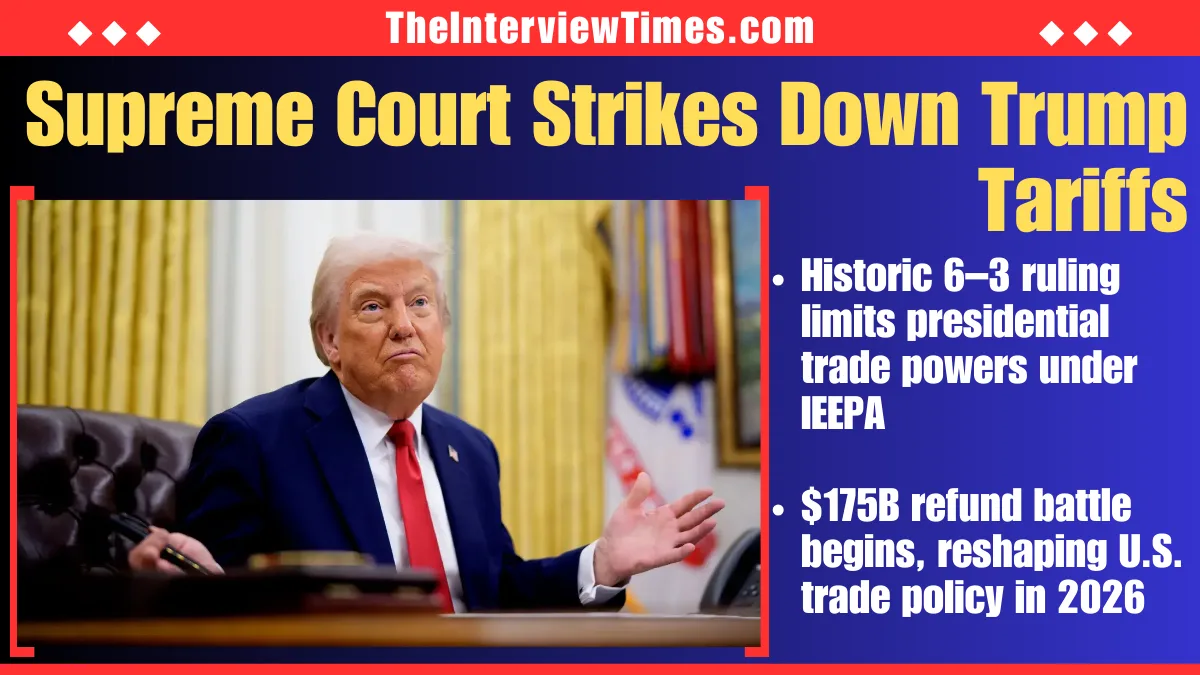
Trump Tariffs dealt major blow as U.S. Supreme Court rules President Donald Trump exceeded IEEPA powers in 6-3 decision, triggering $175B refund battle and reshaping U.S. trade policy in 2026.
Supreme Court Delivers Major Blow to Trump Trade Agenda
In a landmark 6-3 ruling on February 20, 2026, the Supreme Court of the United States held that President Donald Trump exceeded his authority by imposing sweeping tariffs under the International Emergency Economic Powers Act of 1977.
Chief Justice John Roberts, writing for the majority, said the emergency law was designed for genuine national crises and does not authorize the executive branch to impose broad import duties that function as taxes. The Constitution gives Congress the power to levy taxes and regulate commerce.
The ruling invalidates Trump’s country-specific “reciprocal” tariffs and the 25 percent duties imposed on goods from Canada, China, and Mexico linked to fentanyl enforcement concerns. However, tariffs imposed under separate statutes, including Section 232 national security measures covering steel, aluminium, and certain automobiles, remain intact.
The case marks the most significant judicial setback to Trump’s second-term economic and trade agenda.
Timeline of the Legal Battle
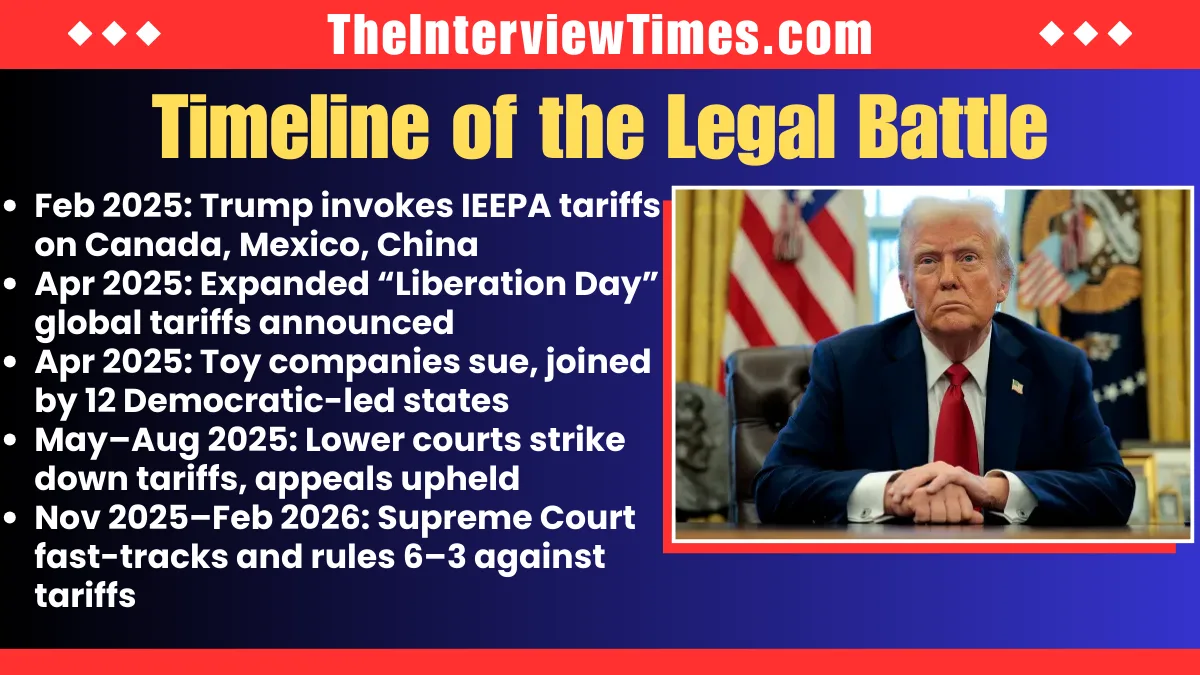
- The dispute began in February 2025, when Trump invoked IEEPA to announce tariffs on Canada, Mexico, and China. In April 2025, he expanded the move with so-called “Liberation Day” global tariffs targeting a broad range of imports.
- On April 22, 2025, family-owned educational toy companies Learning Resources and hand2mind filed suit in federal court in Washington, arguing that tariffs on Chinese imports had increased their costs by as much as 44 times. Twelve Democratic-led states later joined the legal challenge.
- In May 2025, the United States Court of International Trade invalidated the tariffs, ruling that the administration had exceeded its authority. The judgment was upheld in August 2025 by the United States Court of Appeals for the Federal Circuit in a 7-4 decision.
- The Supreme Court fast-tracked the case and heard oral arguments on November 5, 2025. Several justices, including Roberts and others across the ideological spectrum, questioned whether IEEPA could justify such sweeping trade measures and raised concerns about the administrative complexity of refunding billions of dollars.
- On February 20, 2026, the Court issued its final ruling, formally invalidating most of the IEEPA-based tariffs.
$175 Billion Refund Process Creates Logistical Challenge
According to estimates from the Penn Wharton Budget Model, more than $175 billion in tariff revenue collected under the invalidated measures could now be subject to refund claims.
The duties were applied across roughly 34 million import entries involving more than 300,000 importers. The scale of the potential refund operation is unprecedented in modern U.S. trade history.
The U.S. Customs and Border Protection agency has prepared an electronic refund process using Automated Clearing House transfers. Importers must file claims referencing product classification codes, country of origin, and proof of paid duties.
The Court of International Trade will oversee the claims under a two-year statute of limitations. Legal experts predict that processing could take years due to the sheer volume of filings.
During oral arguments, several justices acknowledged that unwinding the tariffs could create administrative strain, but the majority opinion emphasized that logistical complexity cannot justify unconstitutional executive action.
Trump Signals Tariff Comeback Through Alternative Laws
President Trump responded defiantly to the ruling during remarks at a Georgia steel facility one day before the decision was released. He insisted his administration would continue pursuing aggressive trade enforcement.
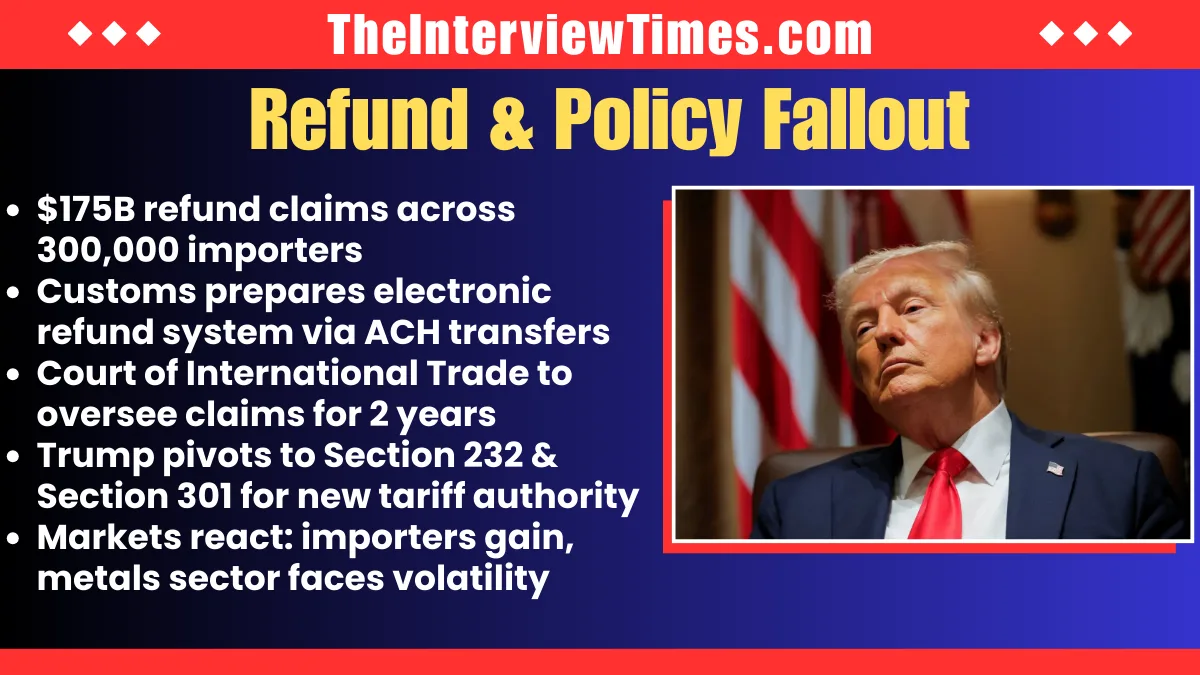
Following the decision, the White House signalled that it may pivot to alternative statutory tools, including:
- Section 232 of the Trade Expansion Act, which allows tariffs for national security reasons following a Commerce Department investigation.
- Section 301 of the Trade Act of 1974, which authorises tariffs in response to unfair trade practices after a U.S. Trade Representative probe.
Unlike IEEPA, these mechanisms require formal investigations, public comment periods, and agency findings. Legal analysts say any reimposition of comparable tariffs would likely take months rather than weeks.
Markets React as Global Trade Uncertainty Grows
U.S. financial markets reacted positively in early trading following the ruling. Shares of major importers rose on expectations of refunds, while sectors reliant on protective tariffs, including domestic metals producers, saw volatility.
International trading partners such as India and Brazil, which were affected by later rounds of tariffs, are seeking clarification on whether duties paid by their exporters will be refunded.
The ruling could reshape executive trade authority for years. It reinforces congressional primacy over taxation and limits the use of emergency powers for broad economic measures.
With the 2026 midterm elections approaching, the decision adds political pressure on Congress to clarify or potentially expand presidential trade powers. At the same time, small businesses and state governments that challenged the tariffs hailed the ruling as a defence of constitutional separation of powers.
The refund process, however, now becomes the next major battlefield in a trade dispute that is far from over.
Top News: Prince Andrew Arrested Over Jeffrey Epstein Ties, Released Under Investigation
